
Zbąszynek
Accommodation in Zbąszynek
Zbąszynek is best understood through two themes: its railway history and the buildings constructed in the town’s early years. Here you’ll find historical reference points to help you choose a destination that suits your interests.
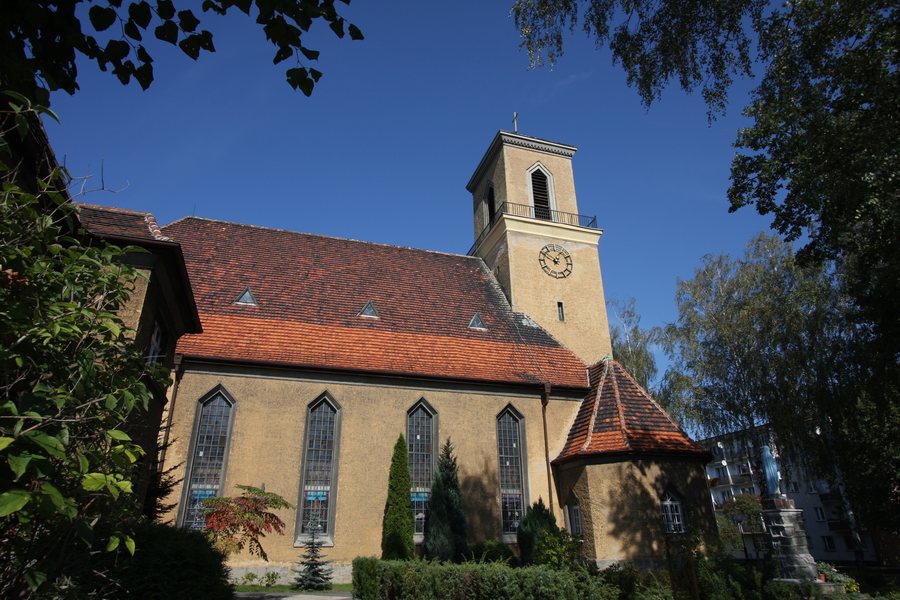 File:20282 Zbaszynek kosciol parafialny pw mnmp 2.JPG
Photo: Silu via Wikimedia Commons, CC BY-SA 3.0 pl
File:20282 Zbaszynek kosciol parafialny pw mnmp 2.JPG
Photo: Silu via Wikimedia Commons, CC BY-SA 3.0 pl
Zbąszynek at a glance
The Warsaw–Berlin and Gorzów Wielkopolski–Sulechów railway lines intersect at a railway junction in Zbąszynek. Early buildings included an engine shed and a 33-metre-high Expressionist water tower, built in 1923–1924 to a design by Bruno Möhring. From 1928 to 1930, the East German Railway Directorate had two churches built. A locomotive next to a newly built fountain in the town centre commemorates the town’s railway heritage.
What has shaped the town’s history?
The railway is more than just one theme in the town’s history. Zbąszynek is described as an urban layout of a town-like workers’ settlement functionally connected to a major railway junction. This connection provides a clear context for the town’s history: its development and its role in rail traffic belong together.
The early buildings also reflect different aspects of this history. The engine shed is among the first buildings in Zbąszynek. The water tower followed in 1923–1924: the 33-metre-high structure was built in the Expressionist style to a design by the German architect, urban planner and engineer Bruno Möhring. For visitors interested in architecture, it provides a tangible historical reference point without requiring a visit inside.
What story does the churches’ construction tell?
The two churches commissioned by the East German Railway Directorate between 1928 and 1930 were intended for different groups: one for the Lutheran population and a smaller Catholic church. The Catholic church was dedicated to the Apostles Peter and Paul. This building history adds to the picture of a town whose early development was not limited to the railway.
A former Protestant church in Zbąszynek was dedicated to the Maternity of the Blessed Virgin Mary on 21 October 1945. In the Church of the Maternity of the Blessed Virgin Mary (Macierzyństwa Najświętszej Maryi Panny), the figure on the main altar represents this maternity. Together, the details about the dedication and the altar figure offer insight into the town’s religious history. They are distinct from the construction dates of the two churches: this refers to a dedication in 1945, while the other refers to buildings erected between 1928 and 1930.
What does the railway junction mean for planning your trip?
The Warsaw–Berlin and Gorzów Wielkopolski–Sulechów lines intersect in Zbąszynek, making the town’s connection to the railway tangible. If you’re planning to arrive by train, check connections and journey times for your travel dates. The locomotive in the town centre, next to a newly built fountain, is another visible reminder of the town’s railway heritage. You can choose a hotel in Zbąszynek based on whether you’d like to combine your stay with this historical and architectural interest; compare specific accommodation features against each listing.
Discover more destinations: Łagów, Mostki, Rokitnica, Niedźwiedź, Lubrza, Szczaniec, Świebodzin, Zawisze.
FAQ
Which railway lines intersect in Zbąszynek?
The Warsaw–Berlin and Gorzów Wielkopolski–Sulechów lines intersect here. For a specific train journey, check connections for your travel dates.
When was the water tower built?
The 33-metre-high Expressionist water tower was built in 1923–1924 to a design by Bruno Möhring.
When was the former Protestant church dedicated?
It was dedicated to the Maternity of the Blessed Virgin Mary on 21 October 1945.
Go to the regional travel overview: Świebodziński.

