
Siemuszowa
Accommodation in Siemuszowa
Siemuszowa brings together two different travel interests: a blue hiking trail that passes through the village, and a cultural and historical landscape featuring a former wooden church and preserved works of art. When planning your visit, it is therefore worth looking at both the trails and the church’s distinctive features.
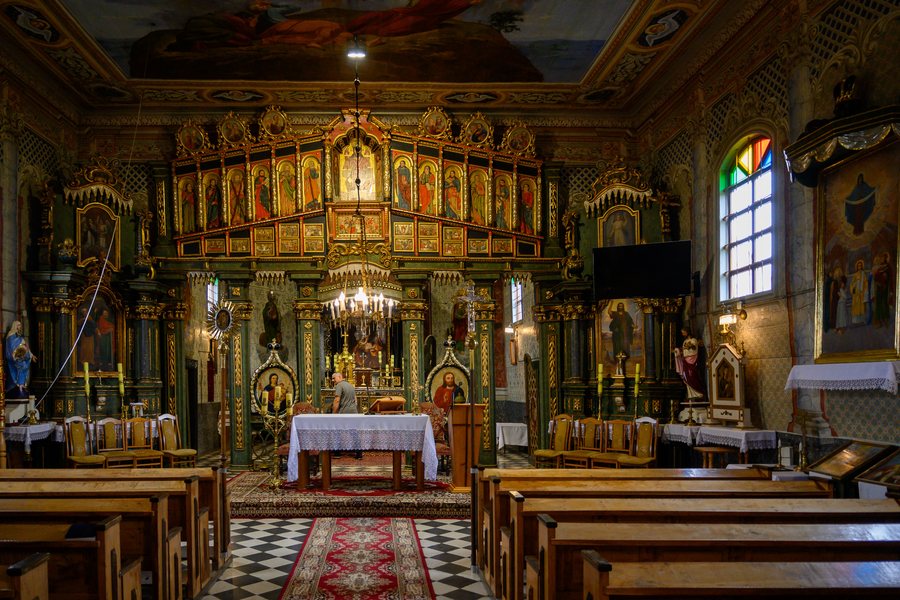 File:Siemuszowa, Cerkiew Przemienienia Pańskiego w Siemuszowej 010723.jpg
Photo: Daniel.zolopa via Wikimedia Commons, CC BY 4.0
File:Siemuszowa, Cerkiew Przemienienia Pańskiego w Siemuszowej 010723.jpg
Photo: Daniel.zolopa via Wikimedia Commons, CC BY 4.0
Key facts about Siemuszowa
The blue hiking trail follows the Kreców–Siemuszowa–Hołuczków route. The approximately 70-kilometer Szlak Ikon, or Icon Trail, also passes through Siemuszowa. It runs through the San Valley and the Gór Słonnych Landscape Park and includes 14 churches within a 25-kilometer radius of Sanok. One of the village’s historical landmarks is a former wooden Greek Catholic filial church, built in 1841.
Which trails are right for your trip?
If you would like to combine a hike with a visit to Siemuszowa, the blue hiking trail is a specific option: the stated route runs via Kreców, Siemuszowa, and Hołuczków. This lets you consider the village as part of a named hiking route without conflating it with the longer Icon Trail, which has a different focus.
The Szlak Ikon (Icon Trail) is approximately 70 kilometers long and passes through Siemuszowa, the San Valley, and the Gór Słonnych Landscape Park. Its distinctive focus is on churches: the route includes a total of 14 churches within a 25-kilometer radius of Sanok. This number refers to the stated radius; it does not describe the distance from Siemuszowa to any single church. Your trip planning can therefore take into account two distinct points of reference: the blue hiking trail on the Kreców–Siemuszowa–Hołuczków route, and the longer Icon Trail, which focuses on churches.
What makes the former wooden church distinctive?
The former wooden Greek Catholic filial church in Siemuszowa was built in 1841. The church has a preserved three-tier iconostasis from the 19th century. The icons mentioned in it include Saint Nicholas, the Mother of God with the infant Jesus in the Hodegetria type, Christ the Teacher, and the Archangel Michael. The subjects therefore range from depictions of saints and Christ to the Mother of God with the infant Jesus. The Hodegetria type is explicitly part of the description of this icon.
The wall decoration is also a distinctive feature of the church interior: the walls are adorned with figural and ornamental polychromes whose motifs include architectural and botanical elements. The iconostasis and wall paintings offer different points of interest for culturally minded travelers. The former is characterized by the icons mentioned above and its three-tier structure; the latter by figural and ornamental painting featuring architectural and botanical motifs. Together, these details form a distinct cultural and historical subject alongside the hiking routes.
If you would like to compare other village pages from this selection, you can find Mrzygłód, Tyrawa Solna, Wola Michowa, Łukowe, Kalnica, Komańcza, Tarnawa Dolna, and Dębna here.
FAQ
Which hiking trail passes through Siemuszowa?
The blue hiking trail follows the Kreców–Siemuszowa–Hołuczków route.
How long is the Szlak Ikon?
The Icon Trail is approximately 70 kilometers long. It passes through Siemuszowa, the San Valley, and the Gór Słonnych Landscape Park and includes 14 churches within a 25-kilometer radius of Sanok.
When was the former wooden church built?
The former wooden Greek Catholic filial church was built in 1841.
What artistic features are described in the church?
The church has a preserved three-tier iconostasis from the 19th century featuring the icons mentioned above, as well as figural and ornamental polychromes on the walls with architectural and botanical motifs.
For the broader travel overview: Sanok.

