
Discover Zahutyń’s History and Nature
Accommodation in Zahutyń
Zahutyń can be understood through a range of very different subjects: medieval royal ownership, a historical clash, a wooden church, and named ecological reserves.
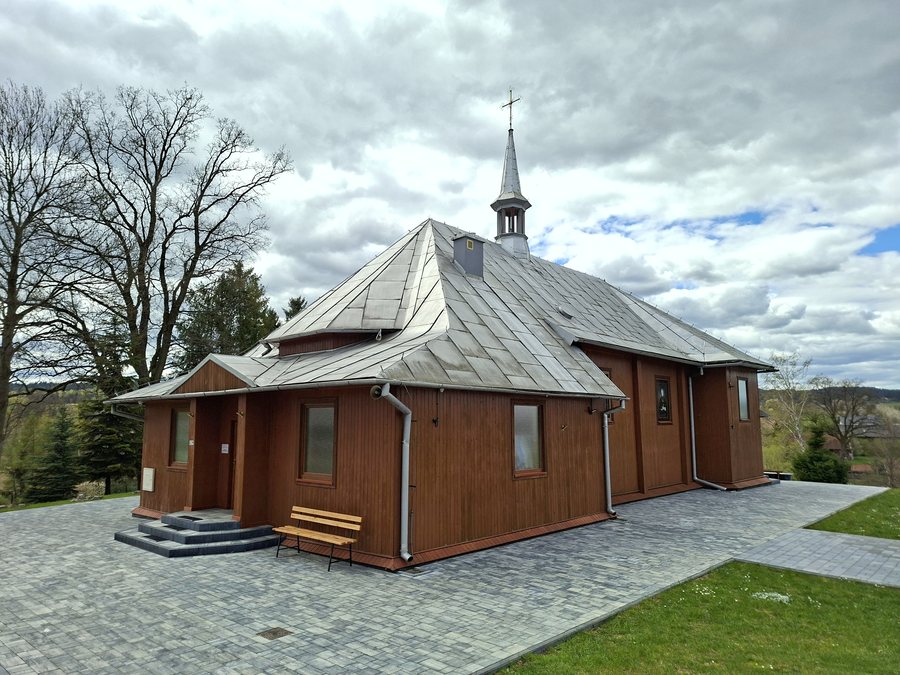 Virgin Mary Queen of Poland church in Zahutyń (2026)a
Photo: Lowdown via Wikimedia Commons, CC BY-SA 4.0
Virgin Mary Queen of Poland church in Zahutyń (2026)a
Photo: Lowdown via Wikimedia Commons, CC BY-SA 4.0
Zahutyń at a glance
In the 14th century, Zahutyń was the only village in the Zagórz municipality owned by the king; Marcin and Pełka of Zahutyń were tenants of this estate at the time. A clash between an insurgent detachment and local peasants is recorded for the 19th century. The wooden Church of Najświętszej Marii Panny Królowej Polski is also part of the village’s history. Two ecological reserves in Zahutyń refer to named plant sites in the Huteński and Zahutyński forests.
Which historical themes shape the village?
The history of the 14th century brings Zahutyń into focus through its form of ownership at the time: the village was owned by the king and was the only place in the Zagórz municipality to hold this status. Marcin and Pełka, both from Zahutyń, were tenants of the royal estate. Two specific aspects therefore sit side by side—the village’s status and the people who rented the estate.
Another historical episode takes us to the 19th century. During the Kraków Uprising and the Galician Peasant Revolt, a clash took place in Zahutyń between an insurgent detachment and local peasants. The detachment intended to attack Sanok. The incident links the local clash with the planned attack on Sanok.
What is known about the wooden church?
The Church of Najświętszej Marii Panny Królowej Polski was built on the site of a former Orthodox church. This connection alone brings together two religious building histories in the same place: the former church site and today’s wooden place of worship. The present wooden church therefore stands on the site of a former Orthodox church.
Its furnishings include a 17th-century image of Our Lady of Mount Carmel painted on wood, with wooden cladding. At the end of May 1956, it was brought to Zahutyń from the Franciscan monastery in Sanok. The new church has no historic furnishings; the image is its only valuable furnishing. The artwork’s material, date, and history give it a story of its own within the village’s history.
Which nature-related features are identified?
In the Huteński Forest, ecological reserve “Stanowisko języcznika zwyczajnego w lesie Huteńskim” is located on part of plot No. 750. Its name refers to the common hart’s-tongue fern. Another ecological reserve lies on part of plot No. 735 in the Zahutyński Forest: “Stanowisko języcznika zwyczajnego i tojadu wiechowatego w lesie Zahutyńskim.” Its name refers to the common hart’s-tongue fern and monkshood.
The two names highlight different botanical features: the first concerns a site of the common hart’s-tongue fern, while the second concerns sites of the common hart’s-tongue fern and monkshood. Their botanical references can therefore be distinguished by their forest names: Huteński and Zahutyński.
Which themes fit your travel plans?
To start planning, you can decide whether you are more interested in local and church history or in the named plant sites. The historical information spans the 14th to the 19th century; the church’s art history adds a work from the 17th century and its transfer in 1956 to this perspective. The reserves, by contrast, have a clear botanical focus.
Discover more destinations: Tyrawa Solna, Mrzygłód, Dębna, Siemuszowa, Wysoczany, Zagórz, Sanok, Czystogarb.
FAQ
What status did Zahutyń have in the 14th century?
At the time, Zahutyń was the only place in the Zagórz municipality owned by the king. Marcin and Pełka of Zahutyń were tenants of this estate.
When did the image of Our Lady of Mount Carmel arrive in Zahutyń?
The 17th-century image was brought to Zahutyń from the Franciscan monastery in Sanok at the end of May 1956.
Which plants are named in the ecological reserves?
The names refer to the common hart’s-tongue fern and, in the reserve in the Zahutyński Forest, also to monkshood.
For the broader travel overview: Sanok.

a.jpg)