
Bata: Churches, Village Museum and Archaeology
Accommodation in Bata
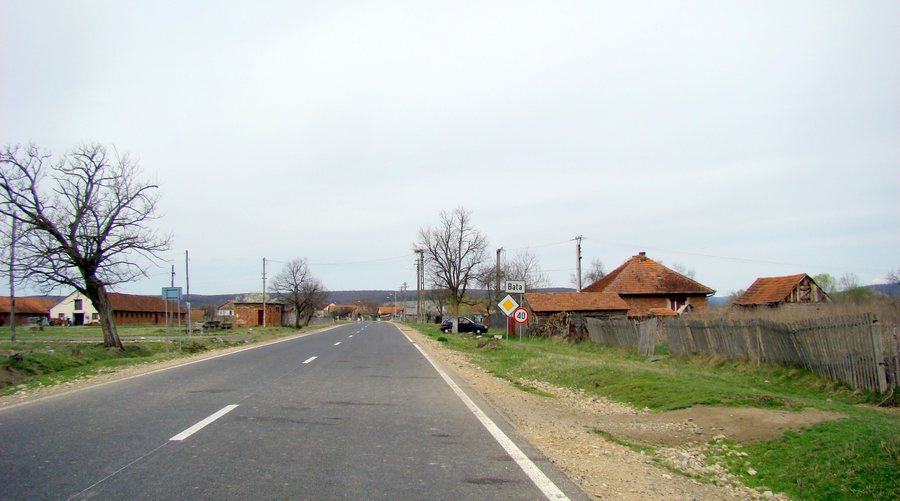
Bata has been documented since 1367; at the same time, it may have been founded as early as the 13th century. The municipality of Bata lies in the contact zone between the Lipova Plateau and the Mureș floodplain, in the Brănișca–Păuliș corridor. The very high foundations of old houses are associated with the village’s location in the regularly flooded Mureș floodplain.
History
The parish church of Bata, “Sfinții Apostoli Petru și Pavel,” was built in 1942 and is dedicated to the Holy Apostles Peter and Paul.
Culture
Traditional women’s dress in Bata includes a coin necklace worn on the head and a Spăcel blouse with large floral motifs known as “pui tablă.” A red sheepskin coat is characteristic of traditional men’s dress in Bata. Bata’s earlier Christmas tradition included 365 carols, with a separate carol dedicated to each day.
The Ruga de la Bata is a religious festival dedicated to the Holy Apostles Peter and Paul, traditionally held on the first Sunday after the end of Lent. At the same time, it is a community gathering at which families, relatives, friends and guests are welcomed. In the 18th and 19th centuries, making plum brandy was one of the most important activities of the villagers of Bata.
Museum and Traditional Architecture
The Casa de la Bata in the Banat Village Museum dates from the second half of the 18th century. It is a two-room wooden building with a stone foundation, a continuous veranda and a thatched roof; in 1970, when the Banat Village Museum was founded, it was moved there. The Casa din Bata from Arad County is a cultural and historical visitor attraction in the Banat Village Museum.
In Bata, at house no. 274, there is a wooden house made entirely with an axe. It has a thatched roof.
Archaeology and Events
The archaeological monuments of Bulci in the municipality of Bata include the ruins of a Benedictine abbey dating from the 13th to the 16th century. The archaeological complex of Bulci in the municipality of Bata comprises an early medieval fortress called “Cetate” and a Roman fort called “Castru,” dated to the 2nd to 4th centuries.
The historic Mocsonyi complex in Bulci, in the municipality of Bata south of the Mureș River, comprised the manor house, a greenhouse, the former employees’ building and additional outbuildings. This Mocsonyi complex includes an extensive dendrological park with significant tree species.
Every year, Bulci hosts a two-day folk-rock program on a stage near Castelul Mocioni, evoking the flower-power atmosphere of the 1960s and 1970s.
When planning your own trip, you can choose between sacred history, traditional clothing and customs, traditional architecture, archaeology and music. The different topics can be considered as separate focal points when comparing several facets of Bata and Bulci.
More local pages: Lipova, Moneasa, Ghioroc, Alt-Petschka, Vinga, Şilindia, Căprioara, Buteni.
Getting There
Batuta railway station is 6 km from Bata. The local Arad–Bata road connects the municipality of Bata with Arad, the county seat.
To the main travel overview: Arad.

