
Dragoslavele in the Leaota Mountains: Landscape and Culture
Accommodation in Dragoslavele
Dragoslavele lies at the western foot of the Leaota Mountains, in the Dragoslavele Depression and along the upper course of the Dâmbovița River. For trip planning, it is helpful to distinguish between the landscape, local history and regional connections.
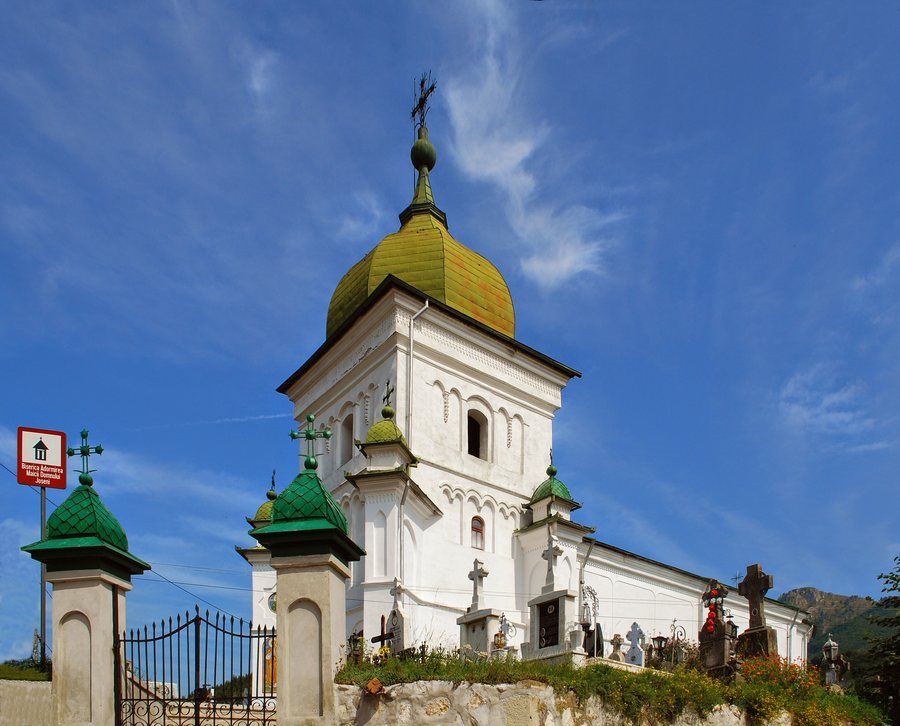 File:RO AG Dragoslavele Joseni church.jpg
Photo: Andrei Stroe via Wikimedia Commons, CC BY-SA 3.0 ro
File:RO AG Dragoslavele Joseni church.jpg
Photo: Andrei Stroe via Wikimedia Commons, CC BY-SA 3.0 ro
For a hotel in Dragoslavele, you can compare travel dates, room categories and cancellation policies on the respective offer pages. These three details make differences between the options visible and provide a clear, comprehensible framework for your own calculations when planning your trip.
Nature and Landscape
The commune's territory includes the Leaota Massif, the Iezer-Păpușa Massif and the Dâmbovicioara Corridor. The eastern part of the commune consists predominantly of forests and mountains; alpine and subalpine meadows also account for a significant share.
The Dâmbovița River flows through the western part of the commune of Dragoslavele. In addition, the commune has a dense network of streams and springs that carry water throughout the year.
Suharatu, Plăișoru, Piatra Dragoslavelor and Fundul Neagului are peaks in the vicinity of Dragoslavele. For different day plans, the commune's territory, the immediate surroundings and the wider regional area can be considered separately, as they do not describe the same geographical scope.
Culture and History
The Dragoslavele Skete was built in 1929 as a patriarchal retreat residence for the clergy of Muscel. The church of the Dragoslavele Skete, dedicated to Saint George, was built at the end of the 17th century by believers from Borșa in Maramureș and was later moved to Dragoslavele and rebuilt there.
The church has a shingle roof and a tall, pointed tower in the Maramureș style, which also serves as a bell tower. Crucea lui Lupu Vameșu in Dragoslavele dates from 1692, Crucea lui Roman Pârcălabul in Dragoslavele from 1724, and Crucea lui Matei Basarab in Dragoslavele from 1632 to 1654.
The Biserica cu hramul Înălțarea Domnului de la Dragoslavele–Suseni was founded in 1745 at the initiative of the customs officers Histea and Sterie, with the support of priests and villagers. Anyone wishing to arrange the local history chronologically can consider the years mentioned separately.
In the wider regional area around Dragoslavele are Castelul Bran as a fortress, Peles Castle as a palace and Caraiman Peak Heroes Cross as a monument. For comparison, the fortress, palace and monument can be considered separately as different types of sites.
Transport and Other Local Connections
The commune of Dragoslavele lies at the intersection of important transport routes. These include a European road between Brașov, Pitești and Bucharest, as well as a national road to Târgoviște. In your own planning, you can consider transport connections, natural areas and cultural sites side by side as separate decision-making levels.
Other Places
The same group of localities also includes Oeștii Pământeni, Coteneşti, Godeni, Oarja, Arefu, Curtea De Argeş, Linteşti and Argeșelu.
For the higher-level travel overview: Argeş.

