
Sărata-Monteoru: Mineral Water, Hiking Trails and History
Accommodation in Sarata-Monteoru
Sărata-Monteoru is situated in a quiet hilly landscape surrounded by forests and lush vegetation. The spa resort can be reached via the DN 1B and DJ 203G from Merei; the DN 1B runs between Buzău and Ploiești. There is a tourist information centre in the town. Cultural and sporting events take place every year. “Zilele Stațiunii Sărata Monteoru” is considered the resort’s celebration in July.
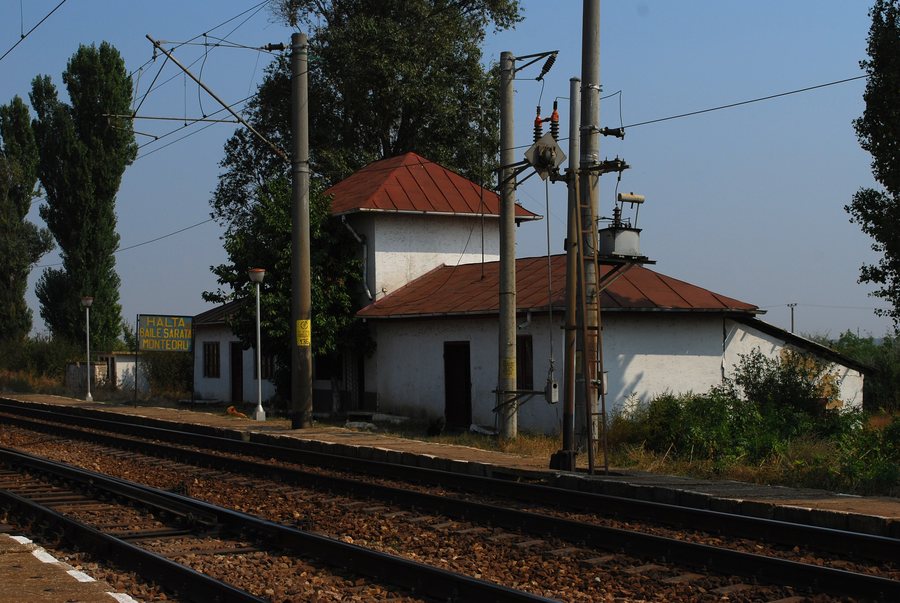 File:RO BZ Baile Sarata Monteoru railway station.jpg
Photo: Andrei Stroe via Wikimedia Commons, CC BY-SA 3.0
File:RO BZ Baile Sarata Monteoru railway station.jpg
Photo: Andrei Stroe via Wikimedia Commons, CC BY-SA 3.0
Hiking trails with clearly defined stages
There are marked hiking trails in Sărata-Monteoru. Trail 1 – Red Triangle leads from the tourist information point via the bed of the Sărata River, Casa de Apă and Stânca lui Monu to Lacul Verde and takes approximately 1 hour and 45 minutes. Trail 2 – Red Dot leads from the tourist information point via the entrance to the forest road and Cazanul Mare to Mina de Petrol and takes approximately 2 hours. Both routes therefore start at the tourist information point, but differ in their named intermediate destinations and endpoints.
Mineral Water and Spa History
Sărata-Monteoru is recognised for its saline, iodine-, bromine-, magnesium-, sulphur- and calcium-containing mineral waters, as well as mineral sediment mud from natural sulphur springs. The mineral waters and mineral sediment mud are recommended for treating musculoskeletal disorders as well as gynaecological, gastrointestinal and hepatobiliary diseases. Ștrandul Paradis is located in the centre of Sărata-Monteoru and is considered the resort’s oldest and largest bathing facility by area; the facility includes therapeutic saltwater pools. Izvorul nr. 6 is also located in the centre and offers mineral water for internal use.
The first saltwater pools of the future spa resort were built between 1888 and 1895. The ruins of the Vechile bazine are located nearby, behind Izvorul nr. 6, and have the status of a historic monument. The Vechile bazine served as an open-air treatment facility.
Archaeology, Monuments and Historic Sites
The Church of “Adormirea Maicii Domnului” in Sărata-Monteoru was built in 1876 by Grigore C. Monteoru, who founded the spa resort. Vila Monteoru was built in 1888 and is situated in an English park now known as the “dendrological park”. The Monteoru culture from the Bronze Age was discovered at the La Cetățuie archaeological site. The site is located on Cetățuia Hill in the eastern part of the town. The Sărata Monteoru – Poiana Scorușului cult complex is dedicated to religious and ritual practices and is being investigated archaeologically.
Mina de Petrol is a historic monument and is considered a rare example of petroleum extraction using mining methods in Europe and worldwide. Public access to the active Mina de Petrol is not permitted for safety reasons. Dealul Istrița has air currents suitable for paragliding. The Sărata-Monteoru adventure park has four courses for adults and two courses for children, with a total of 75 elements. Sărata-Monteoru is also a starting point for cycling tours; one described tour is approximately 30 km long, has around 800 m of positive elevation gain and is of medium difficulty.
More destinations
Other destinations include Nehoiu, Valea Sălciilor, Fântânele, Plaiu Nucului, Chiojdu, Buzău, C. A. Rosetti and Ciuta.
To the higher-level travel overview: Buzau.

