
Calafat on the Danube: Culture and Routes
Accommodation in Calafat
In Calafat, the Monument – 100 Years of Independence stands on the banks of the Danube, at the former positions of the “Stephen the Great” Artillery Battalion in spring 1877.
Culture
Among the religious buildings is the Biserica “Izvorul Tămăduirii”, also known as Biserica “Grecească”, which was built between 1864 and 1874. It has a three-conch layout, walls more than one metre thick and three towers. Its interior is equipped with four genuine Murano crystal chandeliers.
The Marincu Palace houses the Art and Ethnography Museum in Calafat. It was built between 1905 and 1907 by Ștefan Marincu in memory of his daughter Marioara Marincu, according to plans by the architect Paul Gottereau. Reconstructed in 2001–2002, the palace belongs to French Neoclassicism with Baroque and Rococo accents, as well as influences from Romanian architecture of the early 20th century. In 2003, it was included in Romania’s National Heritage and on the list of historic monuments.
Another architectural monument is Biserica “Sfântul Nicolae” in Calafat. It is located in the centre of Calafat, halfway between the town hall and the port entrance. It was built between 1730 and 1740. In 1910, it was completed, consecrated and handed over for use during the tenure of Bishop D. D. Ghenadie.
The cultural sites illustrate different aspects of the townscape: For the two churches, the construction period, architectural features, furnishings and respective location are the focus. The Marincu Palace combines its museum function with a named builder, an architect, several stylistic references and a reconstruction. In this way, religious architecture, museum use and historic building forms remain identifiable as distinct topics.
Nature
The Monument – 100 Years of Independence is 15 metres high overall; its base is made of travertine and has a parallelepiped shape, while its extensive bas-reliefs cover an area of 25 square metres and depict scenes of the Romanian army crossing the Danube in 1877.
Getting around
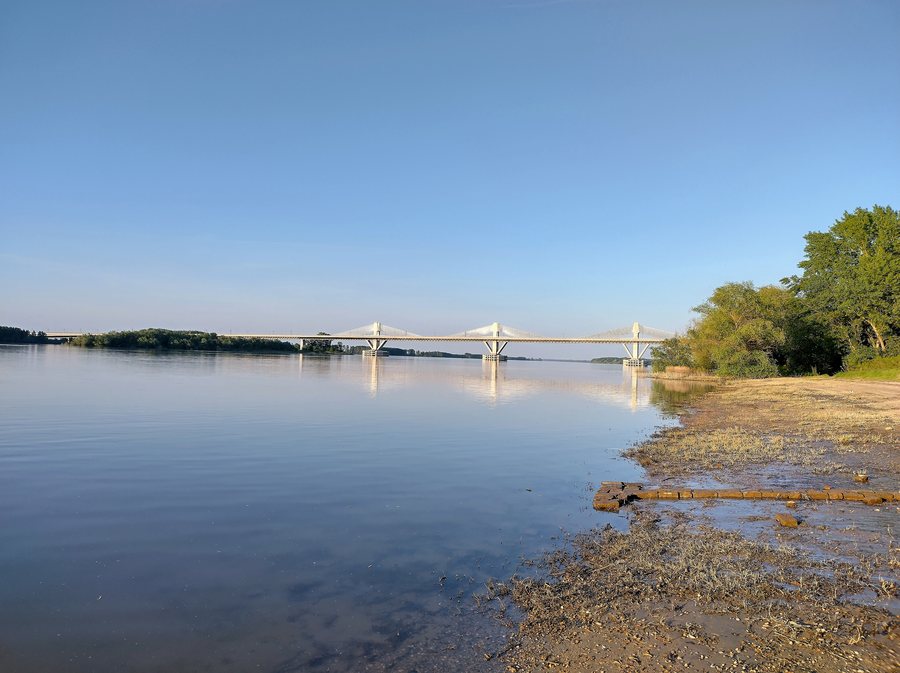
There is a border crossing from Calafat to Vidin in Bulgaria; the Danube is crossed via the road bridge. The EuroVelo 6 route leads to Calafat; the connection from Drobeta Turnu Severin to Calafat runs along national road DN 56A.
For route planning, the information differs according to direction and mode of transport: The bridge leads from Calafat to Vidin, while the connection from the direction of Drobeta Turnu Severin to Calafat runs via DN 56A.
When planning an overnight stay in Calafat, travel dates, room category and cancellation conditions can be considered separately when choosing a hotel. These three details concern different aspects of your own planning: the period, the desired room category and how changes are handled. They therefore stand alongside the cultural sites, the Danube riverbank and the transport routes.

