
Borsec amid Mineral Springs, Karst and Spa Architecture
Accommodation in Borsec
Borsec’s most important mineral springs include Izvorul nr. 3 Boldizsár, Izvorul nr. 5 László, Izvorul nr. 6 Lázár, Izvorul nr. 10 Kossuth, Izvorul nr. 11 Petőfi and Izvorul Pierre Curie.
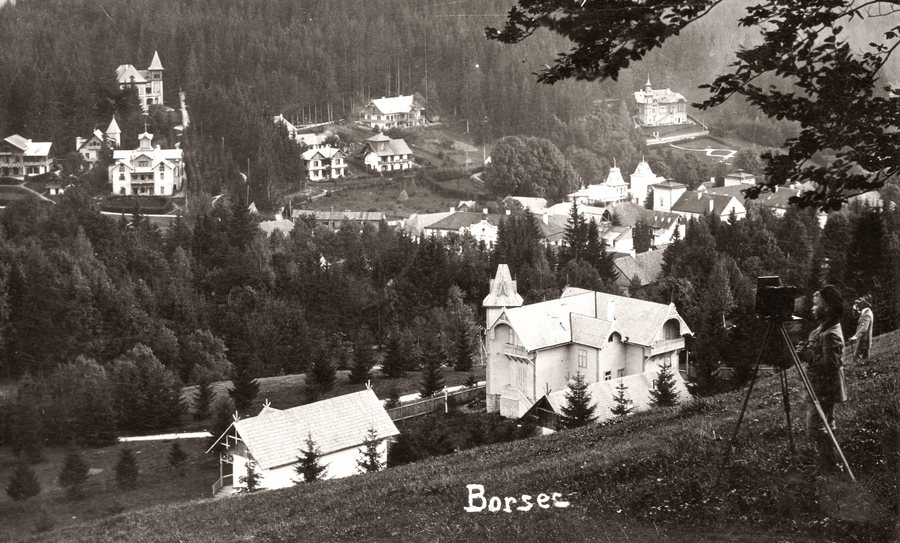 File:Romania, Transylvania, Borsec Fortepan 62378.jpg
Photo: FOTO:Fortepan — ID 62378 : Adományozó/Donor: A R. archive copy at the Wayback Machine via Source, CC BY-SA 3.0
File:Romania, Transylvania, Borsec Fortepan 62378.jpg
Photo: FOTO:Fortepan — ID 62378 : Adományozó/Donor: A R. archive copy at the Wayback Machine via Source, CC BY-SA 3.0
More local pages: Subcetate, Lunca De Jos, Băile Homorod, Cozmeni, Făgeţel, Sâncrai, Izvoare and Jigodin-Băi.
Mineral Water and Spa Resort
Borsec is crossed by the DN15, a road connecting Transylvania with Moldavia. The Poiana Zânelor complex includes mineral springs that have been set up as open-air pools with changing rooms and rest areas, primarily for external treatments. There are also viewpoints as well as areas for picnics or sunbathing.
The mofetta in Borsec was rebuilt in 2010; the building can offer treatments and therapies for up to ten people at the same time. The path from Round Chair to the mofetta has been equipped with benches, tables, waste bins, fire pits and toilets. Access to Baia de Soare is free; a path leads there from the road and takes about two minutes.
Nature and Geology
The Hărmasliget botanical reserve is a wet meadow covering around 2 hectares in the Borsec spa resort area. It is home to rare species, including the dwarf birch (Betula humilis), a glacial relict.
Peștera de Gheață is located in the karst area of Dealul Scaunul Rotund, which is considered Romania’s most significant travertine deposit. A short marked forest trail begins on the edge of the Borsec spa resort and leads via the Mofeta, also known as Izvorul Străvechi, to Peștera de Gheață.
Grota Urșilor is a karst formation with deep, narrow passages created by the natural erosion of limestone by seepage water. It belongs to the Scaunul Rotund karst complex, a geological and botanical nature reserve covering 40 hectares.
Culture and Architecture
Villa 53 Doru is one of the villas in Borsec that have been included on the list of historic monuments. Emil Villa is a historic building in Borsec characteristic of the town’s spa architecture; it was built in 1938.
The Borsec Mineral Water Museum presents the history of the region in connection with the extraction and use of mineral water. Visitors can see more than 100 objects and photographs there, including historic labels from mineral water bottles and containers used to transport water 200 years ago. The oldest exhibit is a bottle used to store mineral water at the end of the 19th century.
Borsec’s Cultural Centre is located in the former Vaitsuk Villa, built in 1902–1903. Its architecture features wrought-iron and wood-carving elements characteristic of historic mountain spa resorts in the former Austro-Hungarian Monarchy. The wooden Church of the Transfiguration in Borsec was built in 1844–1847 on the site of a church dating from 1718. The former Ó-Sáros spa building dates from the 19th century.
Active Experiences
Route 19MN33 is a short semi-circular route on Borsec’s bypass road and is suitable for bicycle touring. Different route and time formats can therefore be viewed separately.
Borsec’s summer toboggan run is just under 1,500 metres long and uses the existing ski lift to transport passengers to the top of the track. It operates between spring and autumn.
A geotouristic walk in Borsec leads to Kerekszék, where the Ice Cave and the Bear Cave can be seen.
To the higher-level travel overview: Harghita.

