
Geoagiu: Rotonda, Thermal Complex and Landscape
Accommodation in Geoagiu
Geoagiu is a destination where historical traces, religious architecture, a local tradition and landscape features stand side by side in different geographical contexts. Those who like to plan a stay around specific places, forms and connections will find several clearly distinct thematic areas here. This thematic breadth can be considered without any fixed order; not every visitor will attach the same importance to the same details.
 File:Geoagiu-Băi 335450, Romania - panoramio.jpg
Photo: mihai moise via Wikimedia Commons, CC BY 3.0
File:Geoagiu-Băi 335450, Romania - panoramio.jpg
Photo: mihai moise via Wikimedia Commons, CC BY 3.0
When choosing a hotel in Geoagiu, you can compare travel dates, room categories and cancellation policies on the respective offer pages. Three practical comparison points remain visible to you, while the town’s historical and landscape themes can be considered independently of them. The three areas form the practical part of planning; the characteristics of the town stand alongside them in their own right.
Culture and History
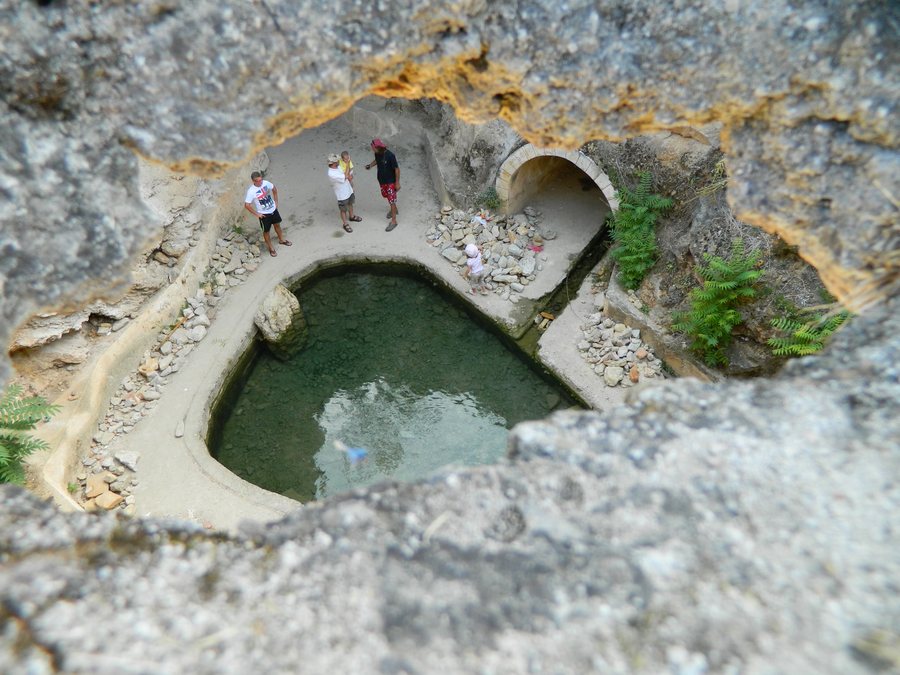
When looking at historical sites, it is worth paying attention not only to buildings but also to individual remains. More than 600 bronze and silver coins, a marble statuette of Diana, votive altars and eight gold votive plaques dedicated to healing deities and the thermal waters were discovered in the Germisara thermal complex.
Those wishing to compare historical sites can distinguish between the form of a complex and its connection to other points. The Roman fort of Cigmău has an irregular, elongated trapezoidal shape and features the most unusual internal layout in all of Dacia. A paved Roman road connected the fort of Cigmău with the Roman baths and the gold-mining area of Săcărâmb.
In the case of religious buildings, form, material and chronology can be considered as separate points. The Rotonda is a unique example of early medieval religious architecture in Transylvania. Its circular nave has an inner diameter of 5.5 m; the mixed masonry consists of rubble and river stone as well as reused Roman bricks. The Orthodox Church of “Sfântul Nicolae” in Geoagiu is 24 m long and 9.20 m wide, dates from 1528 and is now listed as a historic monument.
A local custom can be considered independently of the buildings as a separate cultural reference. The local tradition of “Strigarea peste sat” represents the return of nature and the end of winter evening gatherings before fieldwork begins.
Landscape
For personal orientation, you can consider landscape features separately according to their subject and geographical context. In the wider regional surroundings of Geoagiu lies Mount Vârful Fericelii. Dealul Uroiului Hill lies in the vicinity of Geoagiu. Dealul Gridului Hill lies in the wider regional surroundings of Geoagiu. Dealul Archiei Hill is also located in the wider regional surroundings of Geoagiu.
For your own planning, you can organize mountain, hill and waterfall features by geographical context and subject. Clocota Waterfall is located on the Clocota River, at the entrance to the spa resort of Geoagiu Băi, and has a height difference of just under 20 m.
Other Places
You can also find the destination pages for Diemrich, Kalan, Câmpu Lui Neag, Petroșani, Vălișoara, Cib, Sarmizegetusa and Orăştie.
Getting There
For personal planning, you can distinguish between travel by mode of transport and by train type. Geoagiu can be reached by train or car. The destination station is Geoagiu-Haltă; only passenger trains stop there.
For the broader travel overview: Eisenmarkt.

