
Discover Schaas: Fortified Church, History and Cycling Tour
Accommodation in Schaas
Schaas draws attention to architectural history and landscape without overlooking its sporting side. Different perspectives are available for exploration: historical context, visible architecture, a personal connection to the place and a described cycling route. The topics can be considered individually, meaning that cultural details and practical route information do not require the same kind of travel planning.
Culture
In Șaeș, the Evangelical church is listed as historical monument MS-II-m-A-16038.01 and dated to the years 1820 to 1832. The ensemble of the fortified Evangelical church is listed as monument MS-II-a-A-16038; it is dated to the years 1500 to 1525 and to the 17th to 19th centuries. Biserica Schimbarea la Față is listed as historical monument MS-II-m-A-16037 and dated to the years 1805 to 1821.
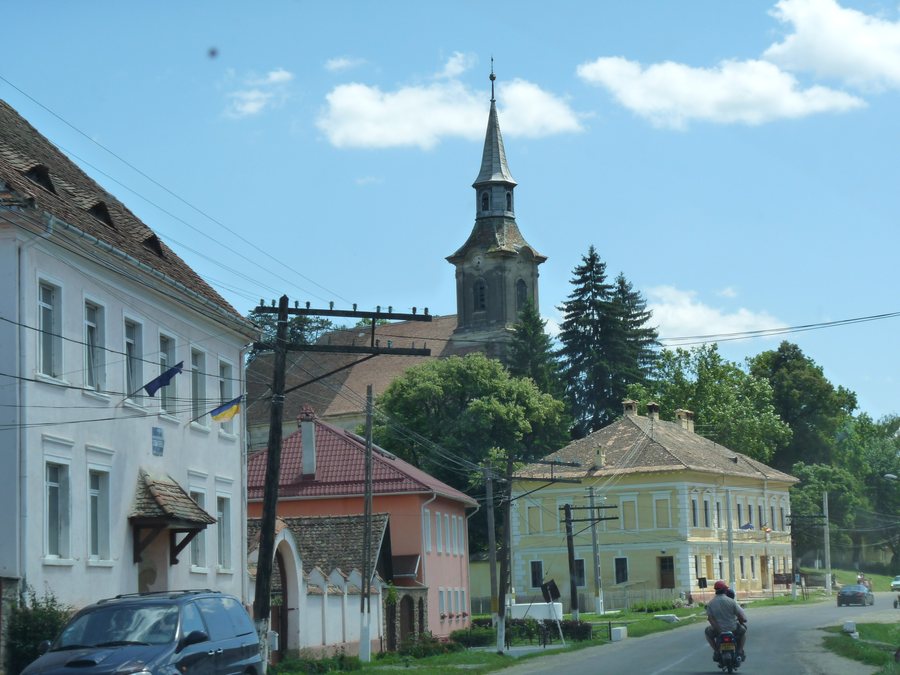
After the original Romanesque church of Șaeș collapsed in 1802, the ruins were completely demolished and replaced by 1820 with a Neoclassical building in the form of a hall church. The church has a recessed chancel and a western bell tower; the church and tower are restrainedly articulated by pilasters and cornices. The tower is crowned by a pyramidal roof with brightly glazed tiles and a sheet-metal-covered lantern. It still bears its original festoon decoration as a sheet-metal ornament.
The fortified church in Șaeș retains remnants of the surrounding wall, a small defensive tower and a defensive building. The latter was probably built as a granary and is said to have served as a prayer house during the construction of the new church. The defensive building is said to be on the verge of collapse; the church has severe structural damage that urgently needs to be repaired.
Josef Haltrich came to Șaeș in 1872, took over the parish there and was buried in the local cemetery. In 1856, through the mediation of Jacob Grimm, he published the collection of fairy tales “German Folk Tales from Saxon Transylvania” in Berlin. The vicarage in Șaeș is considered part of the cultural heritage of Apold commune.
The cemetery in Șaeș, on the edge of the Schaaser Feld, offers a view of the village and its surroundings.
DJ 106 is the most important access road into the Șaeș Valley and runs from Sibiu via Agnita, Apold, Șaeș and Sighișoara to DN 13. The Șaeș stop is listed as a historic stopping point from the late 19th century; it is located at kilometre 10+100 on the outskirts of the village in the direction of Sighișoara.
Further destinations:Bistra Mureşului, Răstolița, Feleag, Târnăveni, Hetiur, Gorneşti, Ungheni and Absdorf.
Cycling
A cycling tour of about 50 kilometres has an easy to moderate difficulty level. It runs mainly along the Via Transilvanica as well as on gravel, dirt and lightly trafficked paved roads.
To the main travel overview: Mures.

