
Brhlovce: Rock Dwellings and Folk Architecture
Accommodation in Brhlovce
Brhlovce reveals an unusual history of living in rock. At its center is the Skalné obydlia Brhlovce exhibition, whose furnished living spaces illustrate the development of the residential culture of the inhabitants of Brhlovce and the wider Tekov and Hont regions. The exhibition was opened to the public in 1992 and combines historical forms of housing with insights into the traditional livelihood of the locality.
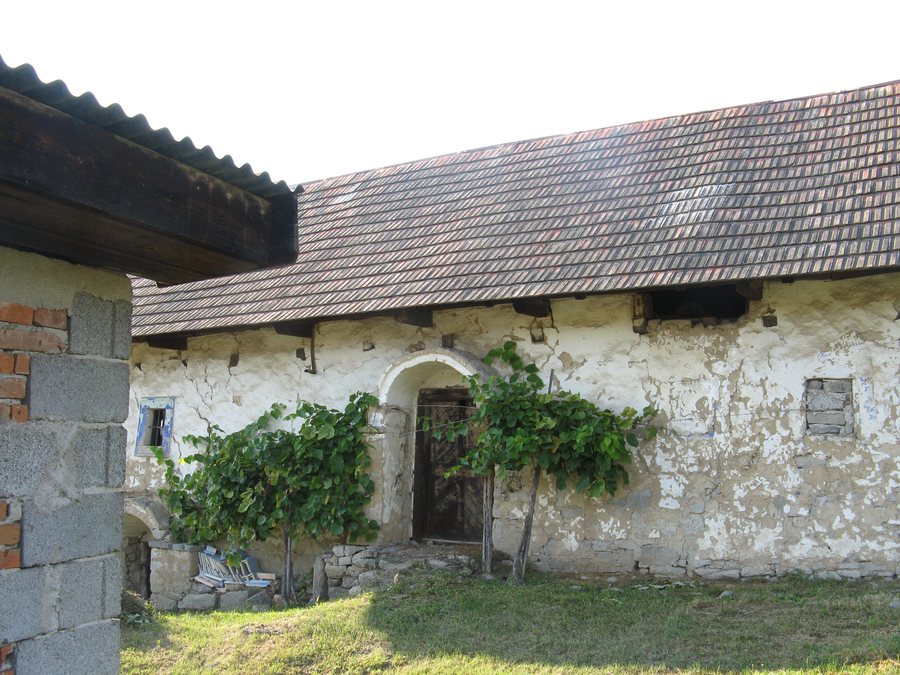 File:935 02 Brhlovce, Slovakia - panoramio (106).jpg
Photo: lubomir.borovic via Wikimedia Commons, CC BY 3.0
File:935 02 Brhlovce, Slovakia - panoramio (106).jpg
Photo: lubomir.borovic via Wikimedia Commons, CC BY 3.0
Culture
The Brhlovce Folk Architecture Reserve is located in the Dolné Brhlovce district of the municipality of Brhlovce in the Levice District. It was approved by a government regulation and designated by Government Resolution No. 272/1983 of 14 September 1983. The reserve includes the historic parts of the village known as Dolina and Šurda. The Dolina-Šurda area contains an exceptional settlement form with a rock settlement.
Rock dwellings dating from the 18th to the 20th century can be found especially in Šurda Lane. At the end of the courtyard, the exhibition extends over up to two levels with rooms carved into tuff. The most important urban and historic value of the reserve is the rock formation as an urban landmark. The exhibition's utility rooms also include a stonemason's workshop; its equipment illustrates the traditional livelihood of the inhabitants of Brhlovce.
In the 19th century, stoneworking became the most important livelihood of the people of Brhlovce. The inhabitants learned techniques for extracting and working stone from the Italian builders of the local manor house. The rock dwellings therefore represent not only a distinctive form of construction, but are also connected with the craft skills that shaped life in the locality.
The local architectural history also includes the Evangelical church. It stands on the Horvát parlag hill and is, in a sense, the center of Dolné Brhlovce. The church is late Classicist in style and dates from the 19th century. It has an elongated hall layout, a rectangular floor plan, and a projecting prismatic tower. Inside is an altar from the second half of the 19th century with a painting of the Garden of Gethsemane.
Nature
The geological foundations of Brhlovce are also closely connected with the appearance of the rock dwellings. The locality lies in an extensive geological area of volcanic origin, shaped by volcanic activity in the Tertiary period. Layers of trachyte, as well as porous andesite tuffs and tuffites, were formed from lava and volcanic ash.
In the Šurda area, the Búr stream forms part of the southern boundary of the Brhlovce reserve. The Búr is also a right-bank tributary of the Ipeľ.
Getting There
There are two specifically named reference points for arriving at the site. A public parking garage is approximately a four-minute walk from the Museum of Rock Dwellings. From the “Brhlovce, Obecný úrad” bus stop, it is approximately a two-minute walk to the Museum of Rock Dwellings.
Local Highlights
The locality's culinary associations include Podlievané buchty, a specialty of Brhlovce. The rock dwellings in Brhlovce are also home to Pivnica BRHLOVCE, a family winery. Another local destination is Nový dvor, a craft center with a café and gallery. It presents the traditional handcrafted production of leather goods such as bags, belts, and shoes, including sandals.
Other Places
Other destinations on poezdka.de: Želiezovce, Devičany, Tekovské Lužany, Iňa, Kozárovce, Čajkov, Čata, Veľké Kozmálovce.
For the higher-level travel overview: Levice.

.jpg)