
Navoiy Province: Petroglyphs and Mountain Landscapes
Accommodation in Navoiy Province
Navoiy Province brings together impressive evidence of early art, historic buildings, and landscapes between mountains and desert plains. When planning your trip, it is therefore worth considering the different highlights: Sarmishsay and Raboti Malik represent history, while the Nurota Mountains, Aydarko‘l, and Sentob offer nature and outdoor activities.
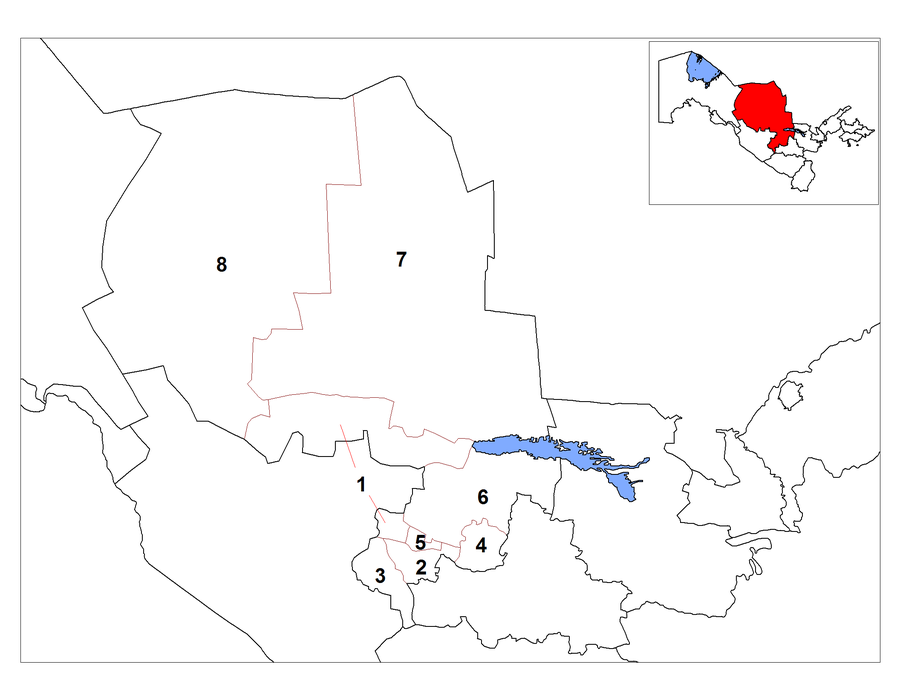
Quick facts about Navoiy Province
- Sarmishsay in Nurota District comprises two petroglyph sites with a total of 10,000 ancient rock carvings. Most are dated to the Bronze Age, from 3000 to 900 BCE.
- A tourist circular route in the province is 340 kilometers long and covers more than 60 sites in Nurota, Karmana, and Qiziltepa.
- The highest peak in the Nurota Mountains is Hayatbashi, at 2,169 meters.
- Sentob is an ecotourism route and recreation area in Nurota District.
- The shore of Aydarko‘l stretches from Nurota District in Navoiy to the Forish and Mirzacho‘l districts in Jizzax Region.
Which cultural sites can you discover in Navoiy?
The rock carvings of Sarmishsay make the region a destination for travelers interested in early art and history. The 10,000 carvings are located at two sites; most are dated to the Bronze Age, between 3000 and 900 BCE. Preservation measures include bypass paths and viewing platforms. These are intended to reduce human contact with the rock art.
Raboti Malik also tells the story of trading caravans. The ruins of an 11th-century caravanserai lie 23 kilometers from Navoiy. Raboti Malik served trading caravans from the 13th century until the beginning of the 18th century; the Rabati Malik caravanserai was built on the orders of the Karakhanid Shams-al-Mulk Nasr.
Toshmasjid, an architectural complex dating from the 16th century, is located in the village of Vangoziy in Qiziltepa District. It comprises a mosque, a minaret, a madrasa, a bathhouse, and an old cemetery. Another notable religious building is the Juma Mosque above the sacred spring of Chashma majmuasi: it has 40 wooden columns and a dome 16 meters wide. Thousands of people visit Chashma majmuasi on pilgrimage and to see its monuments. The sacred spring’s water temperature remains constant at around 20 degrees Celsius.
What do the Nurota Mountains, Aydarko‘l, and Sentob offer?
The Nurota Mountains consist of three low western foothill ranges of the Gissar-Alai system. They lie in a transition zone between the Pamir-Alai and Tian Shan ranges and the desert plains of Turan. Their flora includes numerous endemic and relict species. Travelers who want to combine nature and culture can therefore find a variety of themes in the province, which cannot be reduced to a single type of landscape.
Wildlife is a key attraction at Aydarko‘l: the lake provides refuge for birds listed in Uzbekistan’s Red Book. Ethnographic excursions take place at the yurt camps by the lake. Sentob offers a different kind of nature experience. Guesthouses there offer horseback riding, mountain hikes, and walking tours. In Nurota District, embroidered products have also become an experience of interest to tourists.
How can you choose the focus of your trip?
The 340-kilometer circular route, with more than 60 sites in Nurota, Karmana, and Qiziltepa, provides a regional framework for a round trip. Its length and the number of sites included help put the scope of this travel offer into perspective; individual visits can be tailored to personal interests. For a stronger focus on cultural history, the petroglyphs of Sarmishsay and the buildings of Raboti Malik and Toshmasjid are possible themes. Those seeking nature and activities can instead explore the Nurota Mountains, Aydarko‘l, or Sentob.
This can help you decide whether your plans should focus mainly on cultural sites, nature experiences, or a combination of both. The detail pages for the subregions Karmana District and Malik provide additional guidance within the province. Other destinations to compare include Khorezm, Jizzax Province, Buxoro Province, Bukhara, Ferghana Province, and Surxondaryo Province.
FAQ
How long is the tourist circular route in Navoiy Province?
The tourist circular route is 340 kilometers long and covers more than 60 sites in Nurota, Karmana, and Qiziltepa.
What can you see in Sarmishsay?
There are a total of 10,000 ancient rock carvings at two petroglyph sites, most of them dated to the Bronze Age, from 3000 to 900 BCE.
What activities do guesthouses in Sentob offer?
They offer horseback riding, mountain hikes, and walking tours.
Where is Toshmasjid located?
The 16th-century architectural complex is located in the village of Vangoziy in Qiziltepa District.
For the main travel overview: Uzbekistan.

