
Surxondaryo Province: Nature, History and Culture
Accommodation in Surxondaryo Province
Surxondaryo is Uzbekistan’s southernmost region, extending south to the Amu Darya. Its many themes range from a nature reserve and a long canyon to Buddhist sites, historic complexes and regional cuisine.
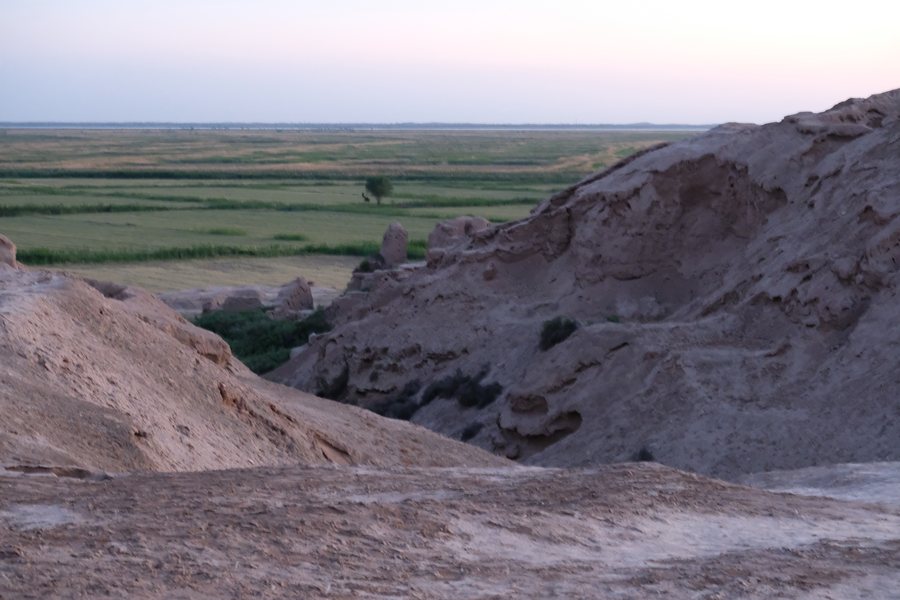 Kampir Tepa archaeological ruins, Surxondaryo Region
Photo: Panpanchik via Wikimedia Commons, CC BY 4.0
Kampir Tepa archaeological ruins, Surxondaryo Region
Photo: Panpanchik via Wikimedia Commons, CC BY 4.0
Surxondaryo Province at a glance
- The Amu Darya forms the region’s southern border.
- The Surkhan State Nature Reserve was established in 1986 by combining the Kugitang and Aral-Paigambar protected areas.
- The “Surkhan oasis-tourism triangle” tourist map shows a three-point route through the region.
- Termez and its surroundings offer regional cuisine, a museum and several historic sites.
What travel themes does the region offer?
The “Surkhan oasis-tourism triangle” map links historic monuments, museums, pilgrimage sites, national cultural centers and natural landmarks along a three-point route through Surxondaryo. It provides an overview of the region’s different cultural and landscape themes. Termez International Airport is considered the air gateway to the region. As a subregion, Termiz is one possible starting point for planning a trip.
When looking for a hotel, it can help to first decide what you want to focus on: should the trip center on regional history, nature, or both?
What makes the nature and landscape distinctive?
More than 130 bird species, over 25 mammal species and 27 reptile species live in the Surkhan Nature Reserve. The protected area dates back to 1986, when Kugitang and Aral-Paigambar were combined. Those interested in wildlife will find a different regional focus here than at the archaeological sites.
Kyzyl Canyon is 30 km long; its highest point is Mount Buritakht, at 1,218 m. Natural labyrinths stretch for several dozen kilometers through the canyon. In another mountain range in the region, Boybuloq Cave lies in the Cho‘lbayir Mountains. At approximately 1,415 m deep, it is considered the deepest cave in Asia. These figures illustrate the variety of nature destinations in Surxondaryo, though they should not be taken as a single combined route.
Which historic sites and museums are worth visiting?
Uzundara Fortress, near Derbent, dates to the 3rd–4th centuries BCE. It stood in the foothills of Baysun at an elevation of more than 1,700 m. Its stone fortifications included double walls and 13 towers; sections of the outer walls were up to 1 km long. The Iron Gate mountain pass is also in the Derbent area. In the Middle Ages, numerous trade caravans and troops used it as a short link between Central Asia, Bactria and India.
Fayaztepa in ancient Termez is a Buddhist temple complex dating to the 1st century BCE. At the time, the complex included a temple, a monastery and a courtyard with utility rooms. A copy of the Fayaztepa Triad is on display at the Termez Archaeological Museum. Sultan-Saodat also reflects a long history of construction: the complex was built from the 12th to the 17th century around the burial sites of the Termez Sayyids. Two mausoleums form its foundation; a connecting iwan served as a memorial mosque.
At Dalverzintepa, an ancient settlement in Shurchi District, are the ruins of a Buddhist temple founded at the beginning of the 1st century CE. It is considered the oldest Buddhist structure in Uzbekistan. Dalverzintepa is 60 km from Termez. Teshik-Tosh Cave is associated with the southern slopes of Boysun and is now considered one of Uzbekistan’s unique archaeological protected areas.
What can you discover in Termez and Boysun?
The Surkhandarya Regional Museum of Local Lore presents more than 60,000 exhibits on regional history and heritage. Founded in 1934, it has a library of 14,000 works. Its themes range from historical studies by scholars from Termez to ethnography, fine arts, folk art and the region’s natural environment. Termez also has many cafés and restaurants where visitors can sample traditional Surxondaryo dishes.
The international folklore festival “Boysun Bahori” is held annually in Boysun District. The festival program has included competitions in kurash, equestrian sports and Ko'pkari, as well as exhibitions of traditional crafts. Those interested in culture and regional traditions can consider this alongside the historic sites and nature destinations when planning a trip.
If you would like to compare Surxondaryo with other regions of Uzbekistan, you can also find Navoiy Province, Samarkand Province, Buxoro Province, Qashqadaryo Province, Khorezm, Andijan Province and Ferghana Province.
FAQ
What animals live in the Surkhan Nature Reserve?
It is home to more than 130 bird species, over 25 mammal species and 27 reptile species.
How far is Dalverzintepa from Termez?
The ancient settlement of Dalverzintepa is 60 km from Termez.
Where is the “Boysun Bahori” festival held?
The international folklore festival is held annually in Boysun District, in the Surxondaryo region.
For the main travel overview: Uzbekistan.

