
Cathedral of the Dormition in Vladimir: Frescoes and History
The Cathedral of the Dormition stands on Cathedral Square in the historic center of Vladimir. Construction began in 1158 under Prince Andrei Bogolyubsky, and the cathedral was enlarged after the city fire of 1185. Its 12th-century architecture, the history of medieval rulers, and frescoes by Andrei Rublev and Daniil Chyorny make it one of the city’s main attractions.
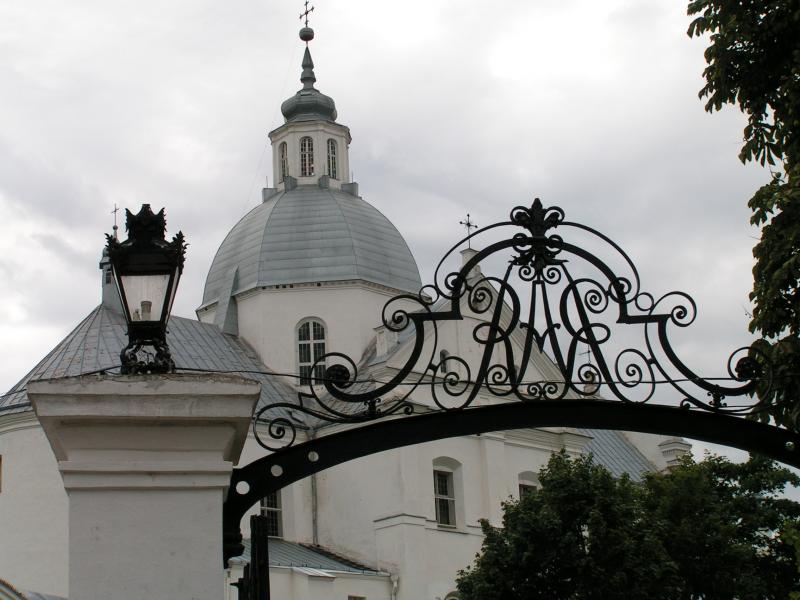 Detail einer orthodox geprägten Kirchenarchitektur mit Kuppel und schmiedeeisernem Tor.
Photo: Ilya
Cathedral of the Dormition: key facts
- Address: 56 Bolshaya Moskovskaya Street, Vladimir.
- The original building was constructed in 1158–1160 under Andrei Bogolyubsky; after the fire of 1185, the cathedral was given five domes.
- Andrei Rublev and Daniil Chyorny painted frescoes in 1408, including scenes of the Last Judgment.
- The cathedral is an active place of worship; liturgical services affect when visitors can enter the interior.
- The Cathedral of St. Demetrius and the Golden Gate are separate stops in the historic center.
Construction and reconstruction of the cathedral
Prince Andrei Bogolyubsky commissioned the cathedral, which was built in 1158–1160; the original building probably had a single dome. The cathedral was damaged in the city fire of 1185. Prince Vsevolod III subsequently had it enlarged and fitted with five domes; the renovated church was consecrated in 1189. The transition from the single-domed founding structure to a five-domed church continues to define its silhouette.
The white-stone building stands on Cathedral Square, once the religious and political heart of Vladimir. The Cathedral of the Dormition was the city’s principal church and was closely associated with the princes of northeastern Rus. Grand princes were enthroned here, and the tombs of Andrei Bogolyubsky and Vsevolod III are also in the cathedral. The Italian architect Aristotele Fioravanti studied it as a model for the later Cathedral of the Dormition in the Moscow Kremlin, adapting its design to the needs of his own project. A manuscript library was also established at the church, and chronicle accounts reflect its importance as a religious and political center. Prince Georgy Vsevolodovich and Bishop Serapion of Vladimir are also buried in the cathedral. These tombs link the building’s history to other periods in the history of the princes and the church.
Nearby are the buildings on Cathedral Square and the Cathedral of St. Demetrius. The latter’s richly carved exterior reliefs offer a different focus from the great Cathedral of the Dormition. Together, the two cathedrals showcase the different functions and architectural styles of medieval Vladimir.
Frescoes by Rublev and Chyorny
The interior is best known for its frescoes. In 1408, Andrei Rublev and Daniil Chyorny painted a new fresco cycle that includes scenes of the Last Judgment. Some of these paintings are considered outstanding examples of Old Russian monumental art. The architecture and murals can therefore be viewed as a unified ensemble: the domes and vaults structure the space, while the frescoes unfold its religious imagery.
The cathedral is still an active place of worship. Services are part of its daily routine, and visitors are asked to remain quiet and considerate of those praying. For an interior visit, choose a time outside the liturgy. The local parish publishes a service schedule by date. The cathedral is located at 56 Bolshaya Moskovskaya Street.
North of the cathedral stands the bell tower, built in 1810 in the Classical style. The St. George side chapel was added between the tower and the cathedral in 1862, joining the two structures as a later extension of the medieval ensemble.
A walk through the historic center
Cathedral Square is a good starting point for exploring the churches and buildings in the city center. From here, a walk leads to the Golden Gate, the medieval city gate, and along other historic streets. The Vladimir Museum offers another stop for learning about the city’s history. Vladimir can thus be explored as a destination in its own right; allow time to walk between and visit each of the central attractions.
The monastery and scenic destination of Bogolyubovo lies beyond this compact city-center walk and requires a separate trip. Suzdal, with its monasteries, is also a separate stop. The Golden Ring links several historic cities northeast of Moscow; its destinations do not form a short walking route. When staying in Vladimir, choose accommodation based on its location relative to the train station, Cathedral Square, and onward transport.
The routes from the train station to Cathedral Square and onward to Bogolyubovo or Suzdal determine which destinations can be combined in a day; getting there and getting around and personal travel preparations are relevant to these legs of the trip. Knowledge of the language and communication can help with conversations locally; architecture and frescoes are part of a cultural holiday.
German bank cards and payment apps do not work in Russia. These conditions also affect travel to and from Vladimir.
Frequently asked questions about the Cathedral of the Dormition
Which frescoes in the cathedral are especially well known?
Andrei Rublev and Daniil Chyorny painted the fresco cycle in 1408, including scenes of the Last Judgment. The paintings are among the outstanding works of Old Russian monumental art.
Where is the Vladimir Mother of God icon today?
The icon is now kept in the Church-Museum of St. Nicholas in Tolmachi, a branch of the Tretyakov Gallery in Moscow. It should therefore be distinguished from the cathedral in Vladimir, with which it is historically associated.
Which other sights can be included in a walk?
The Cathedral of St. Demetrius and the Golden Gate are separate historic stops in central Vladimir. Bogolyubovo and Suzdal are separate excursions that require additional travel.
