
The Matryoshka: History, Craftsmanship and a Russian Souvenir
There is no more traditional Russian souvenir than the Russian matryoshka (also spelled matryoshka). The matryoshka is as much a part of Russia as tea is of England: the trio “vodka – bear – matryoshka” is seen as a symbol of Russia not only by Western tourists.
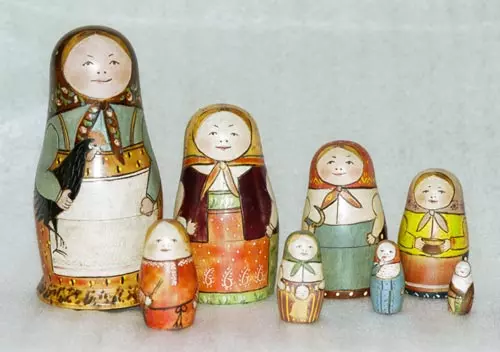 Die erste Matroschkas. Heute sieht man sie im Spielzeugmuseum von Sergijew Possad. Kaum jemand weiß, das die Matroschka, das bekannteste Souvenir aus Russland, eigentlich das Plagiat eines japanischen Spielzeugs ist.
Photo: public domain / Spielzeugmuseum Sergijew Possad
Die erste Matroschkas. Heute sieht man sie im Spielzeugmuseum von Sergijew Possad. Kaum jemand weiß, das die Matroschka, das bekannteste Souvenir aus Russland, eigentlich das Plagiat eines japanischen Spielzeugs ist.
Photo: public domain / Spielzeugmuseum Sergijew Possad
Matryoshka facts
- A matryoshka is a set of nested wooden dolls and a well-known Russian souvenir.
- Its development drew on a Japanese model and led to distinctive Russian forms.
- Sergiyev Posad became an important center for making and painting them.
- Regional schools and workshops differ in the dolls’ shape, decoration and sequence of figures.
- When buying one, consider the woodworking, how well the pieces fit, the painting, provenance and the size you want.
- Check museums, sellers’ information, prices and current travel conditions for your specific visit.
A symbol of Russia
In people’s imagination, Russia is simple: people drink nothing but vodka, bears roam the streets of Moscow, and kind-hearted Russians give matryoshka dolls to every guest. Well, some people’s idea of Russia is also colored by elements from the Cold War era. Few people know that the typical Russian matryoshka is simply an adapted version of a Japanese toy.
The history of the Russian matryoshka
At the end of the 19th century, the daughter of the well-known patron Mamontov brought a Japanese toy to her father’s toy factory—a “Fukuruma”. It consisted of several figures of a bald old man, each nested inside another. The factory workers immediately set about creating a Russian counterpart. In their version, the old man was replaced by a boy and a girl in Russian folk costumes. The symbol of Russia began life as a toy. The toy was named Matryoshka (Matryoshka), because the woman’s name Matryona was widespread in Russia at the time. The Russian matryoshka developed from a Japanese model into a distinctive Russian toy tradition.
A product of the toy factories of Sergiyev Posad
The first workshop to make matryoshka dolls operated until the beginning of the 20th century. The dolls were turned in the old Russian town of Sergiyev Posad. Matryoshka dolls soon became very popular among the people of Sergiyev Posad. Traders from Moscow began arriving soon afterward, and before long the Japanese-Russian toy was being made to order for customers in Paris and Germany.
Matryoshka dolls also began to be made in other Russian cities, and production spread across the country. Each craftsperson had a distinct style: compared with dolls from Nizhny Novgorod, those from Sergiyev Posad tend to look stockier and more solid, while the Nizhny Novgorod dolls are delicate, slender and more brightly painted.
Matryoshka dolls in the Toy Museum
Today, you can see matryoshka dolls at the Toy Museum in Sergiyev Posad, where part of the exhibition is devoted specifically to them. The collection includes the first matryoshka, painted by the artist Malyutin, as well as whole sets of dolls from other schools of craftsmanship, from the Semionovo school to that of Sergiyev Posad. A museum devoted entirely to Russia’s best-known souvenir has also opened in Moscow.
Origins, Russian character and craftsmanship
The matryoshka is not a timeless, unchanging symbol, but a toy with a traceable history. A Japanese model was adopted in Russia and developed into a distinctive form featuring painted figures. The historical overview of the matryoshka provides further background. For travel planning, Russia and the craft tradition of Sergiyev Posad can be considered as separate points of interest.
When buying one, take a close look at the wood, finish, fit and painting. A set may be designed for tourists, made by hand or documented as a museum example; its origin and price cannot be determined from appearance alone. Moscow, shopping in Moscow, GUM and Nizhny Novgorod offer different urban and regional points of reference.
When planning visits to museums and workshops, include culture and history, Moscow museums, getting around and transport and money and payments in your itinerary. Look for clear information from sellers, secure packaging and the rules for taking your purchase home. The current travel and safety advice for the Russian Federation takes precedence over older souvenir descriptions.
Matryoshka FAQ
What is a matryoshka?
A matryoshka is a painted wooden doll containing smaller figures that fit inside one another. It is one of the best-known types of Russian souvenir.
Is the matryoshka entirely Russian in origin?
Its Russian form developed from a Japanese model. This led to a distinctive Russian toy and craft tradition.
Why is Sergiyev Posad important?
Sergiyev Posad became closely associated with the making and painting of matryoshka dolls and represents an important school of craftsmanship.
What should I look for when buying one?
Before buying, compare the wood, finish, fit of the pieces, painting, provenance, size, price and packaging.
