
Kazan on the Volga: Kremlin, Mosques and Tatar Culture
Kazan is one of Russia’s oldest cities. In 2005, the city celebrated its 1,000th anniversary. From its beginnings, it was the economic and cultural center of the Kazan Khanate. Today, Kazan is the capital of the Republic of Tatarstan in the Russian Federation. The Volga—or, more precisely, its tributary, the Bulak—divides the city into a Russian upper town and a Tatar lower town.
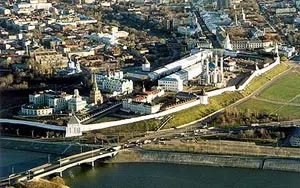 Blick auf den Kasaner Kreml an einem Flussufer.
Kazan is one of Russia’s major university cities. Lenin studied here.
Kazan’s main attractions are all clustered fairly close together in the city center. Important landmarks include the ancient Kremlin, once the residence of the Tatar khan, and old churches such as the Annunciation Cathedral and the Peter and Paul Cathedral. A building with particular symbolic significance for the people of Kazan is the “leaning” Söyembikä Tower, named after the last Kazan queen, Söyembikä. According to some Tatar guides, it is the only building in Kazan to have survived Ivan the Terrible’s conquest in 1552—Russian historians, however, say that the tower was built only after the fall of the Tatars. Visitors should tread carefully here, as this debate concerns a symbol of Tatar national pride.
Kazan, a city of two cultures, also has sacred Muslim sites to offer, including the Qol Sharif and Nurulla mosques.
The city of Kazan is not the only reason to make the trip: the Volga is nearby, and a boat trip on the river is well worthwhile. A visit to the Raifa Monastery, a men’s monastery in a nearby nature park on the shore of a picturesque lake, is also rewarding. The “holy spring” is located here as well.
According to an old legend, a Tatar khan’s treasure is hidden at the bottom of nearby Lake Kaban.
Quick facts: Kazan
- Kazan is the capital of Tatarstan and lies on the Volga in the European part of Russia.
- The Kremlin, Qol Sharif Mosque, Orthodox churches and historic streets reflect the city’s cultural diversity.
- Religious sites have their own rules for access and behavior, which visitors should observe.
- The Volga, Lake Kaban, parks and city center offer different settings for walks.
- Raifa and other destinations outside the city require extra time for travel and transfers.
- Check opening hours, transport, events, access arrangements and current travel advice before your visit.
Kazan between the Volga and Tatar culture
Kazan is one of the most important cities on the Volga and the capital of the Republic of Tatarstan. The city’s defining features include the Kazan Kremlin, mosques, Orthodox churches, its university tradition and its location at the confluence of the Volga and the Kazanka. It is a good choice for travelers who want to experience Russian and Tatar culture in a major regional city. Planning is easier with a few clear priorities: the old town and Kremlin, riverfront areas, museums, markets and day trips nearby.
Experience Kazan between the Kremlin and Tatar culture
Kazan brings together its location on the Volga, Tatar culture, Russian history and the energy of a university city and major urban center. For a first visit, focus on the Kremlin, the historic center and religious architecture. Markets, museums and riverfront areas can round out your itinerary, but choose them according to their locations and the time available.
Before traveling, decide whether architecture, history, food or city life is your main interest. Check current opening hours, admission, transport and travel times between neighborhoods. If Kazan is part of a Volga itinerary, allow realistic time for transfers. One full day is enough for a general overview; visiting several key sites takes longer.
Kazan suits a range of trips, from a compact cultural weekend to a longer journey along the Volga. The best place to stay depends on whether you prioritize the historic center, nightlife, rail connections or peaceful walks. Check current access arrangements for religious and cultural sites before visiting. On a short stay, a route combining the Kremlin with one other main attraction is usually more practical than trying to visit many distant places. For longer excursions outside the city, check return transport, weather and available services separately.
Discover the Kremlin, the Volga and Tatar culture
A first day in the city can combine the Kazan Kremlin with nearby streets, squares and a stretch of riverfront. Visit the mosque, cathedrals and museums with respect for religious customs and their individual opening hours. A full day’s itinerary needs to leave time for getting around and visiting interiors.
The Volga region and Russia provide the geographical setting. Ulyanovsk, Nizhny Novgorod and Samara are distinct stops along the Volga. Plan any trip to the wider Volga region with separate arrangements for getting there and back.
For practical preparations, see getting there and getting around, travel preparation, culture and history and regional cuisine. The UNESCO information on the Kazan Kremlin provides additional cultural and historical context. Check opening hours, events, transport routes and current travel conditions before your visit.
FAQ about Kazan
What makes Kazan special?
The combination of the Volga, the Kremlin, mosques, Orthodox churches, Tatar history and a modern big-city atmosphere shapes the experience.
How much time should I allow for the Kazan Kremlin?
Set aside a substantial part of a day for the Kremlin, religious buildings, museums, getting around and breaks. Check current opening hours and access arrangements.
Can I visit Raifa from Kazan?
Yes, provided you make realistic plans in advance for the journey there and back and the time required. The excursion is not a casual add-on to a full day in the city.
What should I bear in mind when visiting mosques and churches?
Respect visiting hours, dress requirements, photography rules and local guidance. Confirm the current rules immediately before your visit.
