
Check currency and money exchange before your trip
Before a trip, it is worth taking a close look at the destination’s currency and the terms for exchanging money. This makes it easier to decide how much cash you actually need and when using a card may be more convenient. The rate shown is not necessarily the amount you will ultimately receive or be charged: fees, markups, the exchange provider and the payment method can all affect the final amount.
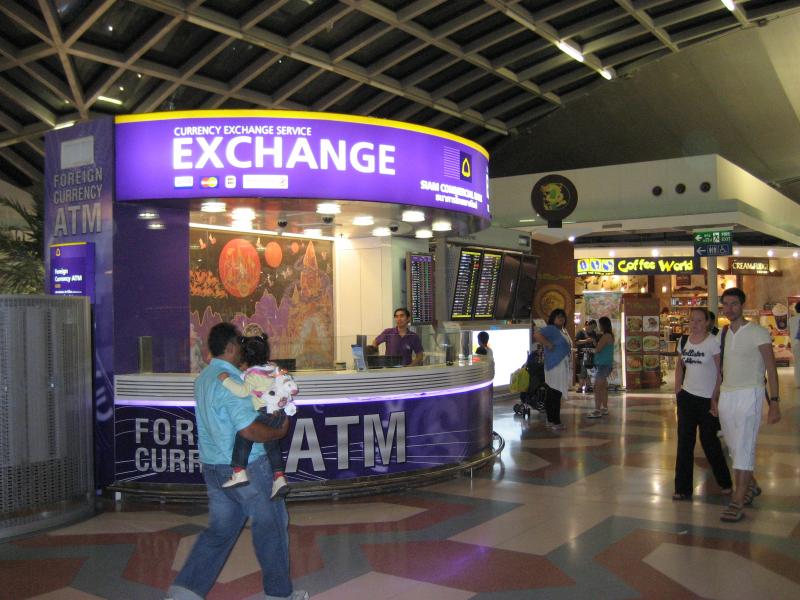 Wechselstube mit großem EXCHANGE-Hinweis und Geldautomat in einem belebten Terminal.
Photo: Vitaly Naidion
Wechselstube mit großem EXCHANGE-Hinweis und Geldautomat in einem belebten Terminal.
Photo: Vitaly Naidion
Quick facts: Currency and money exchange
- Before you leave, check your destination, transit countries and the currencies used there.
- Compare not only the exchange rate, but also fixed fees and possible markups.
- Exchange only as much as you really need for your upcoming expenses.
- Keep your receipt, cash and a second payment option separate.
- A small reserve in the local currency can help with minor expenses or technical problems.
- A reference rate is for guidance only and does not replace the actual transaction rate.
Which currency will you need on your trip?
Start by considering your entire route. If you have a stopover, are taking a round trip or will be continuing your journey, you may need several currencies. Entry requirements and documents can help you plan the order of the countries, while Getting there and getting around brings together the places and stages of your journey for practical planning. For each country, check whether everyday transactions are usually made in the local currency, a widely used secondary currency or mainly by cashless payment. General expectations are no substitute for checking the conditions at your specific destination.
You should also factor in the first leg of your journey after arrival. You may need small amounts for local transfers and public transport before you reach your accommodation or a larger service provider. For a long onward journey, long-distance buses and ferry connections and train travel and stations can help you anticipate extra costs.
Exchange rates, fees and the amount you actually receive
An exchange rate is a comparison value between two currencies. For a general guide, you can check the European Central Bank’s euro reference rates. The actual amount at an exchange provider, at an ATM or when paying by card may differ. What matters is the rate shown, any fixed fee and whether an additional markup is built into the amount you receive.
Read the entire display before confirming the exchange. For cash, check the amount dispensed and the stated fee; for a card, your own provider’s subsequent transaction processing also comes into play. The information in Money and payments provides the right context for this check. You can then use your daily budget to assess whether the amount you exchange fits the planned length of your stay.
Where and when should you exchange money?
An exchange provider that clearly displays its terms and issues a receipt makes it easier to check the transaction. At an ATM, before confirming, check which currency the amount is shown in and whether an additional fee is listed. If a terminal lets you choose between the local currency and conversion into your own currency, read both amounts carefully. Make your decision based on the actual final amount offered, not on an assumption.
Don’t exchange all your travel money at once. A limited amount for your first journeys and small expenses is easier to keep track of; you can exchange more later as needed. Card, cash and a second payment option explains how to prepare several payment methods separately. It is also worth planning reserves, contacts and a Plan B in case something gets lost.
Reserves, receipts and safekeeping
After exchanging your money, split your cash between safe, separate places. Keep a small daily reserve within reach, while storing another amount somewhere you won’t need to open every time you make a purchase. Keep receipts if the amount is unusually large or you may need to verify the transaction later. Deposits and extras for a rental car, accommodation or ferry trip can change how much you need; Rental cars and local journeys can help you assess this.
Make a note of the currency used and the reason for a larger exchange, especially if you are travelling with other people. This makes it easier to compare expenses with your second payment method and daily budget. You can also store important receipts or contact details with your digitally backed-up travel documents, without throwing away the paper receipt straight away.
Frequently asked questions
Is the reference rate the amount I will receive?
No. The reference rate is for guidance only. An exchange provider, bank, card provider or ATM may apply its own rate or additional fees.
How much cash should I exchange?
It depends on your route, the length of your trip, payment acceptance and your planned initial expenses. A limited amount to start with, plus a reserve, is usually easier to manage than exchanging a large total amount.
Why is a receipt important?
It shows the amount applied and the stated fee. If you have a question or need to verify the transaction later, the receipt makes it easier to trace what happened.
Can I pay by card everywhere?
You shouldn’t count on it. Small shops, markets, public transport or technical outages may mean you need cash.
