
Kakanj: Culture, Nature and History in Central Bosnia
Accommodation in Kakanj
Kakanj is located in Central Bosnia and offers quick and easy connections to larger cities and transport routes. At the same time, the municipality preserves eight national monuments that document the historical development of Bosnia and Herzegovina over the centuries. Archaeological sites, medieval heritage, natural areas and trails through the landscape are spread across different parts of the municipality.
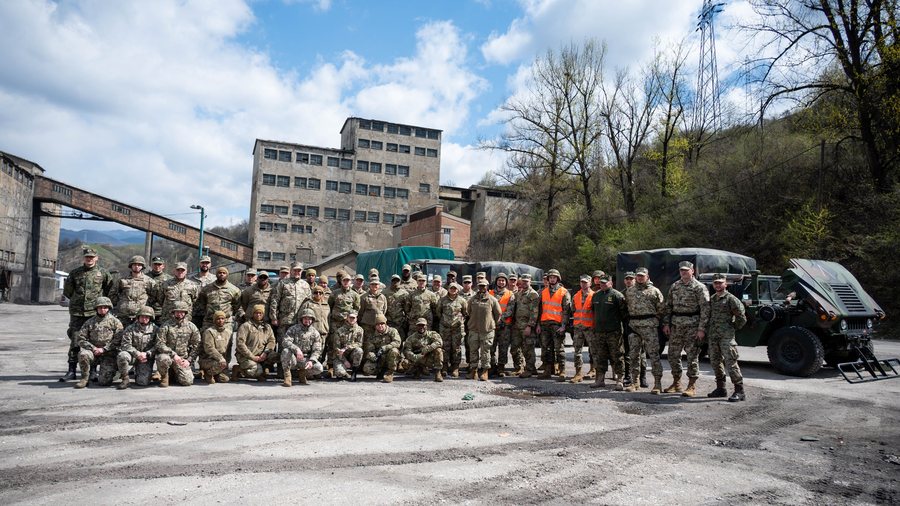 File:MDNG and AFBiH pose for group photo during convoy operation, Kakanj, BiH (8958520).jpg
Photo: Airman 1st Class Sarah Hoover via Source, Public domain
File:MDNG and AFBiH pose for group photo during convoy operation, Kakanj, BiH (8958520).jpg
Photo: Airman 1st Class Sarah Hoover via Source, Public domain
Culture and History
Among the archaeological sites is Obre II, a prehistoric Neolithic settlement at the Gornje polje archaeological site in the village of Obre in the municipality of Kakanj. In Ribnica stands the building known as the “Turkish Court”, the Tower of Hadži Muhamed-beg; it is a historical monument in the municipality of Kakanj. Glavica in Bilješevo is a historic area in the municipality of Kakanj, while the Ivo-Duspera House in Kraljeva Sutjeska has been preserved as a historic building in Kakanj.
In the heart of Kraljeva Sutjeska, at the foot of hills and on the banks of the Trstionica River, lie the remains of the palace of the Bosnian kings. In the 14th and 15th centuries, the palace was an important political and administrative centre of the medieval Bosnian state. Kraljeva Sutjeska is also home to the Franciscan monastery and the Church of Saint John the Baptist, which are national monuments of Bosnia and Herzegovina. The Franciscan monastery’s library preserves a collection of 22 incunabula, meaning books from the first decades after the invention of the printing press.
The Kakanj Museum has a permanent archaeological exhibition entitled “Kakanj’s Past from Prehistory to the End of the Middle Ages”. With accompanying texts, captions, photographs, drawings and reconstructed graves, the archaeological exhibition takes visitors through the investigated sites of Kakanj and its surroundings. The Crkvine archaeological site in Zgošća contains around eleven medieval tombstones; the site has been partially researched. The Zgošćanski sljemenjak is considered one of the region’s most representative stećci. After Ćiro Truhelka explored the Crkvina site in Donja Zgošća, the Zgošćanski sljemenjak was transferred to the garden of the National Museum of Bosnia and Herzegovina in 1913.
Nature and Landscape
The Kacalj viewpoint on Gradina can be reached from Zagrađe via a paved path in around 30 minutes on foot. Alternatively, a more demanding route with a steep ascent leads there via Ivnice and Skenderovići. The viewpoint offers panoramic views of Kakanj and the surrounding villages.
The Crkvenjak Lake–Bistrik wetland frequently serves as a resting place for migratory birds during their seasonal migrations and is important to ornithologists and birdwatchers. More than 212 bird species have been recorded in the area of Crkvenjak Lake and the Bistrik wetland; many of the species found there are rare and legally protected. Tajan Nature Monument is a protected area since 2008 at the intersection of the municipalities of Kakanj, Zavidovići and Vareš.
Ponijeri and Trails
From Kakanj, Ponijeri can be reached via four routes: via Kraljeva Sutjeska, through the valley of the Ribnica River, via the Mala Rijeka route through Jehići, or via the shortest route, around 20 kilometres long, along the Zgošća River through Tršće and Paočina. Ponijeri has a prepared ski slope and a 1,100-metre ski lift; opportunities for sledding and skiing are available there.
In summer, the forest paths in Ponijeri can be used for hiking and cycling; mushrooms, medicinal herbs and forest berries can also be collected there. New visitor signposts have been installed along previously mapped hiking trails, including 20 information boards to improve orientation. The Kakanj–Vukanovići–Bočica–Žitelj–Haljinići route is recommended for mountain biking and motocross tours. It connects Bočica with the protected Bistrik wetland.
Visit and Information
The Kakanj Museum’s visit request form covers individual, group, family, school and other visits. The Kakanj Tourist Information Centre provides information about the destination, sights, accommodation and events. The Kakanj Municipality Tourist Board coordinates visits to local attractions and cultural sites for groups and individual visitors. Cultural and historical tours are offered in Kakanj, covering royal monuments, mosques, monasteries and other cultural attractions.
The Kakanj Municipality Tourist Board also coordinates hikes and excursions around Kakanj, using experienced, certified mountain guides for this purpose. It is located in the Cultural Centre Park, at the heart of Kakanj’s cultural life. Nearby are, among other places, the museum, library, music school, cultural centre and the public institution KSC.
Further destinations: Doboj, Zenica, Dobrinje, Tešanj, Uvorići, Strica, Vranduk, Visoko
To the higher-level travel overview: Zenica-Doboj Canton.

.jpg)