
Kyustendil
Accommodation in Kyustendil
Kyustendil combines thermal waters with a diverse cultural offering: ancient bath complexes, museums, historic buildings and a tourist walking route through the city center give your trip a range of different highlights.
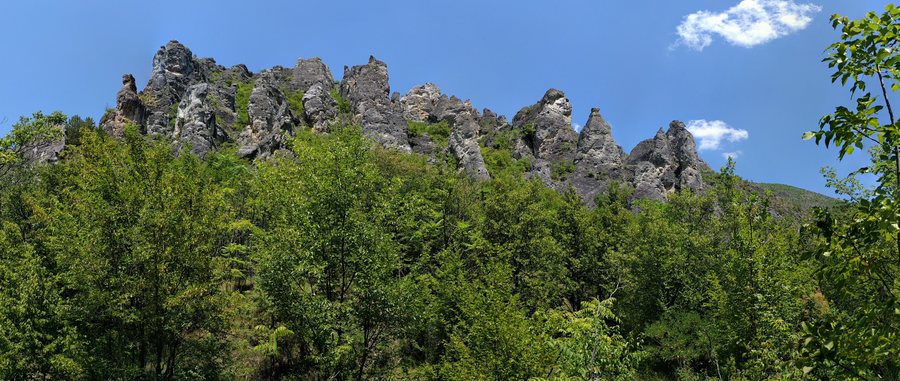 File:Bulgaria Kyustendil Province Kyustendil Municipality Village of Razhdavitsa Shegava Canyon (12).jpg
Photo: Камен Ханджиев via Source, CC BY-SA 4.0
File:Bulgaria Kyustendil Province Kyustendil Municipality Village of Razhdavitsa Shegava Canyon (12).jpg
Photo: Камен Ханджиев via Source, CC BY-SA 4.0
Kyustendil facts at a glance
- The mineral water springs provide thermal water at temperatures of 26 to 76 °C.
- The tourist walking route through the city center is approximately 2 kilometers long and takes about 2 to 3 hours.
- The National Mask Festival “Djamala” takes place every year in February.
- The tourist information center provides city maps and guidebooks and offers information about transport and communication.
Which cultural attractions define Kyustendil?
The Ancient Bath Complex “Asclepion,” also known as the Roman Baths, links a specific historic monument with the city’s thermal history. It dates from the beginning of the 2nd century. The complex covers more than 3,000 square meters; each of the nine excavated rooms has a Roman hypocaust heating system. Those interested in ancient construction and heating technology will find a different way to explore history here than in the museums’ collections.
The Regional Historical Museum “Acad. Yordan Ivanov” preserves more than 100,000 movable cultural artifacts from archaeology, numismatics, ethnography, and both ancient and modern history. Its courtyard houses the “Pautalia” lapidarium, with stone sculptures and architectural elements from the 2nd and 3rd centuries. For an art-focused visit, the “Vladimir Dimitrov – The Master” Art Gallery is a good choice: it owns 1,359 works by the artist, about 100 of which are on display in the permanent exhibition.
Several other places offer different historical themes. The Dimitar Peshev House Museum presents, in a permanent exhibition, the events of March 1943 and the role of Dimitar Peshev and his fellow citizens in saving Bulgarian Jews during the Second World War. At the Ilio Voivoda House Museum, an exhibition in six halls focuses on the region of Kyustendil’s national liberation struggles. The “St. George” Museum Complex includes a preserved church dating from the 11th to 12th centuries, with five layers of frescoes.
Which historic buildings can you discover?
The Prokopieva House is considered the oldest surviving building from the Bulgarian National Revival period in Kyustendil. It was built at the end of the 18th century in the Gradets (Varosha) neighborhood, in the heart of the old town near Velbazhd Square and the Church of the Assumption. The Ahmed Bey Mosque, also called Indzhili—the Christian Mosque—dates from 1575; it was rebuilt and extended in 1734. Today it serves as an exhibition hall for the Regional Historical Museum and is a nationally significant architectural monument. Hisarlaka Fortress is also designated a nationally significant architectural and construction monument.
The Mutual School “Sts. Cyril and Methodius” has been restored and designated a cultural monument. Today it is a venue for exhibitions, concerts and other events. The Dervish Bath was restored in 2005 and is also designated an architectural monument.
What does Kyustendil offer beyond museums and architectural history?
The mineral water is also important for understanding the bathing facilities. Chifte Bath is a public bath dating from 1913 and supplied with hot mineral water. It offers balneotherapy, including therapeutic treatments, kinesiotherapy and massages.
Those interested in traditional crafts can meet regional craft masters in person at the Crafts Center and learn more about knife-making, beekeeping, woodcarving, pottery, shoemaking, traditional costumes, embroidery and stained glass. The “Ezerata” Eco Park offers a different kind of outing: two artificial lakes are connected by a tunnel bridge. A walking path and a decorative stream run around them, and there are also green spaces and places to relax.
The Pautalia go-kart track is located in the southwest of the city, surrounded by a pine forest. It has four track layouts; the longest is 1,050 meters long. In February, the annual National Mask Festival “Djamala” provides another cultural occasion. At “Djamaljiysko Selo,” local craftspeople and artists display handmade masks, Kukeri accessories and traditional products.
How can you compare your choice of location with other places?
For information about other places, you can also visit the pages for [[Lomnitsa]], [[Kopilovtsi]] and [[Ranentsi]]. Other destinations in the catalog include [[Rila]], [[Kocherinovo]], [[Treklyano]] and [[Boboshevo]].
FAQ
How long is the tourist walking route through Kyustendil’s center?
The walking route is approximately 2 kilometers long and takes about 2 to 3 hours.
When does the “Djamala” Mask Festival take place?
The National Mask Festival takes place every year in February.
How large is the permanent exhibition at the “Vladimir Dimitrov – The Master” Art Gallery?
The gallery owns 1,359 works by the artist; about 100 of them are on display in the permanent exhibition.
For the broader travel overview: Kyustendil Province.
More destinations
More places in the same destination:

.jpg)