
Schaben: Fortress, Chapel and Mineral Spring
Accommodation in Schaben
Schaben can be understood through its historic architectural forms and landscape setting. A prominent feature is Šabina Fortress. It is a two-storey, rectangular building. Originally Gothic, it was rebuilt in the Renaissance style under Stolz of Simbsdorf; his coat of arms is located on the façade.
In the 19th century, the fortress served as a school until 1891, then as a poorhouse and later as a warehouse. Its history of use thus complements the architectural classification with several functions that followed one another over time.
St. Anne’s Chapel is a four-sided building with a neighbouring well. In 2001, it was built as a replica of the original chapel, which was demolished in 1960 during road expansion. The dates make the distinction between the lost predecessor building and the replica erected later clearly visible.
House No. 9 also represents the local building culture. The residential house, built using log construction, has a half-timbered gable and a masonry stable; it is a typical example of local vernacular architecture from the late 18th century.
The site of Šabina Fortress is classified in the Czech state archaeological register as a significant archaeological site in category ÚAN I. In your own preparations, you can consider architectural form, history of use, reconstruction and archaeological classification as separate aspects.
When choosing a hotel in Schaben, the travel period, room category and cancellation conditions form a separate basis for comparison. The local points of interest remain independent of this: Šabina Fortress, St. Anne’s Chapel, House No. 9, the Šabinská kyselka spring, the village setting and the mountains represent different thematic focuses that can be weighted separately when planning your trip.
Landscape and Spring
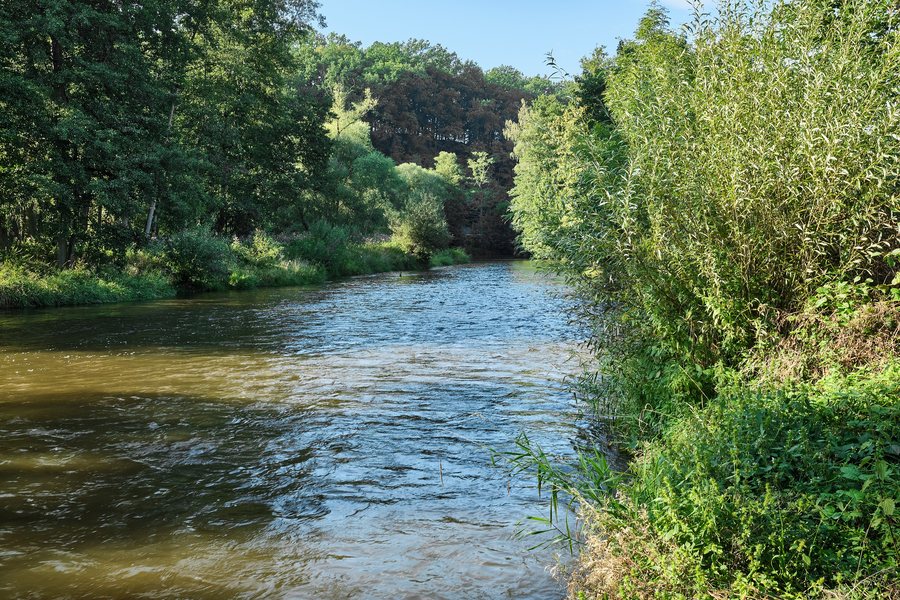
Šabina is located in a bend of the river on the valley floor and extends into strongly dissected slopes. The village setting thus combines a clearly defined valley floor with a more strongly relief-shaped landscape.
The mountains Lobezský vrch, Chrudim, Špičák and Lysina are located around Šabina. The four names give the nearby landscape different individual designations.
The refurbished Šabinská kyselka spring is located south of Šabina. It is a drinkable mineral-water spring with a pleasantly acidic and refreshing taste.
The Šabinská kyselka spring can be reached by bicycle via a path, although with some difficulty. For your planning, cultural sites, mountain names and the connection with the water can be noted separately by topic.
Regional Surroundings
The wider regional surroundings of Šabina include the Center of Europe monument and the Church of St. Michaelis in Bad Brambach. Both destinations therefore belong to a different spatial level from the buildings and landscape features located directly in Šabina.
In Šabina, the fortress, chapel, House No. 9, spring and river landscape stand in contrast to the wider regional surroundings. This makes it possible to clearly distinguish local points of interest from regional destinations when planning.
Other Places
Brösau, Neusattl, Bukwa, Gossengrün, Falkenau An Der Eger, Graslitz, Wintersgrün, Douglasgrün
For the higher-level travel overview: Falkenau An Der Eger District.

.jpg)