
Dłużyna Dolna: Traces of Local History
Accommodation in Dłużyna Dolna
Dłużyna Dolna offers cultural and historical points of interest that cannot be reduced to a single building: in the Albrechtshof manor complex, a brick chimney remains as a remnant of a distillery from the late 19th century; today, it is a ruin. A chapel was built on the site of the former Protestant church using materials from the demolished building. After the church was demolished, epitaphs of former pastors and their children were set into the wall surrounding the cemetery. Those choosing Dłużyna Dolna for its cultural attractions can distinguish between industrial history, church architecture, and commemorative culture.
Dłużyna Dolna: Key Facts
- In the Albrechtshof manor complex, a brick chimney stands as a ruin and remnant of a distillery from the late 19th century.
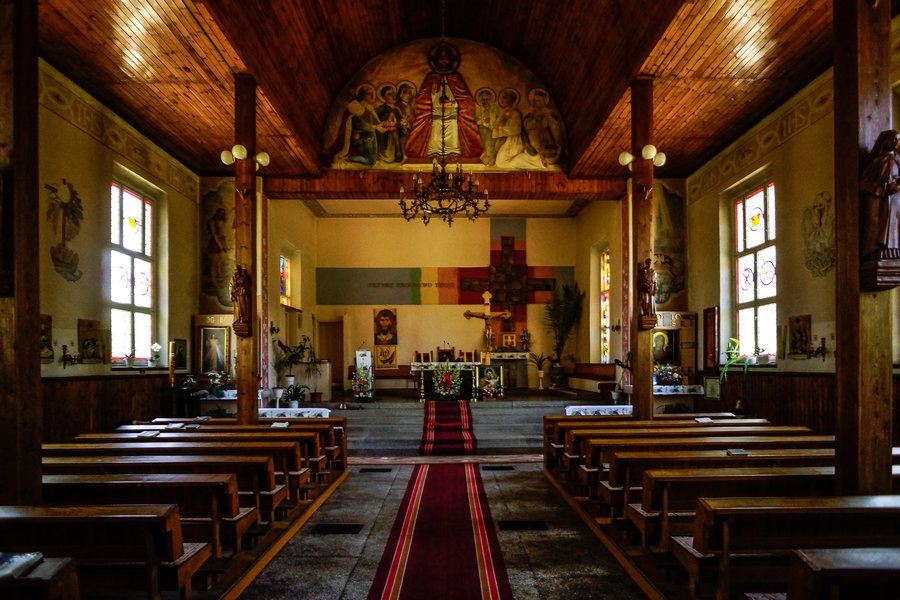
- A chapel was built on the site of the former Protestant church using materials from the demolished church.
- After the church was demolished, epitaphs of former pastors and their children were placed in the wall surrounding the cemetery.
What stories do these traces of cultural heritage tell?
The three clues tell different parts of the town's history. The chimney brings together its material, function, and condition: the brick structure is associated with a distillery from the late 19th century and is now a ruin. Its architectural form is thus linked to a former use. The Albrechtshof manor complex provides the specific context for the chimney.
For the chapel, the relationship between the earlier building and its later use is central. It was built on the site of the former Protestant church using materials from the demolished church. The town's history here includes both the former church building and the chapel that was built in its place. The epitaphs add another perspective: they commemorate former pastors and their children. They were initially set into the wall of the former church; after it was demolished, they were placed in the wall surrounding the cemetery. This gave these memorials a different architectural setting.
How do the historical periods differ?
A specific point in time is the distillery from the late 19th century; the chimney is now a ruin. For the chapel and epitaphs, the context is what happened before and after the church was demolished: materials from the demolished church were used for the chapel, while the epitaphs were moved from the church wall to the cemetery wall. This reveals two distinct historical contexts: the distillery's historical period and the changes at the former church site. This perspective connects the traces without merging them into a single story.
Which cultural themes match your interests?
For your travel plans, the cultural appeal depends on which trace interests you: the chimney links a specific structure to a former economic use, the chapel to the transformation of a church site, and the epitaphs to the commemoration of pastors' families. If you are interested in architectural history, the chimney and chapel take center stage; if you want to follow the history of memorials, the epitaphs offer the clearest starting point. What these places have in common is not a single period or uniform style, but the question of how different architectural remains preserve parts of the town's history.
Discover more destinations: Ruszów, Sławnikowice, Zgorzelec, Bogatynia, Bierna, Pieńsk, Trójca, Jędrzychowice.
FAQ
What was the chimney used for?
The brick chimney in the Albrechtshof manor complex is a remnant of a distillery from the late 19th century and is now a ruin.
Where was the chapel built?
It was built on the site of the former Protestant church using materials from the demolished church.
Where were the epitaphs moved after the church was demolished?
The epitaphs of former pastors and their children were set into the wall surrounding the cemetery.
Go to the main travel overview: Zgorzelecki.

