
Discover Sławnikowice
Accommodation in Sławnikowice
Sławnikowice brings together several distinct themes from the town’s history: a church with a long building history, a mausoleum and a penance cross, as well as a palace and a pilgrimage route that passes through the town. These historical details can help you choose places to visit according to your interests and focus your stay on culture and history.
Sławnikowice at a glance
- The Church of the Sacred Heart of Jesus (Najświętszego Serca Pana Jezusa) was first mentioned in a document in 1346.
- North of the church stands a mausoleum with cross vaults dating from 1733.
- The two-storey palace has a rectangular floor plan and a columned portico on its front façade.
- The Lower Silesian Way of St. James (Dolnośląska Droga św. Jakuba) passes through Sławnikowice and continues to Santiago de Compostela.
What historical traces can you find at the church?
The Church of the Sacred Heart of Jesus (Najświętszego Serca Pana Jezusa) offers several points of reference from different periods. It was first mentioned in a document in 1346. The building was later extensively altered in 1776 and 1838, and its interior was also modernised. The church today is therefore part of a history that cannot be reduced to a single year of construction.
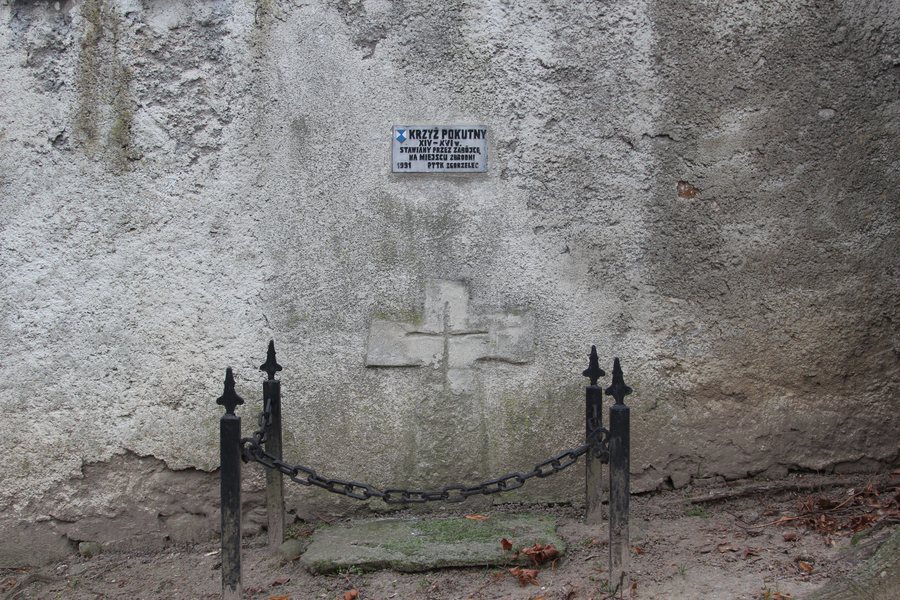
North of the church is the mausoleum of its patrons at the time, the von Fromberg family. It was built in 1733 and has cross vaults. The town’s history here is not only about the church building itself, but also about the burial history associated with it. A penance cross also stands next to the church.
The cemetery by the church also has several historical layers: it dates from the turn of the 18th and 19th centuries, was Protestant, and is now Roman Catholic. The church, mausoleum, cross and cemetery can therefore be read as distinct points of reference, reflecting the building’s history, its former patrons and changes in religious affiliation.
What is known about the palace and its grounds?
The palace in Sławnikowice is two storeys high and rectangular in plan. Its front façade features a columned portico.
The grounds around the palace also have a historical feature. They are crossed by drainage ditches and were landscaped for recreation in the second half of the 19th century. Together with the palace architecture, this offers a view of two different aspects of the town: the building itself and the history of its surrounding grounds.
How can the pilgrimage route be understood in context?
The Lower Silesian Way of St. James (Dolnośląska Droga św. Jakuba) passes through Sławnikowice and continues to Santiago de Compostela. This makes the town part of a named pilgrimage route leading to that destination. For your travel plans, you can consider this connection as a separate focus alongside the historic buildings: the route represents a connection beyond the local area, while the church, mausoleum and palace tell the story of the town itself.
Which notable figure is part of the town’s history?
Ehrenfried Walther von Tschirnhaus was born in Sławnikowice in 1651 and lived until 1708. He is described as a scholar and philosopher. His birthplace adds a biographical perspective on Sławnikowice to its architectural and religious points of reference. If you are interested in the histories of individual figures, this local connection is another aspect to consider when exploring the town.
Discover more destinations: Ruszów, Jędrzychowice, Dłużyna Dolna, Bogatynia, Trójca, Pieńsk, Zgorzelec, Bierna.
FAQ
What is Sławnikowice’s historical connection to the Way of St. James?
The Lower Silesian Way of St. James (Dolnośląska Droga św. Jakuba) passes through Sławnikowice and continues to Santiago de Compostela.
What is located north of the church?
A mausoleum with cross vaults dating from 1733 stands there. It served as the burial place of the church’s patrons at the time, the von Fromberg family.
What are the features of the palace in Sławnikowice?
The palace is two storeys high, has a rectangular floor plan and a columned portico on its front façade.
For the wider travel overview: Zgorzelecki.

