
Pieńsk: Architecture and Glassmaking History
Accommodation in Pieńsk
Pieńsk combines an industrial character with a distinctive settlement structure.
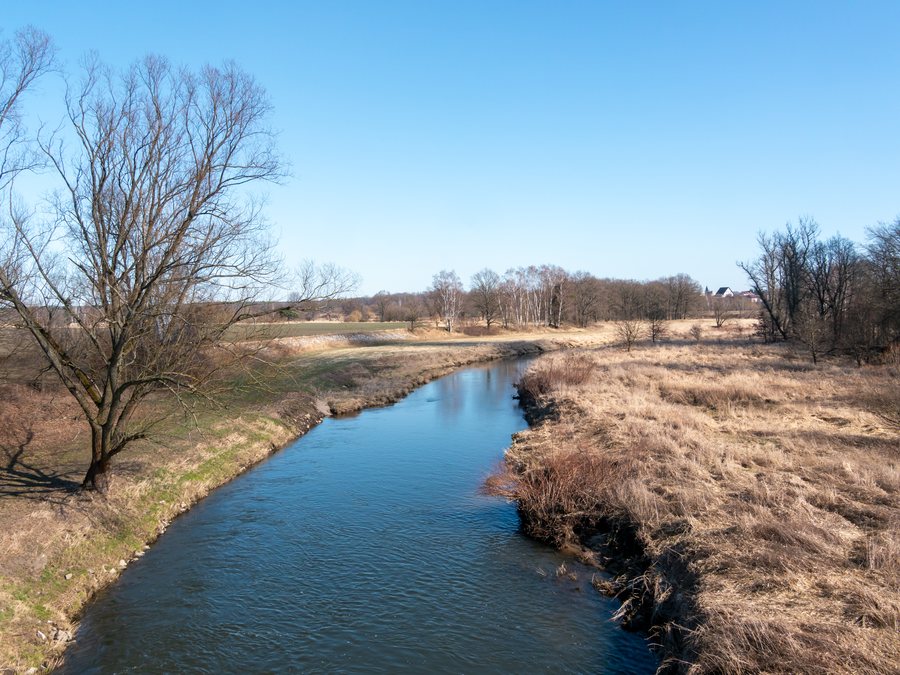
Key facts about Pieńsk as a place to stay
- Pieńsk developed from a rural settlement and has a hybrid urban layout.
- The parish Church of Saint Francis of Assisi is an example of Neo-Romanesque architecture and is located in the town centre.
- The Lucyna glassworks complex, Nysa Plant, is no longer in operation. It comprises more than 30 buildings, almost all of which are listed in the register of monuments.
- A green cycling route starts in Pieńsk and is about 19 km long.
What shapes Pieńsk’s urban character?
Pieńsk is an industrial town whose development began as a rural settlement. Its hybrid layout combines a typical rural structure along Ulica Zgorzelecka with elements of a factory settlement. This means that two different settlement forms coexist in Pieńsk: a linear structure along a road and elements shaped by the factory site. This mix offers a concrete way to consider the town not only through individual buildings, but also through its urban form.
The urban-style buildings are concentrated in the centre, mainly along K. Świerczewskiego, Dworcowa and Kościuszki streets. The Church of Saint Francis of Assisi is also in the centre, with its façade facing K. Świerczewskiego Street. These streets and the church help orient visitors to the features of the townscape described here, without implying a specific route.
What architecture tells the story of Pieńsk?
The parish Church of Saint Francis of Assisi displays Neo-Romanesque architecture. For travellers interested in culture, it is an example of this architectural style in Pieńsk’s townscape. The former Lucyna glassworks complex, Nysa Plant, has a different architectural character: its surviving buildings are distinguished by characteristic Neo-Gothic forms and façades of red and yellow facing bricks. Most of the buildings were constructed between 1900 and 1925.
The complex comprises more than 30 buildings, almost all of which are protected by being listed in the register of monuments. Its status as a glassworks that is no longer operating and its surviving architecture are two distinct aspects: Lucyna is no longer producing glass, but its ensemble shapes the townscape. Its Neo-Gothic forms and façades of bricks in different colours give the complex a different appearance from the Neo-Romanesque church.
What role does glassmaking play?
The ŁUŻYCE glass factory in Pieńsk was founded in 1872. It was intended to produce optical glass, pressed glass and bottle glass.
What should you consider if you are interested in cycling and culture?
The green cycling route starts in Pieńsk and is about 19 km long. You can take this approximate distance into account when planning your day; on its own, it says nothing about the route’s duration or difficulty. A foot and cycle bridge over the Lusatian Neisse connects Pieńsk with the neighbouring municipality of Neisseaue and its twin town of Rothenburg. The bridge is a separate landmark for pedestrians and cyclists. However, the information provided does not establish a connection between the bridge and the green cycling route.
Another cultural feature is “Szczodry Wieczór”, an annual cross-border event held at the Dom Kultury. Polish, German and Czech participants exchange Christmas traditions and celebrate together. Alongside its architectural heritage, Pieńsk thus also offers an event focused on cultural exchange among these three groups.
The topics described here are quite different: you can plan your stay around your interest in urban structure and architectural styles, industrial history or cycling.
To compare more local pages, you can also visit Zgorzelec, Bogatynia, Jędrzychowice, Trójca, Dłużyna Dolna, Ruszów, Bierna and Sławnikowice.
FAQ
How long is the green cycling route from Pieńsk?
The route starts in Pieńsk and is about 19 km long.
What architectural styles can be found in Pieńsk?
The parish Church of Saint Francis of Assisi is Neo-Romanesque. The surviving buildings of the Lucyna glassworks complex, Nysa Plant, feature characteristic Neo-Gothic forms.
Where does the foot and cycle bridge over the Lusatian Neisse lead?
It connects Pieńsk with the neighbouring municipality of Neisseaue and its twin town of Rothenburg.
For the broader travel overview: Zgorzelecki.

.jpg)