
Suzana Monastery: Monastic Culture and Hiking Trails
Accommodation in Suzana Monastery
Suzana Monastery is a historic monument with a building and artistic history that unfolds across several periods and through different materials. Around 1740, the nun Suzana built the monastery’s first church from wooden beams and dedicated it to Saint Hierarch Nicholas. The present church, by contrast, is a brick-built structure dating from 1882.
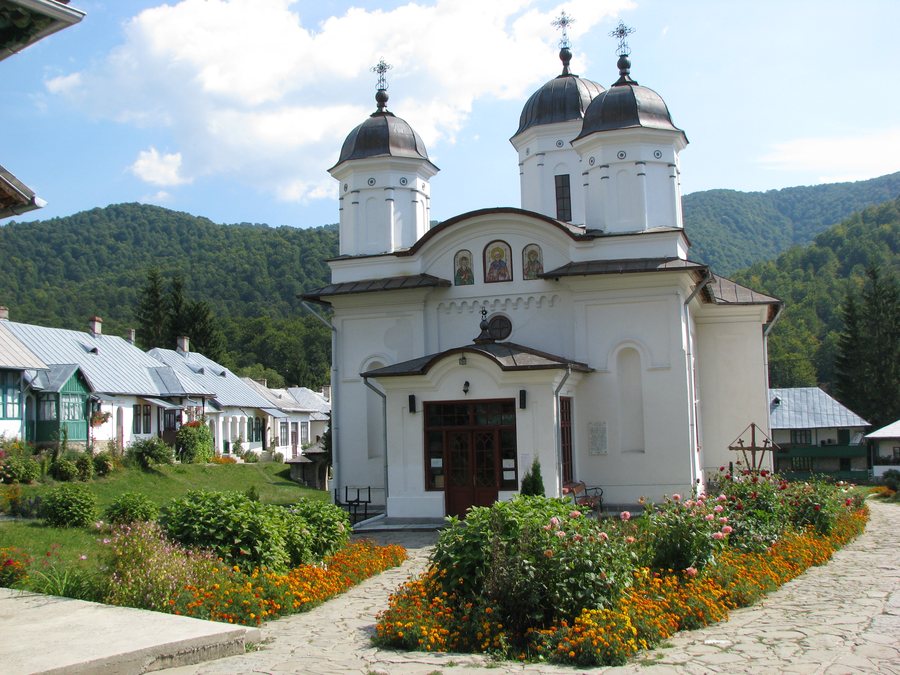 File:Manastirea Suzana - comuna Maneciu Ungureni.JPG
Photo: Andreescu N. Stefan via Wikimedia Commons, CC BY-SA 3.0 ro
File:Manastirea Suzana - comuna Maneciu Ungureni.JPG
Photo: Andreescu N. Stefan via Wikimedia Commons, CC BY-SA 3.0 ro
Culture
Suzana Monastery also includes the chapel built in 1911 and dedicated to Acoperământul Maicii Domnului. Thus, alongside the present church building, the grounds also focus on a later sacred structure and the monastery’s earlier foundation history. The original painting at Suzana Monastery dates from 1882 and was executed by Petre Nicolau.
The chapel fresco was executed by the painter Eremia Profeta. The religious art collection includes wooden icons as well as glass icons from the regions of Nicula, Făgăraș, and Olt. The named painters, construction years, and icon regions provide several specific points of reference for appreciation: they bring together architecture, painting, and regional art forms without allowing the individual elements to merge into an undifferentiated impression.
Landscape
Suzana Monastery lies in the valley of the Teleajen River, on a ridge at the foot of Mount Bobu. This location brings together four distinct reference points in its spatial description: the valley, the river, the ridge, and the foot of the mountain. In front of Suzana Monastery, the Stancea and Iepurasul streams join to form the Teleajen. The watercourse and its two tributaries thus supplement the monastery’s topographical setting with a clearly identified three-part body of water.
Hiking
The Măneciu–Muntele Clăbucetul Măneciului–Suzana Monastery hiking trail is marked with a blue dot and takes five to six hours. The route names both Măneciu as its starting point and Mount Muntele Clăbucetul Măneciului, with the monastery as its destination. The Suzana Monastery–Stanca–Muntele Bobu Mare–Vârful Bobu Mare hiking trail bears a red cross marking and takes two to three hours. This route includes Stanca, Muntele Bobu Mare, and the summit of Vârful Bobu Mare. The marking color, waypoints, and time frames clearly distinguish the two routes.
For the journey, the connection can be considered in sections: there is a rail connection between Ploieşti and Măneciu; from Măneciu to Suzana, there is a bus connection. Thus, this part of the journey involves two different means of transport and the transition between the named locations.
When comparing hotels in Suzana Monastery, travel dates, room category, and cancellation conditions are separate points of comparison. Particularly when planning on a budget, these details can be considered in relation to the intended period and the desired room category; the cancellation conditions add another contractual detail to the comparison. The accommodation decision therefore remains a separate practical consideration alongside culture, landscape, and hiking routes, and can be made independently of the information about the destination.
Other Places
At the same higher-level destination, you will also find Sinaia, Cheia, Măneciu-Ungureni, Băicoi, Aluniş, Valea Doftanei, Talea and Chițorani.
For the higher-level travel overview: Prahova.

