
Španie Pole – Church, Handicrafts and Karst Landscape
Accommodation in Španie Pole
Španie Pole brings together local history, traditional handicrafts, and the landscape of the Drienčanský Karst. Between an Evangelical church, traces of traditional work, and karst formations, a diverse picture of this Slovak village emerges.
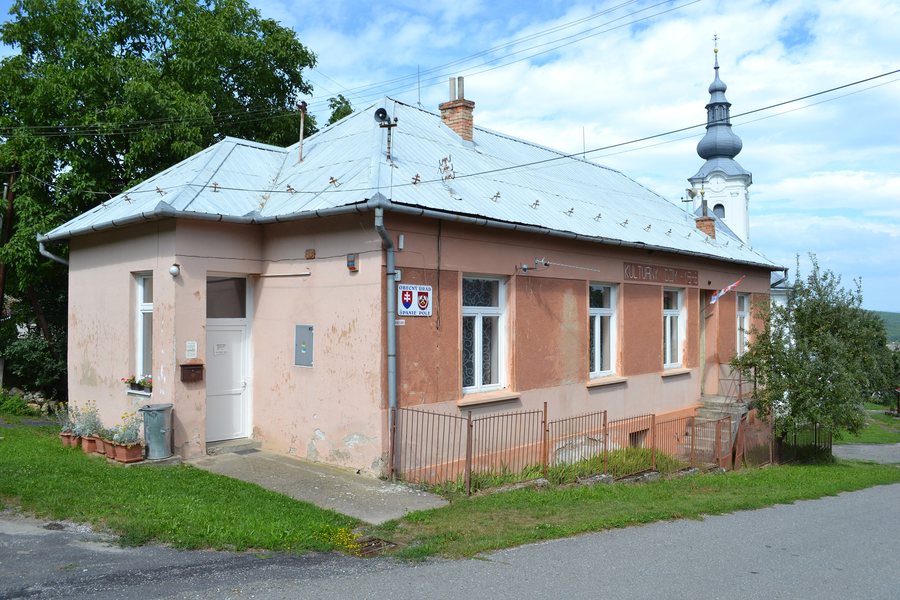
Culture
The Evangelical church in Španie Pole was built from 1805 to 1810 and restored in 1931. It has a hall space with a segmental apse and an attached tower. Dating from the construction period, it retains a wooden gallery supported by carved columns. The local history of handicrafts is also diverse: traditional crafts in Španie Pole included lime burning. In the first half of the 20th century, the village was known for processing and selling beeswax. Spindles and brdá were produced at home and sold by itinerant traders in other regions. Brdárstvo was a seasonal winter sideline in Španie Pole, often associated with processing beeswax and making and selling other wooden implements.
Nature
The Španopoľská jaskyňa cave offers insights into both the geological history and the archaeology of the area. Opal mineralization has been identified in the stalactites of its upper level. Archaeological finds were discovered there in 1988, including sherds from the Kyjatice culture. The Drienčanský Karst associated with Španie Pole contains 190 sinkholes and 42 caves. The karst landscape also includes blind valleys, marginal karst depressions, and karst lakes.
Landscape
The Drienčanský Karst is a karst area in the Revúcka vrchovina, west of the Slovak Karst and south of the Muránska planina. It stretches between Drienčany, Hrušovo, Striežovce, Španie Pole, Hostišovce, and Budikovany. The mountains Molnár, Paláska, Železník, and Čahovica lie in the vicinity of Španie Pole.
Trails
The Drienčanský Karst educational trail is 7,540 metres long and runs through easy terrain. At its stations, visitors can learn about caves, karst lakes, karren, and karst depressions or sinkholes. Another route through the karst area is the 15-kilometre Budikovany–Chvalová hiking trail. It leads through the Drienčanský Karst to Španie Pole. A preserved lime kiln stands along this hiking trail near the section between Španie Pole and Chvalová. For a cycling route, 70 percent of the surface is asphalt and 30 percent is forest track.
On the respective offer page, it is worth checking the exact location, type of accommodation, and permitted occupancy. Included services, individual price components, and the conditions for booking and cancellation can also be compared. This information helps assess different options transparently, without inferring specific facilities, accessibility, or suitability from the village profile.
For further village selection, Lipovec, Drienčany, Kraskovo, Drňa, Dulovo, Padarovce, Jestice, and Blhovce are also available.
For the higher-level travel overview: Okres Rimavská Sobota.

