
Zborov: Makovica Castle Ruins and Historic Churches
Accommodation in Zborov
Above Zborov stands Zborov Castle, also known as Makovica, a castle ruin. The complex was built in the 14th century to protect the trade route to Poland.
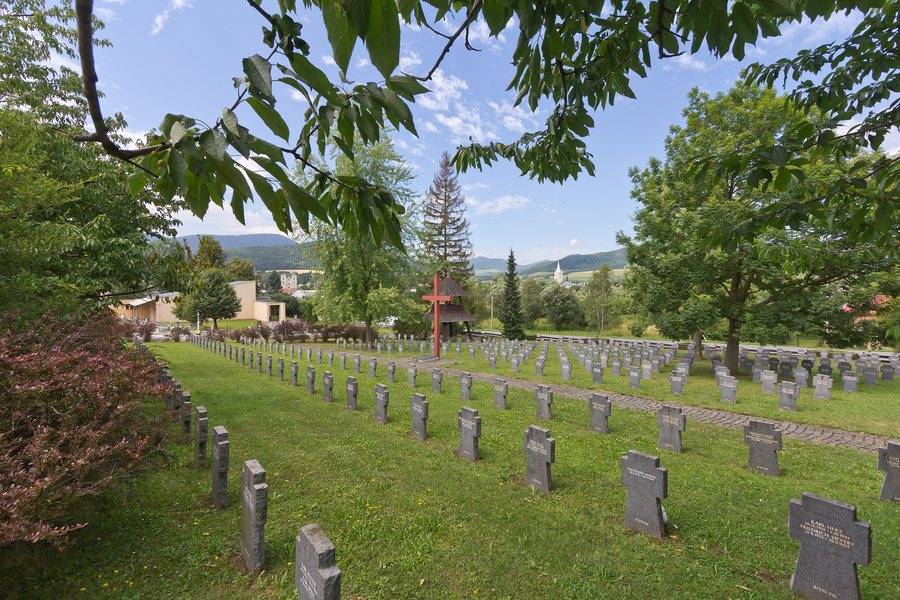 File:Military cemetery 1939-45, Zborov, Slovakia-5551.jpg
Photo: Raimond Spekking via Wikimedia Commons, CC BY-SA 3.0
File:Military cemetery 1939-45, Zborov, Slovakia-5551.jpg
Photo: Raimond Spekking via Wikimedia Commons, CC BY-SA 3.0
Other destinations in the same destination area include Bartošovce, Smilno, Bartfeld, Stebnícka Huta, Regetovka, Bardejovské Kúpele, Fričkovce and Malcov.
Culture and History
The permanent exhibition “History of the Makovica Estate” is housed in the Šerédyho Manor. It opened in 2023 and is dated August 29, 2024. Using exhibits as well as extensive visual and textual material, the exhibition presents the history, ethnography and natural conditions of the Makovica estate.
St Sophia Church is a 17th-century sacred building and was originally part of the extensive Rákoci Manor. It was destroyed during the First World War; after reconstruction work, it was ceremonially reopened in March 2022. It was built in 1640 in a pure Renaissance style with two towers. During the 2026 summer tourist season, the church is open from May 1 to September 30 on Thursdays and Sundays from 3:00 to 6:00 p.m.
St Margaret Church dates back to the first half of the 14th century. Its design is associated with the spread of Strasbourg Gothic through the area around 1330. The south chapel has fully preserved stucco ornaments from 1663 and is considered one of the most valuable monuments in present-day Zborov.
Next to St Margaret Church stands St Anne's Chapel, an octagonal chapel from the early 18th century with a lantern dome. Inside is a rare Baroque altar with statues of John the Baptist and Paul the Hermit. At the upper end of Zborov, the Chapel of the Crucified Savior was built in 1757 on the road to present-day Chmeľová.
The Jewish Cemetery in Zborov was established at the beginning of the 18th century and used until the middle of the 20th century. Zborov's last rabbi, Ignác Ansel, is buried there. The German Military Cemetery is divided into four burial fields; a total of 1,137 German soldiers are buried there.
The Czechoslovak Army Memorial was unveiled on April 29, 1928, on the occasion of the tenth anniversary of the founding of the Czechoslovak Republic. It stands in a newly established triangular park next to the Alley of 100 Lime Trees. On the northern side of Zborov, the Chapel of the Holy Trinity was rebuilt in 1921 and consecrated on May 24, 1922.
The chapel in the Roman Catholic cemetery is considered the oldest building in the built-up area and was constructed between the 13th and 15th centuries. On the western side of Zborov is the Batek Family Chapel, which also served the Malirsz family and bears a donor inscription dated 1875. The Funeral Chapel in Zborov is an important national cultural monument; its roof was restored in 2024.
Trails and Landscape
The fastest walking route to Zborov Castle begins in the Zborov-podhradie district and follows the yellow trail markers. It takes about 30 minutes and includes a steep ascent. Zborov Castle Hill has been protected since 1926 and was designated a state nature reserve in 1950. The protection focuses particularly on several centuries-old pedunculate oaks along the access road to the castle.
The Makovická cycle route passes through Zborov and is 52.5 km long. The Bardejov Spa–Zborov Castle Hill educational trail is a five-hour circular route via Zborov-podhradie and Zborov Castle. It is 8 km long and has six information boards.
Music and Events
The municipality of Zborov held the cultural music event “Zborovské hudobné leto” for the fifth time in 2026. It takes place from mid-June to mid-September.
For the higher-level travel overview: Bardejov.

