
Brela: A seaside resort on the Makarska Riviera
Brela lies on the Makarska Riviera in Dalmatia, between the pebbled coast and the Biokovo Mountains. Pine trees, small coves and a long promenade define this seaside resort, while the mountains rise steeply behind the houses. Punta Rata and Podrače are close to each other, but differ in size, location and facilities.
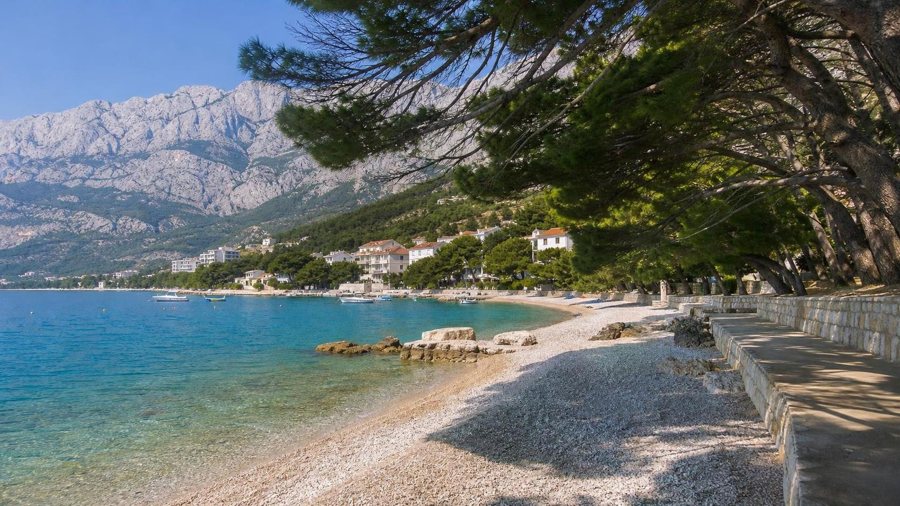 KI-generierte Illustration der Küste von Brela mit Kiesstrand, Pinien und Bergen.
Brela at a glance
- Brela is on the Makarska Riviera on the Dalmatian Adriatic coast.
- Pebble beaches, pine trees, coves and the path along the water define the coastline.
- Many beach access routes involve steps, so where you stay affects the walk back.
- Makarska is a nearby larger coastal town; Split and Dubrovnik are separate city destinations.
- Public parking near the Church of Our Lady of Mount Carmel and toward Punta Rata is close to the beach access.
- Punta Rata and Podrače are close to one another, but occupy coastal stretches of different sizes.
Brela combines swimming and walks with views of a dramatic mountain backdrop. Pebble beaches, steps and patches of shade shape the way down to the water. Beaches and roads are busier during peak season. Punta Rata sits on a wooded, protected headland; Podrače is a smaller pebble cove nearby.
Beaches, coves and promenade
Aleppo pines provide natural shade at Punta Rata. Showers, toilets and a café add to the beach facilities, and there is a public parking area nearby. The smaller cove of Podrače also has showers, toilets and a café. The two beaches differ in location and width, even though they are close to each other.
The promenade connects coastal stretches and passes pebble beaches and coves. The path is not level throughout; steps and changing surfaces affect access. For strollers and people with limited mobility, the precise beach location and the route from the accommodation are therefore important. A coastal walk is usually more pleasant in the morning or later in the afternoon than in the hottest part of the day.
Brela on the Makarska Riviera
Dalmatia stretches along the Adriatic coast and includes islands, coastal towns and historic cities. Makarska is on the same Riviera and has a harbor and town center. Trogir lies farther north along the coast; Split is a larger port city with a historic center. Dubrovnik lies far to the south and is a destination in its own right. The Dalmatian coastal route is part of the Croatian Adriatic coast.
For a shorter outing, Makarska and the neighboring coastal towns are closer than Split or Dubrovnik. The coastal road can take longer to drive during peak season because of traffic. The Biokovo Mountains rise directly behind the Riviera; their elevation and access routes differ from the seaside paths.
Accommodation and practical planning
Accommodation close to the beach may still be on a hillside. Stairs, the route with your luggage, parking and the distance to the water vary depending on the location. A sea view does not necessarily mean step-free access to the coast. Accommodation in Croatia includes seaside locations, hillside properties and city stays; in Brela, changes in elevation particularly shape the daily walk between your room and the shore.
Summer brings warm days for swimming and larger crowds. Spring and autumn are often well suited to walks and coastal excursions; beach and restaurant opening schedules may vary by season. Tap water in Brela is safe to drink. For longer days outdoors, bring sun protection and plenty of drinking water, and have a light layer for the evening.
Public parking is available near the Church of Our Lady of Mount Carmel and toward Punta Rata. Spaces are limited, especially in July and August. The access route leaves the coastal road, Breljanska cesta, via Put Solina. Visitors walking from town can reach the coves by the paths and steps leading to each stretch of coast.
Choosing beaches, the promenade and mountain views
The pebble coastline offers different experiences from one stretch to another: the ground, shade, steps and access to the water vary along the town. Dalmatia has other coastal landscapes; Makarska is close to Brela. Split and Dubrovnik are much farther away and are best treated as separate city days.
Cavtat lies south of Dubrovnik, while Brač is an island off the Dalmatian coast. Hvar is also an island and requires its own ferry and overnight plans, rather than a short beach trip from Brela.
The coastal road, Breljanska cesta, leads to the turnoff for Put Solina and the parking areas near Punta Rata. The route to Brela follows the Riviera, with parking available near the beach access. For a day at the beach, sun protection, drinking water and a suitable route back are important. Fees for public parking are among the costs incurred locally. Pebble coves and pine trees define the coastal landscape; in hot weather, breaks and water are part of planning a safe day.
Frequently asked questions about Brela
What is Brela known for?
Brela combines pebble beaches, pine trees, small coves, a coastal promenade and views of the Biokovo Mountains.
What is the difference between Punta Rata and Podrače?
Punta Rata is larger and sits on a wooded headland. Podrače is a smaller pebble cove near the headland. Both beaches have showers, toilets and a café.
How far is Makarska from Brela?
Both towns are on the Makarska Riviera and are connected by the coastal road. Traffic and the search for parking can increase journey times during peak season.
How much does parking near Punta Rata cost?
Local service information lists a rate of €4 per hour for public parking near the Church of Our Lady of Mount Carmel and toward Punta Rata. This rate was retrieved on October 24, 2026; spaces are limited, especially in July and August.
