
Samarkand: Registan, the Timurids and Silk Road history
Samarkand, one of the oldest cities in Central Asia, is renowned for its history, sights and legends. It is a city of mysteries. To this day, its exact age has not been established. There are several theories. According to one, the city is 2,750 years old (according to the sacred Zoroastrian book, the “Avesta”); a second puts its age at 3,700 years (the view of the Arab historian Abu an-Nesefi); and a third at 4,700 years (according to a number of Arab historians). In any case, there is little point in arguing about Samarkand’s age. Uzbeks themselves say that Samarkand is as old as the Earth.
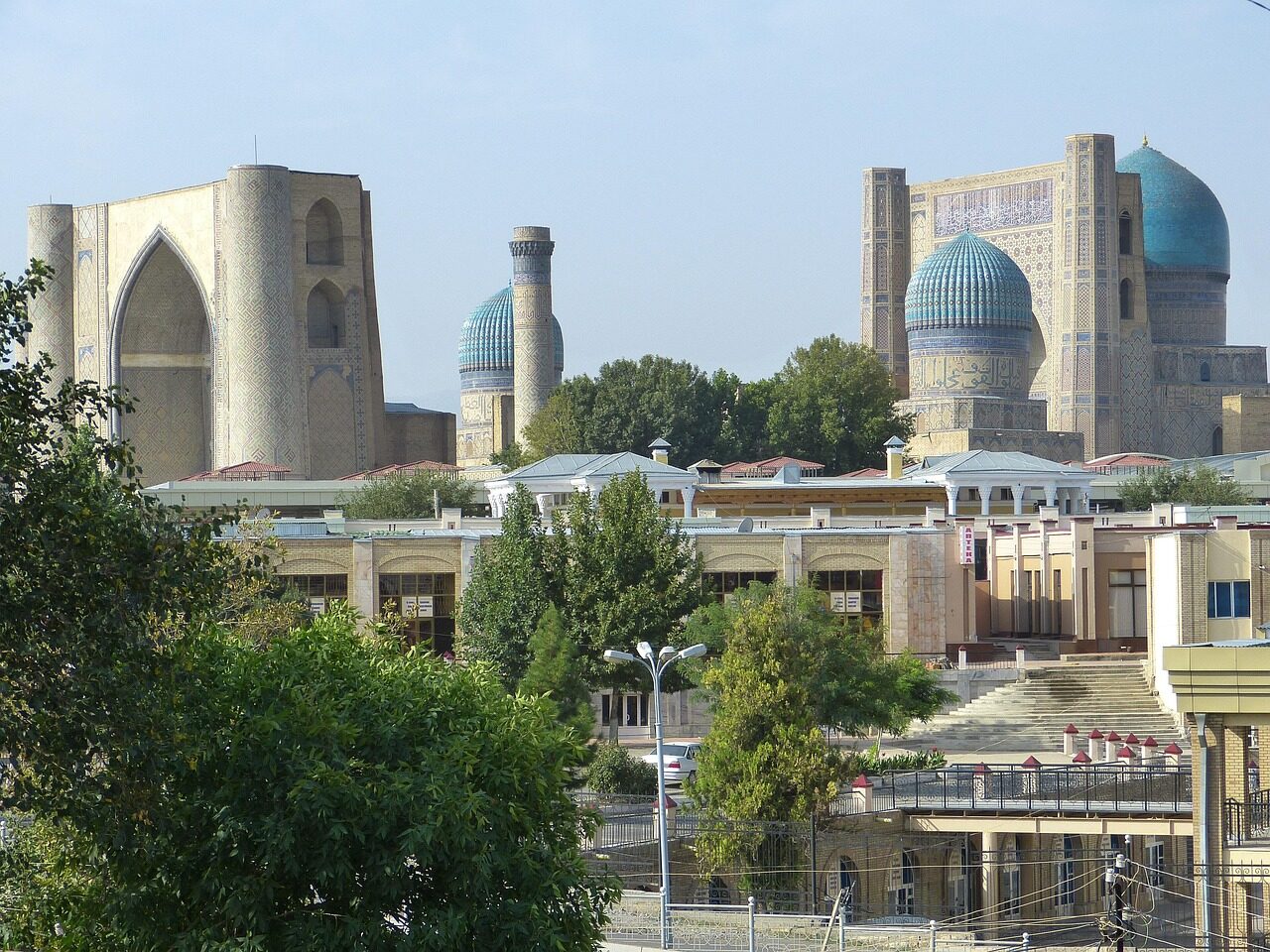 Verzierte Kuppeln und Fassaden historischer Gebäude in Samarkand.
Photo: LoggaWiggler from Pixabay
Verzierte Kuppeln und Fassaden historischer Gebäude in Samarkand.
Photo: LoggaWiggler from Pixabay
Legends follow you everywhere in Samarkand. Take the tomb of Timur, the Mongol conqueror who struck fear into half the world. According to legend, anyone who dares to open the tomb of the bloodthirsty ruler will release his spirit, plunging the world into darkness. Since archaeologists are, for the most part, not superstitious, they did not believe the “tales of the East.” The tomb was opened on 22 June 1941. On that very day, Hitler’s Germany attacked the USSR.
Besides its mysteries, the city has a great many monuments: Bibi-Khanym Mosque, one of the oldest mosques in the Muslim world; the ruins of the observatory of the famous Eastern thinker and astronomer Mirzo Ulugbek; Samarkand’s beautiful gardens; and numerous museums. Few cities in the Arab world have such a rich collection of architectural monuments of Muslim culture.
The museums deserve a special mention. Samarkand is itself a museum, with more than 20 collections of ancient artefacts and manuscripts. Among the city’s most interesting museums are the Museum of Ancient History, the Orif Gulkhani Museum (dedicated to an Uzbek poet and thinker), the Museum of Winemaking and, of course, the Museum of the History and Culture of Uzbekistan. The Museum of Culture has many unique exhibits, particularly well known among them are Timur’s coffin and a collection of Qurans dating from the 11th century.
The area around Samarkand is also ideal for excursions. A horseback ride to legendary places on the outskirts—such as Pereletewschaja Gora, the Plateau of Stone Giants and the Pyramids near Samarkand—can be especially enjoyable.
In any case, if you are genuinely interested in the East, you must visit Samarkand.
Quick facts: Samarkand
- Samarkand is one of Central Asia’s historically significant cities and is located in modern-day Uzbekistan.
- Registan, Gur-e Amir, Bibi-Khanym, Shah-i-Zinda and the Ulugh Beg Observatory each offer a different perspective.
- Monuments, museums and market areas are not all located along one short walking route.
- Heat, sun, dry air and time of day affect sightseeing and when to take water breaks.
- Religious sites have their own rules regarding clothing, conduct, photography and access.
- Entry requirements, transport, opening hours, admission and current travel conditions should be checked before your visit.
Samarkand and the Silk Road
Samarkand is one of Uzbekistan’s best-known cities and is synonymous with the history of the Silk Road. Registan, the Bibi-Khanym Mosque, Shah-i-Zinda and the Gur-e-Amir complex define a visit and show why the city played such an important role in architecture, trade and scholarship. Rather than treating Samarkand as just a photo stop, travellers should allow time to explore individual architectural ensembles, museums and bazaars, and to plan onward travel to Bukhara or Tashkent.
Planning routes around Registan, the Timurids and the city
For a first day, combine Registan, Gur-e Amir and another historic highlight, allowing plenty of time for getting around and taking breaks. Bibi-Khanym, Shah-i-Zinda and the observatory each have their own character. The heat and sun make an early start, breaks in the shade and flexible indoor options advisable.
Samarkand can be included in a longer cultural itinerary with Central Asia, Uzbekistan and Bukhara. Culture and history, museums and exhibitions, getting there and getting around and travel preparation can help with planning the stages of your trip. Check the latest information on entry requirements and documents before travelling.
The UNESCO documentation on Samarkand provides additional cultural and historical context. Confirm access, opening hours, admission, religious rules, weather and local transport conditions for your specific travel dates; legends should be treated as tradition, not established historical fact.
Frequently asked questions about Samarkand
Which places should I visit on my first trip?
Registan, Gur-e Amir, Bibi-Khanym, Shah-i-Zinda and the Ulugh Beg Observatory offer different historical and architectural highlights.
How many days do I need in Samarkand?
Two full days allow for a more relaxed itinerary, with time for walking, museums and breaks. If you have only one day, limit the number of monuments you visit.
What should I keep in mind at religious buildings?
Respect local expectations regarding clothing, conduct, photography rules, opening hours and possible prayer times, and follow them while on site.
Can I combine Samarkand with Bukhara?
Yes, as part of a longer trip through Uzbekistan. Plan transport, luggage, the length of your stay and accommodation as separate stages.
