
Kostroma on the Volga: The Golden Ring and the City’s History
Kostroma, about 370 kilometres northeast of Moscow, lies on the Volga and is the capital of the region of the same name (Kostroma Oblast). It has a population of approximately 300,000. The city has a rich history: Kostroma is believed to have been founded in 1152 by Prince Yuri Dolgoruky, just five years after Moscow.
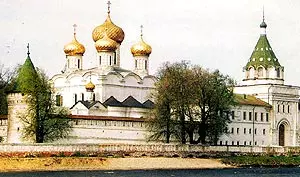 Luftaufnahme des Ipatjewskij-Klosters mit hellen Gebäuden und roten Dächern.
Photo: Kostroma + Titelbild Kostroma Schönheit vor dem Spiegel, Text: Peter Struben
Luftaufnahme des Ipatjewskij-Klosters mit hellen Gebäuden und roten Dächern.
Photo: Kostroma + Titelbild Kostroma Schönheit vor dem Spiegel, Text: Peter Struben
Among the cities of the Golden Ring—a chain of ancient Russian towns stretching from Moscow to the Volga, including Vladimir, Novgorod, Suzdal, Kostroma, Yaroslavl, Rostov Veliky and Sergiyev Posad—the old Hanseatic city of Kostroma holds a special place. The Hanseatic cog is the city’s emblem, and Kostroma is known as the “cradle of the Romanov dynasty.” On 4 March 1613, the history of the new ruling dynasty began here, at the Ipatiev Monastery, when Mikhail Romanov was elevated to the throne. The monastery is famous for its Trinity Cathedral and its beautiful frescoes, painted by the workshop of Yuri Nikitin.
Kostroma has a distinctive character. Under Catherine the Great, the city was given an “ideal” layout: all the streets fan out from the main square, Susanin Square. Many buildings in the city centre are neoclassical. Two striking late neoclassical buildings stand on Susanin Square: the fire-watch tower and the guardhouse. Also well worth seeing is Russia’s largest historic shopping complex, the Flour Rows and the Red Rows. The Central Market is housed in the Flour Rows, with numerous shops in the surrounding gallery. The Church of the Saviour in the Red Rows stands within the Red Rows.
From the mid-18th century, Kostroma became Russia’s principal centre for flax processing, earning it the name “linen capital” of Russia. Flax-processing industries emerged in the second half of the 19th century, and the city gained a reputation as a textile town. Today, Kostroma is home to Europe’s largest linen mill, whose products—including tablecloths, bedspreads, rugs, runners and decorative fabrics—are in demand both in Russia and abroad.
Today, energy production, timber processing and machine-building—including the production of construction equipment, woodworking machinery and large barges—are playing an increasingly important role in Kostroma’s economy. The gemstone industry is also an important economic sector. The jewellery-making village of Krasnoye-na-Volge, near Kostroma, is known throughout Russia.
Anyone wishing to learn more about Kostroma may enjoy the following book:
At a glance: Kostroma
- Kostroma lies on the Volga and is one of the well-known historic towns of the Golden Ring.
- The city centre, fan-shaped street plan, shopping arcades and riverfront offer different options for exploring on foot.
- The Ipatiev Monastery is a cultural and religious site in its own right, with separate access rules.
- Yaroslavl, Rostov, Plyos and Myshkin extend the Volga route, but they are not close enough to visit on short walks between them.
- Older economic and population figures are not presented as current descriptions of the city.
- Check schedules, accommodation, opening hours, weather, religious requirements and return travel before your visit.
Planning a visit to Kostroma on the Volga and the Golden Ring
Kostroma brings together Volga scenery, a historic city centre and religious architecture, making it a rewarding addition to a trip around the Golden Ring. For a first visit, you can explore the central squares and one monastery on foot; allow more time if you are interested in crafts, history or the riverside landscape.
The city works both as a destination in its own right and as a stop along the way. When planning your route, take arrival and departure times, the journey to your accommodation and current opening hours into account. A walk along the river depends on the weather and can be rescheduled as needed. Allow extra time if you plan to visit several buildings indoors.
Peter Struben
Kostroma – Beauty Before the Mirror. Life in a Russian Provincial Town
Edition Fischer, Frankfurt, October 2008.
ISBN: 978-3-89950-401-9. €12.80
Plan your time between the city centre, monastery and Volga riverfront
Kostroma is easy to plan around three distinct areas: the historic city centre, the Ipatiev Monastery and the Volga riverfront. Kostroma is a stop in its own right on the Golden Ring. The historical information about Kostroma provides additional context; confirm opening times, admission and current transport connections shortly before travelling.
For a regional itinerary, compare Yaroslavl, Rostov, Plyos and Myshkin. The Volga connects these places geographically, but does not replace the need for specific travel arrangements. Those interested in religious architecture can also consider Pokrova-Bogoroditsy or Vladimir as cultural destinations in their own right.
Before setting out, check arrival and transport, rail travel and stations, travel preparations, staying safe while travelling, culture and history and contingency plans and alternatives. The current travel and safety advice for the Russian Federation takes precedence over historical travel information.
FAQ about Kostroma
What is Kostroma known for?
Kostroma is associated with the Volga, its historic city centre, its monastic heritage and the Golden Ring.
How much time should I allow?
A full day is suitable for exploring the centre, visiting one monastery and taking a walk by the water. Allow extra time for additional indoor visits.
Can I visit Kostroma and Yaroslavl on the same trip?
Yes, as part of a longer Volga or Golden Ring itinerary. Plan the schedule, accommodation and return journey separately for each leg.
What should I bear in mind when visiting the monastery?
Confirm access, opening hours, dress requirements, services, photography rules, weather and current local guidance before your visit.
