
Palace Square in Saint Petersburg: the Hermitage, Winter Palace, and city guide
Palace Square is the central historic square in the heart of Saint Petersburg. The Winter Palace, the General Staff Building, and the Alexander Column form a unified ensemble whose design took shape over more than a century. The open square connects the imperial residence with the General Staff’s triumphal arch and the monument to victory over Napoleon.
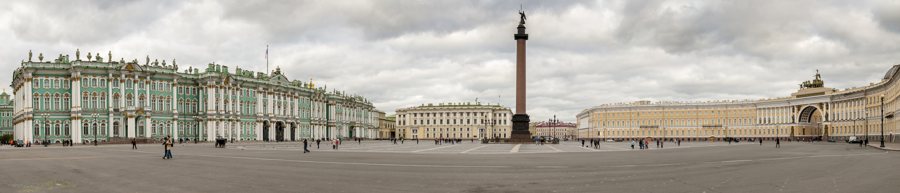 Winterpalast und Alexandersäule prägen den weiten Schlossplatz.
Photo: Alesia Belaya
Palace Square at a glance
- The square lies between the Winter Palace and the General Staff Building, on the banks of the Neva.
- The Winter Palace is now an important part of the Hermitage Museum; the outdoor square and museum entrance are separate visitor areas.
- The Alexander Column was designed by Auguste de Montferrand and unveiled on August 30, 1834.
- The column commemorates Alexander I and the victory over Napoleon; the General Staff Arch completes the ensemble.
- An outdoor walk can be combined with a separate time slot for a museum visit and entry checks.
The Winter Palace and the General Staff Arch
The Winter Palace dominates the north side of the square with its long, richly articulated façade. As part of the State Hermitage Museum, it houses collections and historic interiors; museum admission and entry requirements apply to visits inside. The square itself is separate and offers a view of the entire ensemble. On the opposite, southern side, the General Staff Building frames the square with its grand triumphal arch, which connects the building’s two wings.
The ensemble can be taken in stages: first the broad expanse of the square and its façades, then the General Staff Arch, and finally the Alexander Column at the center. The view changes with your position: up close, inscriptions and reliefs come into view, while from the edges of the square you can better appreciate how the buildings relate to one another. On event days, barriers may restrict access to parts of the square.
The Alexander Column and the square’s history
After the death of Alexander I, Nicholas I decided to erect a monument to his brother. Auguste de Montferrand designed the column; by imperial decree, the original design for an obelisk was changed to a column. The granite monolith was erected in 1832. Its ceremonial unveiling took place on August 30, 1834, according to the calendar used at the time, corresponding to September 11 in the modern calendar. The inscription on the pedestal dedicates the monument to Alexander I and describes Russia as grateful. The column complements the General Staff’s triumphal arch and forms the focal point of the square’s composition.
Palace Square lies in the historic center of Saint Petersburg. Nevsky Prospekt adjoins the square; in early summer, the White Nights in Saint Petersburg extend the time you can spend outdoors in the evening. A crossing leads to the islands of Saint Petersburg. Visits inside the Winter Palace are subject to the Hermitage’s entry requirements; Nevsky Prospekt and the islands of Saint Petersburg can be explored as separate stretches of your itinerary. More collections are part of Saint Petersburg’s museum offerings. When planning arrival and your trip, allow separate time slots for the indoor visit and the outdoor route.
A walk between the square and the city center
Nevsky Prospekt begins near Palace Square and leads into the city’s commercial and cultural center. A visit to the Hermitage requires a separate time slot for entry and the collections; afterward, you can continue along Nevsky Prospekt or cross a bridge to the islands of Saint Petersburg. During the White Nights, it stays light late into the evening; Palace Square is a distinct outdoor space between the Winter Palace and the General Staff Arch.
In windy or rainy weather, the open square is highly exposed; you can combine a break at an indoor destination with your city walk.
When choosing accommodation, consider whether your day will end by the Neva or in another neighborhood. The White Nights bring longer, brighter evenings in early summer. Accommodation in a convenient central location shortens the journey back after an evening stroll. Arrival and transport, trip planning, getting around by public transport, your return journey, and staying safe while out and about are all connected.
Planning your visit and current conditions
When planning arrival and city travel, include the relevant bridge crossing and your return journey in the day’s schedule. Trip planning should take museum hours, possible closures, and the weather into account; if you’ll be out in the evening, also consider how to get around safely when choosing your way back.
Frequently asked questions about Palace Square
What does the Alexander Column commemorate?
It was dedicated to Alexander I and the Russian victory over Napoleon. The column, designed by Montferrand, was erected in 1832 and unveiled on August 30, 1834, according to the calendar used at the time.
Is Palace Square part of the Hermitage?
No. The square is a public urban space; the State Hermitage Museum comprises the Winter Palace and other museum buildings, each with its own admission and access requirements.
What does the inscription on the pedestal say?
The dedication means, in effect: “To Alexander I from a grateful Russia.” Alexander I is the person honored; Russia is the dedicator.
What keeps the granite monolith of the Alexander Column in place?
The granite monolith is neither sunk into the ground nor anchored to a foundation. It stands in place thanks to the precise calculation of its shape and its own weight.
