
Prepare essential words for everyday situations
A few prepared words can make a trip much more relaxing. The point is not to plan every conversation in advance. It is more helpful to have a small selection for greetings, getting oriented, shopping, accommodation, transport, and situations where something does not go as expected. Numbers, times, and polite follow-up questions are often more useful than rare specialist terms.
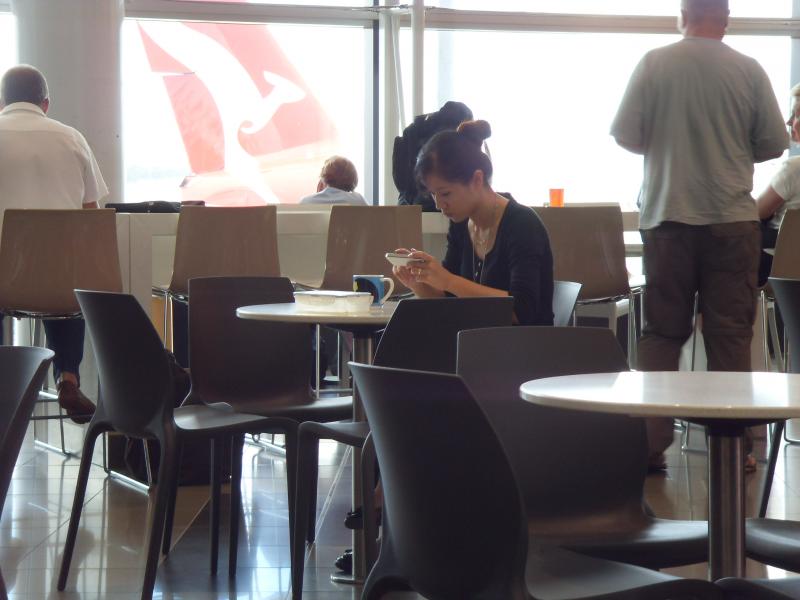 Reisende mit Smartphone in einer Flughafenlounge mit sichtbarem Qantas-Flugzeug im Hintergrund.
Photo: Markus
Reisende mit Smartphone in einer Flughafenlounge mit sichtbarem Qantas-Flugzeug im Hintergrund.
Photo: Markus
Quick facts: Essential words and everyday situations
- Start by learning words for greetings, please, thank you, numbers, and simple follow-up questions.
- Organize phrases by situation, such as arrival, eating, asking for directions, and accommodation.
- Also write down important names and addresses in the local script.
- Save the most important terms offline and add a simple pronunciation guide.
- Short, clear sentences and pointing can help you communicate when you cannot find the words.
- For complaints or emergencies, have the necessary details ready in a clear and complete form.
Start with a few situations
Put together a small collection for your first few hours: greetings, please, thank you, yes, no, excuse me, and asking whether someone speaks English or another language you have in common. Next, learn numbers, times, and directions. When you arrive, local transfers and public transport and air travel and airport arrivals are useful topics, since they bring together your destination, stop, and time.
For your accommodation, it is useful to know the name, address, reservation number, and how to ask for directions to your room. These details should also be included in your digitally backed-up travel documents. If a document is missing or you need information, passports and personal documents can help you prepare the right paperwork.
Shopping, eating, and paying
For everyday situations, words for water, food, the bill, price, allergies, and asking whether cards are accepted are often enough. Numbers become especially important when prices, quantities, or bus numbers are mentioned. Money and payments helps you connect your language preparation with cash, cards, and your daily budget. When visiting a market or café, the tips on markets, cafés, and local food culture can help you prepare for these everyday situations.
Write down a few short questions: Could you speak more slowly? Could you repeat that? How much does this cost? Where is the checkout? Could you write that down? A photo of the product or a translation app can also help, but you should still check the amount and what is included. Having a card, cash, and a second payment option also means another way to pay is available if communication at the checkout is difficult.
Prepare for transport and accommodation
For buses, trains, and ferries, you will need to know the departure time, destination, platform or pier, and how to ask about changes. Write down the destination address in a form you can show someone. Train travel and stations and long-distance buses and ferry connections explain which details you should keep handy for longer journeys.
If you are driving, include words for gas stations, parking, tolls, damage, and returning the vehicle in your collection. Rental cars and getting around locally rounds out your practical preparations. For questions about entering or transiting a country, entry requirements and documents and visas and entry permits can help you remember that the required documents are not the same as language assistance.
When something goes wrong
Prepare a short, factual phrase for a lost item, illness, accident, delay, or incorrect booking. Important details include the place, time, name, booking number, and the specific issue. Staying safe while travelling provides a framework for these situations. Keep the name of someone to contact with questions and other important contacts in writing, too; backups, contacts, and a Plan B can help with the practical arrangements.
Practice the words out loud once and check that you can find them quickly on your phone or on paper. A small, well-organized selection is more useful on the go than a long list. The advice in Practical information connects these preparations with documents, transport, money, and safety.
Organize your collection by when you will need it: arrival, accommodation, food, onward travel, and getting help. For important phrases, add a short answer you are likely to hear, such as a number, name, or direction. That way, you can pick out the key information even if you do not understand every word. For children or older travel companions, it may be helpful to make an additional card with a few especially important phrases.
Frequently asked questions
Which words should I learn first?
Greetings, thank you, numbers, directions, food, accommodation, and simple follow-up questions are usually the most useful in everyday situations.
Is a translation app enough?
It can help, but it should not be your only solution. Also save important names, addresses, and short phrases offline.
How can I prepare for emergencies in the local language?
Write down the location, names, phone numbers, and specific problem in short, factual notes. You can show them to someone if needed.
What is important when it comes to names and addresses?
Keep the spelling shown on your booking or ticket and, if necessary, add a local or Latin-script version to help with searches.
