
Armenia: Monasteries, Nature and Regional Travel Ideas
Accommodation in Armenia
Armenia combines significant monastic complexes with hiking trails, natural sites and regional wine experiences. Which of these highlights shapes your trip can also guide your choice of accommodation and the regions you explore.
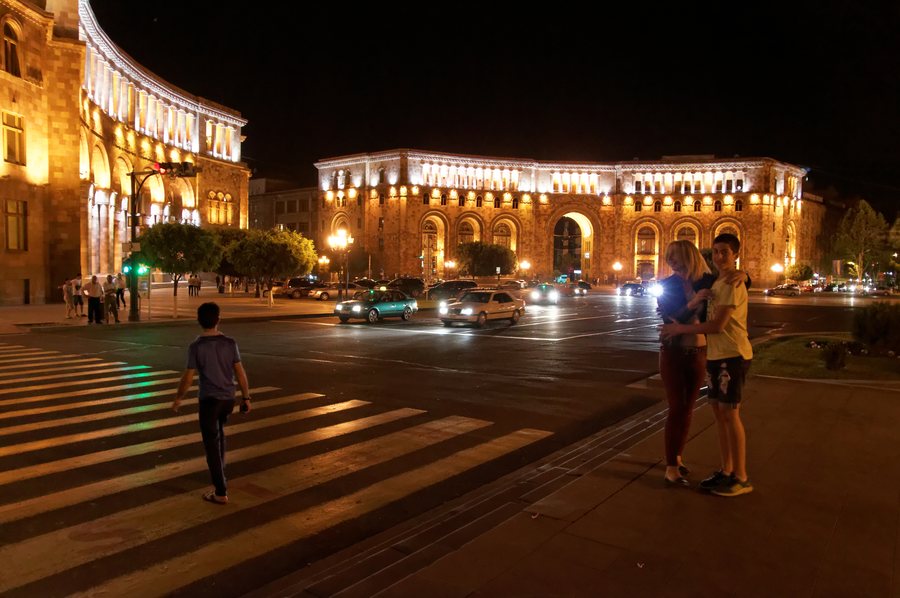 Yerevan, Armenia Marriott Hotel, Republic Square at night, Armenia
Photo: Vyacheslav Argenberg via Wikimedia Commons, CC BY 4.0
Yerevan, Armenia Marriott Hotel, Republic Square at night, Armenia
Photo: Vyacheslav Argenberg via Wikimedia Commons, CC BY 4.0
Quick Facts About Armenia
The hiking season begins in April and lasts until November. The Armenian National Trail extends for more than 950 kilometers and connects five regions and 109 villages and towns. There are two international airports for air travel: Zvartnots in Yerevan and Shirak in Gyumri. Travel by land is also possible; there are land crossings from Iran and Georgia, while the land borders with Turkey and Azerbaijan are closed.
Which monasteries and churches shape Armenia’s cultural heritage?
At Haghpat, the monastery’s history dates back to 976 AD: Queen Khosrovanush, wife of the Armenian King Ashot III the Merciful, founded it that year. The Church of St. Nshan is the oldest monument in the complex and was built between 976 and 991 AD. These dates refer to different aspects of the site: the monastery’s foundation and the construction of the church.
Sanahin also offers a glimpse into several aspects of medieval history. The monastery comprises three churches, narthexes, a scriptorium, a bell tower and an academy. Sanahin was the administrative center and family burial place of the Kyurikian Bagratids, and served as the episcopal seat of the diocese until the 11th century. Geghard, in turn, was an ecclesiastical and cultural center with a school, scriptorium and library. Several churches and tombs there are mostly carved into the rock; the complex illustrates a high point of medieval Armenian architecture. Geghard has been continuously used as a monastery for many centuries.
Other structures reflect different periods and forms: Etchmiadzin Cathedral was built in 301–303 AD. The Church of St. Gayane, built in 630 AD, combines a three-nave basilica with a central dome. Zvartnots Cathedral was built in the mid-7th century and destroyed in the 10th century. Sevanavank Monastery stands on Lake Sevan.
What nature and hiking experiences can you plan for?
Lake Sevan is a high-altitude freshwater lake in the Gegharkunik region and one of the country’s special natural sites. A different landscape awaits you at the Symphony of Stones: this natural monument lies in the gorge of the Azat River. Its stones resemble a musical instrument—a pipe organ.
If you’re considering a hike to Lake Gosh, keep the stated distance and terrain in mind: the lake can be reached via an approximately 3-kilometer hike along a steep trail. It is surrounded by the dense forests of Dilijan National Park. The approximate distance and steep trail are specific features of this hike; the country’s hiking season runs from April to November.
For longer hiking plans, the Armenian National Trail provides a nationwide framework: it runs for more than 950 kilometers and connects five regions and 109 villages and towns. In the Lori region, a 153-kilometer section is open to hikers. Trail information for this section is available on the HIKEArmenia website. This lets you distinguish between a single hike, such as the one to Lake Gosh, and exploring a longer section of the trail.
What can you expect from wine and cuisine?
Armenia has several wine routes offering practical experiences related to winemaking and wine tasting. The Vayots Dzor wine route includes stops at wineries where visitors can taste local wine and learn about wine production in the region. If you’re interested in wine, you can include this theme in your travel plans.
A distinctive food of Armenian cuisine is lavash: this traditional thin flatbread is baked in a conical clay oven and is considered an essential part of the cuisine. Together with the monasteries, hiking trails and wine routes, it offers a range of travel options with different focuses on culture, nature and local food traditions.
Regional Guides to Armenia
If you’d like to focus your search on individual regions, you can browse the guides to Gegharkunik, Syunik, Aragatsotn, Shirak, Vayots Dzor, Ararat, Armavir and Yerevan, as well as Tavush, Lori, Kotayk and Vayots Dzor.
FAQ
When does the hiking season in Armenia begin?
The hiking season begins in April and lasts until November.
How long is the hike to Lake Gosh?
Lake Gosh can be reached via an approximately 3-kilometer hike along a steep trail.
Which international airports are there?
Armenia has two international airports: Zvartnots in Yerevan and Shirak in Gyumri.
What does the Vayots Dzor wine route offer?
It includes stops at wineries where visitors can taste local wine and learn about wine production in the region.

