
Bílá Voda U Javorníka: Hotels and Accommodation
Accommodation in Bílá Voda U Javorníka
The pilgrimage Church of the Visitation of the Virgin Mary and the former Piarist College have formed the spiritual and historical centre of Bílá Voda for centuries. The church's present appearance was created by the Baroque reconstruction of a smaller church, which Baron Kryštof von Maltitz had built between 1602 and 1604. Bílá Voda was the first Piarist foundation in all of Silesia.
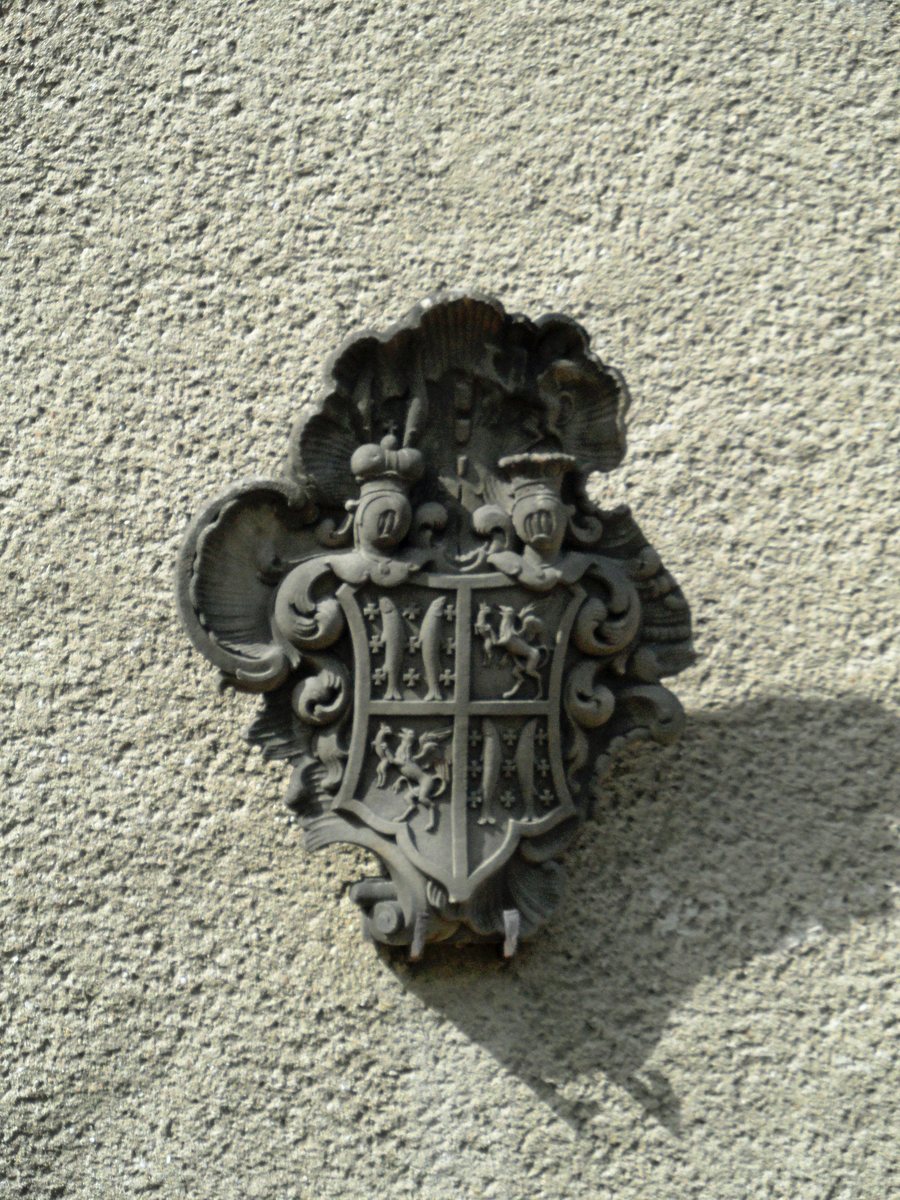 File:Městys Bílá Voda H. Erb na budově muzea.jpg
Photo: Stribrohorak via Wikimedia Commons, CC BY-SA 3.0
File:Městys Bílá Voda H. Erb na budově muzea.jpg
Photo: Stribrohorak via Wikimedia Commons, CC BY-SA 3.0
Culture and History
The Museum of Isolation, Internment and Integration tells the story of Bílá Voda: from the settlement's first written mentions as Wyssoká, through Weissasser, to its later repopulation. The second part documents the internment of nuns in Bílá Voda. This period began on 28 September 1950 with the arrival of the first transport as part of Action R, which aimed to dissolve women's religious communities.
The history of the town as an ecclesiastical centre is also reflected in individual memorial sites and events. At the solemn consecration of the Church of the Visitation of the Virgin Mary in 1777, seminarians performed a play watched by around 4,000 people. The Piarist seminary in Bílá Voda also served as a venue for music concerts and theatre performances. The Bílá Voda cemetery is the final resting place of around 700 nuns.
Groups wishing to visit the museum in the Piarist Grammar School and College with a guided tour must register by telephone or email three weeks in advance.
Nature and Trails
The former château park in Bílá Voda was established in the second half of the 18th century and is the starting point of the Bílá Voda–Grenze route. This former château park is home to a yew tree more than 300 years old, which is protected as a national monument.
The Bílá Voda–Grenze route leads to the former Kukačka limestone quarry. Numerous plant species occur in its relatively small area, including rare and endangered species. Above the route near Bílá Voda lie the Kraví Rocks, which are used by climbers.
For cyclists, the marked Route 6044 connects several towns and landscape areas: it is 37 kilometres long and runs from Bílá Voda via Růženec and Javorník through the Račí Valley, to Uhelná and Vlčice, and on to Hraničky. The Silesia Trail reaches Bílá Voda via the ridge of the Rychlebské Mountains and continues from there to Javorník and Vidnava.
You can reach additional town pages via Rejvíz, Supíkovice, Bílá Voda, Skorosice, Ostružná, Bobrovník, Javornik and Hradec-Nová Ves.
For the overview of the wider travel area: Jeseník District.

