
Cărpiniș: Swabian Houses and Geometric Settlement Plan
Accommodation in Cărpiniș
Townscape
In Cărpiniș, traditional Swabian houses meet a geometric settlement plan. The houses belong to the German house type of the Banat: their short side faces the street, while the buildings extend into the depth of the plot. The gable façades of the German houses are decorated with motifs such as the sun, rosette, diamond, triangle, tree of life, laurel and flowers. The shape of the house describes individual plots, while the settlement plan describes the arrangement of the village.
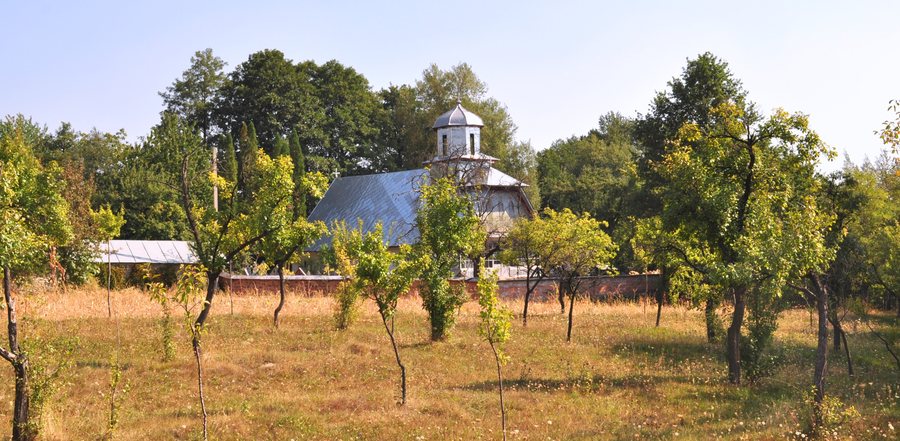 File:RO GJ Biserica de lemn Cuvioasa Paraschiva din Carpinis (18).JPG
Photo: Țetcu Mircea Rareș via Wikimedia Commons, CC BY-SA 4.0
File:RO GJ Biserica de lemn Cuvioasa Paraschiva din Carpinis (18).JPG
Photo: Țetcu Mircea Rareș via Wikimedia Commons, CC BY-SA 4.0
History
Cărpiniș has been documented since at least 1387. Between 1776 and 1778, 56 Swabian families were settled there.
Churches and Commemorations
The Roman Catholic church in Cărpiniș dates from 1862 and is dedicated to Saint Martyr Maximilian. The Romanian Orthodox church dates from 2004. The patronage of the Greek Catholic church in Cărpiniș is dedicated to the Holy Archangels Michael and Gabriel.
In addition to the monument for the First World War, a reinforced-concrete monument was erected in 1992. Its plaque commemorates those who died in the Second World War, as well as those deported to Russia from 1945 to 1951 and to the Bărăgan from 1952 to 1956.
Culture and Festivals
Two groups of Romanian folk dancers rehearse at the Cărpiniș cultural center. The Ruga and the patronal feast of Cărpiniș take place on October 26, the feast of Saint Dumitru. Cărpiniș Community Day is celebrated on the first Sunday in September. In addition to the churches and memorial sites, the Ruga, patronal feast and Community Day are three dated components of the local festival calendar.
Landscape and Water
Cărpiniș lies in natural valleys that belong to an old marshland, which was drained over time. Within the built-up area, there are five natural accumulations of water, as well as two larger bodies of water to the north and east. These two larger bodies of water were created by earlier excavations. The five natural accumulations of water lie within the built-up area; the two larger bodies of water to the north and east, on the other hand, were created by earlier excavations.
Railway
CFR Cărpiniș railway station is a railway junction. It connects Cărpiniș with Timișoara, Jimbolia, Cenei and other places in the county and the country.
Other Places
Biserica Romano-Catolică Biled, a church, is located in the vicinity of Cărpiniș. Biserica Ortodoxă Biled, also a church, is likewise located nearby.
In the wider regional surroundings of Cărpiniș are Casa Contelui Mercy Timişoara, a historical site, and Biserica Romano-Catolică Sfântul Vedelin, a church. La Gomila is a hill in the wider regional surroundings of Cărpiniș. Dealul Botianului is also a hill there. Fântâna lui Goga is a spring in these wider regional surroundings. La Canton is a hill there.
To the higher-level travel overview: Timis.

.JPG)