
Kvetoslavov – Culture and History in the Village
Accommodation in Kvetoslavov
Kvetoslavov combines sacred architecture, manor houses, places of remembrance and archaeological traces. The history of the village is particularly vivid in the districts of Uzor and Fakov, where buildings from several centuries stand alongside more recent evidence of local life. This picture is complemented by a historic railway station and a railway line with its own history of development.
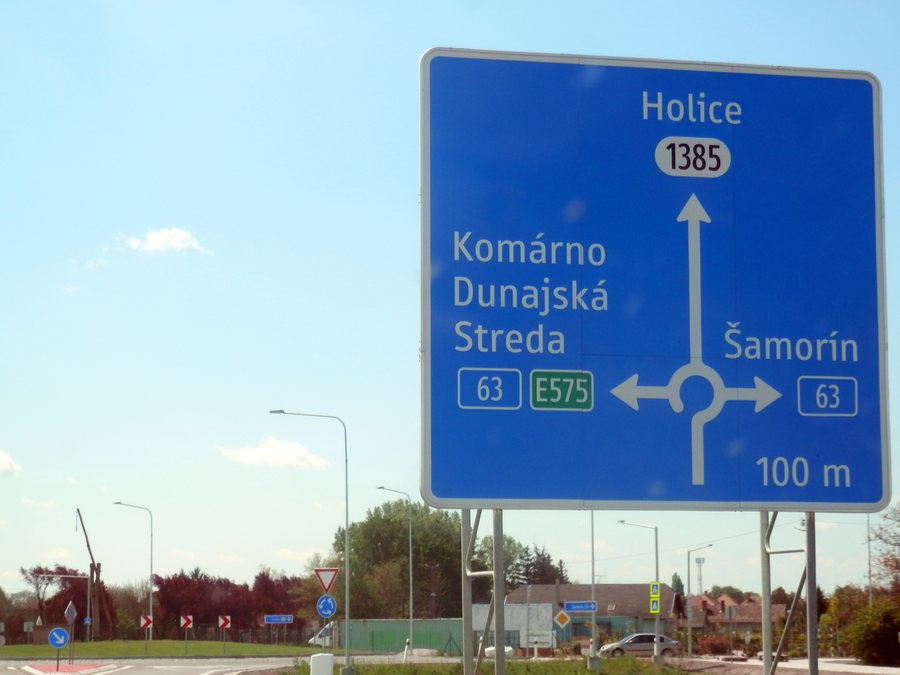 File:Rýchlostná cesta R7, úsek Kvetoslavov - Holice 21 Slovakia 22.jpg
Photo: Ing.Mgr.Jozef Kotulič via Wikimedia Commons, CC BY-SA 4.0
File:Rýchlostná cesta R7, úsek Kvetoslavov - Holice 21 Slovakia 22.jpg
Photo: Ing.Mgr.Jozef Kotulič via Wikimedia Commons, CC BY-SA 4.0
Culture
The Roman Catholic Chapel of the Assumption of the Virgin Mary stands in the Uzor district. It was built in 1883 in the Neo-Romanesque style with Neo-Gothic elements. The single-nave building has a polygonal apse, a small integrated turret and a bronze bell. Its furnishings also include a Baroque painting of Our Lady of the Rosary from the late 18th century.
At the end of the Fakov district, towards Uzor, stands a Neo-Baroque manor house built by Fridrich Pongrácz in the late 19th century. After its restoration, it retained its original form; only the wooden veranda was replaced with an iron one.
In the southeastern part of Uzor stands an early Baroque summer manor house from the early 18th century. The two-storey building has an L-shaped floor plan. The heirs of Ľudovít Reicher still own the early Baroque manor house today.
Smaller landmarks are also part of the village landscape. The war memorial in the park on the square in the Uzor district was erected in 1925. It was later supplemented with a plaque bearing the names of the victims of the Second World War.
At the bend of the side road to Šamorín stands the wayside shrine “Božia muka”. It dates from the second half of the 19th century and contains a Pietà in its semicircular niche.
History
The depth of time reaches considerably further back than the surviving buildings. The oldest evidence of human presence in Kvetoslavov is a small stone wedge from the Neolithic period.
A Roman-era barbarian settlement was also discovered in the cadastral area of Kvetoslavov. Thus, a stone artifact from the Neolithic period and an archaeological site from the Roman era are found side by side here, without this requiring any broader historical classification of the village.
Local Connections
A specific connection with agriculture is associated with the history of seed production. In 1949, a breeding station for vegetable seeds was established in Kvetoslavov. The blue kohlrabi variety “Kvetoslavovský” bears the name of Kvetoslavov.
Transport
Kvetoslavov railway station was built in 1895 and is located on the Bratislava–Dunajská Streda railway line. This line was completed as far as Komárno in 1896.
When comparing accommodation offers for Kvetoslavov, it is worth looking at the respective offer pages. Check the exact location, type of accommodation and stated occupancy there, as well as the included services and individual price components. Before booking, the booking and cancellation conditions should also be clear, along with all services actually listed. This makes it possible to compare the differences between the individual offers based on their specific details.
More Village Pages
More village pages: Dolny Stal, Medveďov, Oľdza, Kľúčovec, Vrakúň, Trstená Na Ostrove, Veľké Blahovo, Ohrady.
To the higher-level travel overview: Okres Dunajská Streda.

