
Pitsunda in Abkhazia: Coast, Pine Forest, and History
Pitsunda, also known as Bichvinta, lies on the Black Sea in northwestern Abkhazia. The cape, the coastal pine forest, and its history as an ancient settlement and Soviet-era resort shape its identity. Pitsunda is part of this region.
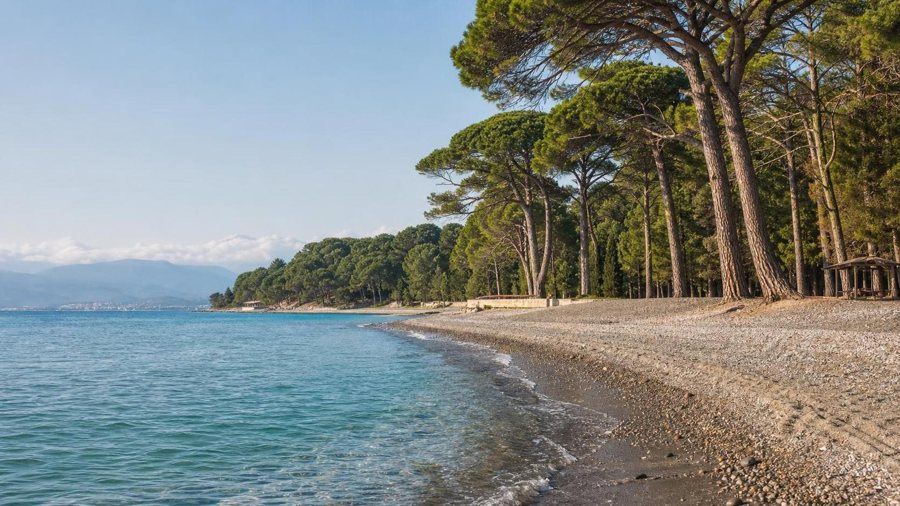 KI-generierte Illustration: Kiefern säumen einen Kiesstrand am ruhigen Meer.
Pitsunda at a glance
- Pitsunda lies on the Black Sea coast in the Gagra area and is also known as Bichvinta.
- The cape, forest, and coastline define the area’s distinctive landscape.
- The town combines ancient and religious history with its development as a Soviet-era resort.
- Under Georgian law, foreign nationals and stateless persons must enter Abkhazia from the direction of the Zugdidi Municipality.
- Border crossings also carry specific legal consequences.
Pitsunda is one of the best-known coastal towns on the Black Sea. Its peninsula extends into the sea, while pine trees define the coastal landscape. The place is referred to as Bichvinta in Georgian contexts; Russian-language sources use the name Pitsunda. Its location and changing names reflect the region’s complex history.
Cape, pine forest, and coastal landscape
Cape Pitsunda is the town’s most prominent geographical landmark. The pine forest reaches close to the coast, giving the landscape a different character from the more densely built-up stretches of the Black Sea coast. The relationship between sea, forest, and settlement helps explain why Pitsunda became known as a resort and place of recreation. The region’s broader landscape is part of the wider travel destination of Abkhazia.
In regional comparisons, neighboring Gagra is more closely associated with the history of an urban resort. Novy Afon is known for its caves, monastic traditions, and distinctive coastal landscape. Farther south lies Sukhumi, a center of regional urban and cultural history. These places differ in their landscapes and historical development.
Ancient history, the cathedral, and the resort era
Pitsunda’s history dates back to antiquity. The settlement was an important coastal center and developed into a religious hub for the region. Pitsunda Cathedral is one of its best-known landmarks. Together with other religious sites, it shapes the town’s historical character.
In the 20th century, Pitsunda was developed as a Soviet resort. Sanatoriums, green spaces, and seaside paths formed part of the tourism infrastructure of the time. Alongside its older history, a second defining layer emerged: Pitsunda became known as a holiday destination for visitors from across the Soviet Union.
The town’s history can be placed in the wider context of the Caucasus and Georgia. The landscape, religious history, and role as a Soviet-era holiday destination reflect different periods in the town’s past.
Travel and legal situation
The area is not under the control of the Georgian government; Russian troops are stationed along the administrative boundary lines.
Article 4 of Georgia’s Law on Occupied Territories states that foreign nationals and stateless persons may enter Abkhazia only from the direction of Zugdidi Municipality. Entry from other directions is prohibited and punishable under Georgian criminal law. The law provides for limited permits and exceptions for specific state, peacebuilding, or humanitarian purposes.
Documents, emergency contacts, and return travel are part of a personal travel checklist. Other practical topics include entry requirements and documents, safety while traveling, getting there and getting around, and travel planning.
Pitsunda in its regional context
Even within Abkhazia, the character of each place differs: alongside Pitsunda, Abkhazia, Gagra, Novy Afon, and Sukhumi each represent different connections between coast, town, and history. The topics nature and landscape and culture and history provide a framework for these different themes. General travel topics also include types of accommodation.
Frequently asked questions about Pitsunda
What is Pitsunda known for?
Pitsunda is best known for its cape, pine forest, Black Sea coast, ancient and religious history, and Soviet-era resort tradition.
What shapes how travel to the area is viewed today?
The specific legal provisions governing border crossings are another important factor.
For what purposes does Georgian law provide for special permits?
Article 4 cites state interests, peaceful conflict resolution, ending the occupation, confidence-building measures, and humanitarian purposes as possible grounds for special permission to enter from a direction that would otherwise be prohibited.
How does Pitsunda differ from Gagra?
Pitsunda is particularly defined by its cape, forest, and coastal landscape. Gagra is more strongly associated with an urban resort character and its own architectural and recreational history.
