
Sukhumi: Black Sea Coast and Botanical Garden in Abkhazia
Sukhumi lies on the Black Sea coast in Abkhazia. Its seafront promenade and botanical garden reflect two defining aspects of the city: its coastal setting and an important plant collection. Georgian border penalties shape its current legal status.
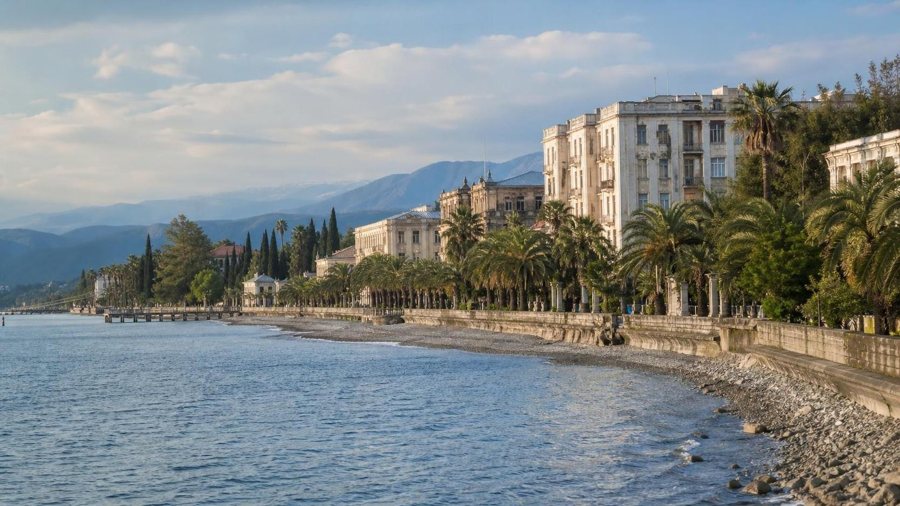 AI-generated illustration of Sukhumi’s Black Sea waterfront, lined with palms and historic-looking buildings beneath distant mountains.
Sukhumi at a glance
- Sukhumi is a city on the Black Sea coast of Abkhazia.
- The seafront promenade, urban area and botanical garden represent distinct urban and landscape features.
- The botanical garden brings together plants from many climate zones, including ginkgo, boxwood and araucaria.
- Abkhazia is not under the control of the Georgian government; Russian troops are stationed there.
- Rescue flights are not guaranteed.
- Georgian authorities punish entry into Abkhazia from Russia as an illegal border crossing; fines or prison sentences of up to five years are possible.
A city on the Black Sea coast
Sukhumi’s coastal location shapes the cityscape. Waterfront areas and a promenade line the sea, while the botanical garden complements this coastal setting with a scientifically organized plant collection. In the regional context, Abkhazia defines the territorial framework, while Sukhumi is described as an urban place with a coastline, public green spaces and its own institutions.
Botanical garden and plant collections
Sukhumi’s botanical garden brings together plants from different climate zones around the world. Its collections range from plants such as ginkgo, boxwood, araucaria and metasequoia to newer cultivated varieties. The subtropical climate of the Black Sea coast shapes the conditions in which these species are grown.
The garden is also part of a research tradition focused on the introduction and acclimatization of plants. Botanical research compares species from different regions, observes their growth under new conditions and studies the local flora. This work also includes plant fossils and the development of vegetation in the Caucasus. The study of nature and landscape is part of the botanical garden’s culture and history.
Sukhumi in its regional context
The Black Sea coast of Abkhazia includes several places, each with its own history and landscape. Gagra is associated with its history as a resort, Pitsunda with its coastal headland and pine forest, and New Athos with its monastery and cave. Sukhumi stands apart as an urban coastal area with a promenade and botanical collection.
These places reflect different periods: a climatic station opened in Gagra on January 9, 1903, marking an important step in the development of the resort. The cave at New Athos was explored in 1961; in 1975, a visitor train first ran through a purpose-built tunnel. Gagra, Pitsunda and New Athos add to the comparison between a resort, a coastal forest and a religious and geological site. They are all located in Abkhazia.
Elsewhere in the South Caucasus, Georgia, Tbilisi, Mtskheta and Mount Kazbek are located in other parts of the Caucasus region. Armenia and Azerbaijan are separate states, each with its own entry, security and border regulations.
Abkhazia is not under the control of the Georgian government; Russian troops are stationed in the region and along its administrative boundaries. The situation can change rapidly.
Georgian law establishes a special regime for Abkhazia, with restrictions on freedom of movement, economic activities and certain land and property transactions. Entry into Abkhazia from Russia, as well as exit from Georgia to Russia through Abkhazia, is punished by Georgian authorities as an illegal border crossing. This may result in fines or prison sentences of up to five years; subsequent entry into Georgia may also be denied. Under this legal framework, the actual border line and the direction of crossing are decisive.
Georgian travel requirements include entry and documents, safety and conduct, getting there and transportation and travel preparation. When choosing accommodation, location, amenities and booking conditions matter.
Frequently asked questions about Sukhumi
When was the botanical garden founded?
The botanical garden was founded in Sukhumi in 1840 at the initiative of General Nikolai Raevsky. The Institute of Botany traces its history back to that founding year.
What plants can be found in the botanical garden?
The collection includes plants from different climate zones, including ginkgo, boxwood, araucaria and metasequoia. The garden also describes plants from newer cultivated varieties.
What current conditions shape the travel situation?
Georgian authorities punish certain border crossings with fines or prison sentences.
