
Abkhazia: Black Sea Coast, Resort Towns and Caucasus Landscapes
Abkhazia lies on the eastern Black Sea coast, on the edge of the Caucasus. Gagra, Pitsunda, Novy Afon and Sokhumi represent different coastal, urban and cultural histories.
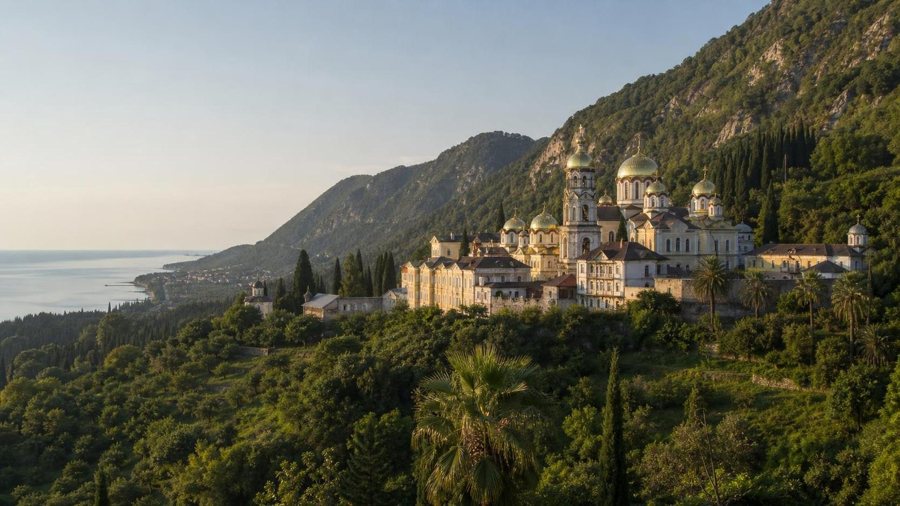 KI-generierte Illustration: Klosteranlage am bewaldeten Berghang mit Blick auf das Schwarze Meer.
Quick facts: Abkhazia
- The coastal region lies between the Black Sea and the Caucasus.
- Gagra, Pitsunda, Novy Afon and Sokhumi differ in their townscapes, landscapes and histories.
- Abkhazia is not under the control of the Georgian government; Russian troops are stationed in the region.
- Entry from Russia is treated by Georgian authorities as an illegal border crossing.
- Georgian law restricts travel and activities in the area; fines or prison sentences may be imposed.
Coast, resort towns and local history
Gagra is known as a coastal town in the western Caucasus. Pitsunda lies on the Black Sea coast and is associated with a long history as a spa and seaside resort. Novy Afon is known for its religious and cultural-historical sites; Sokhumi is the larger city on the coast.
The coastline, subtropical vegetation and nearby foothills shape the landscape. Historical descriptions of the resort towns tell the story of the earlier development of Black Sea tourism.
For context within Georgia, consider the wider Georgian Caucasus. Tbilisi and Mtskheta lie in areas controlled by the Georgian government and are separate travel destinations. Armenia and the Russian Caucasus are also separate travel regions, with their own borders and conditions.
Legal status and current security conditions
Abkhazia is not under the control of the Georgian government; Russian troops are stationed in the region and along the administrative boundary lines.
Georgia’s “Law on Occupied Territories” restricts travel and other activities in Abkhazia, with few exceptions. Georgian authorities treat entry into Abkhazia from Russia, as well as departure from Georgia via Abkhazia to Russia, as an illegal border crossing; fines or prison sentences of up to five years are possible. Subsequent entry into Georgia may be refused if the passport documents such a border crossing. The Federal Foreign Office recommends obtaining the necessary approval from the Georgian government in advance for the specific case.
Under these conditions, Abkhazia, the rest of Georgia and Russia cannot be freely combined as travel stops. The competent legal authority and a specific permitted route in depend on current Georgian rules and any required permits.
Distinguishing other Black Sea regions
Yalta and Sevastopol are in Crimea, a different Black Sea region. Ukrainian airspace is closed, and entry and departure are possible only by land. These conditions differ from those in Georgia and Abkhazia. Yalta and Sevastopol are historic coastal towns, not connection points on a Caucasus route.
Croatia and Albania are also not on the Black Sea coast; both are Adriatic destinations. Montenegro is also on the Adriatic.
Thematic differences also include nature and landscapes as well as culture and history. When choosing accommodation in Eastern Europe, location and type of travel matter. Preparing for a trip involves entry requirements and documents, safety while travelling and getting there and getting around.
Frequently asked questions about Abkhazia
What are the differences between Gagra, Pitsunda, Novy Afon and Sokhumi?
Gagra and Pitsunda are mainly associated with the coast and resort history. Novy Afon is known for its religious and cultural-historical sites; Sokhumi is the larger coastal city.
Is entering Abkhazia from Russia a permitted onward journey to Georgia?
No. Georgian authorities treat entry into Abkhazia from Russia as an illegal border crossing. Subsequent entry into Georgia may be refused; fines or prison sentences may also be imposed under Georgian law.
