
Viktor Ginko: Belarusian Race Walker and Sporting Career
Viktor Ginko is a Belarusian race walker. His personal best for 50 kilometres is 3:42:20; international results databases list him as representing Belarus. Race walking combines endurance over long distances with its own technical rules: contact with the ground must remain visible, and the leading leg must be straight from touchdown until the body is upright over it. These requirements distinguish the discipline from running.
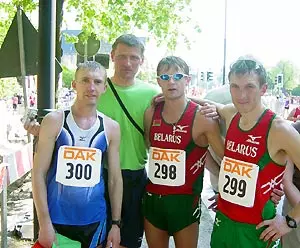 Vier belarussische Geher nach einem Rennen in Naumburg im Jahr 2007.
Viktor Ginko: quick facts
- Ginko competed as a race walker for Belarus.
- His personal best for 50 kilometres is 3:42:20, set on 5 March 1995.
- He was born on 7 December 1965.
- During his career, World Athletics records one top-eight finish at the Olympic Games and three top-eight results at the Race Walking World Cup.
- Race-walking technique requires visible ground contact and a straight leading leg until the body is upright over it.
Race walking and personal best
A 50-kilometre time can only be meaningfully compared with results over the same distance. Ginko’s best time of 3:42:20 was set on 5 March 1995 and is a historic performance. Age category, course length and competition conditions all affect comparisons; a 50-kilometre time therefore cannot be directly equated with times over shorter race-walking distances.
In race walking, at least one foot must remain in contact with the ground. In addition, the leading leg must remain straight from initial ground contact until the body is upright over it. Judges assess this technique during competition. Maintaining a steady pace over a long distance and visibly correct walking form go hand in hand: anyone whose movement approaches running risks breaking the rules. These requirements explain why race walking is a distinct athletics discipline, with competition conditions different from those of a road race.
Belarus and Vitebsk as a travel setting
Vitebsk lies in northern Belarus, on the Daugava River. The city combines its riverside setting with a rich cultural history; the Slavianski Bazaar is an international arts festival. Vitebsk is therefore a city-break destination in its own right, while Minsk is the capital and Grodno is another historic destination. The museum in Minsk offers a different focus from a stay in northern Vitebsk.
The urban area of Vitebsk lies on the Daugava River. The Slavianski Bazaar arts festival gives the city its own distinctive events programme.
Belarusian destinations are spread across the country. The Slavianski Bazaar and Vitebsk are part of a northern city itinerary; Vitebsk in northern Belarus lies on the Daugava River. The festival in Vitebsk provides a cultural reason to visit, while the museum theme in Minsk belongs to the capital. For a longer trip, other destinations in Belarus make for separate stops, each requiring its own journey.
Travel conditions for Belarus
Crossings into Ukraine are closed; crossings with Poland, Lithuania and Latvia are subject to restrictions depending on the mode of transport. Non-Belarusian credit cards can only be used to a limited extent, and taking banknotes from an EU member state into Belarus is generally prohibited. These conditions also affect a trip to Vitebsk and should be considered when deciding how to travel and pay.
Travel preparation includes the paperwork for entry and documents; getting there and transport covers the relevant route and border crossing. Language and communication are also an important part of preparing for everyday interactions. When staying overnight in Vitebsk, consider the location and plans for the day; suitable accommodation is part of planning each leg of the trip.
Frequently asked questions about Viktor Ginko
What discipline did Viktor Ginko compete in?
Ginko was a race walker. In this athletics discipline, ground contact must remain visible and the leading leg must stay straight until the body is upright over it.
When did he set his 50-kilometre best?
His personal best of 3:42:20 was set on 5 March 1995.
What was the average speed for this best time?
A time of 3:42:20 for 50 kilometres works out to an average speed of around 13.5 kilometres per hour. This is the average across the entire competition distance.
What international finishes are listed for his career?
World Athletics lists one top-eight finish at the Olympic Games and three top-eight results at the Race Walking World Cup.
