
Suzdal Kremlin: Cathedral, Ramparts and City History
Today’s Suzdal Kremlin was the city’s original fortified core, around which medieval Suzdal gradually grew. The written history of Suzdal begins in 1024, while oral traditions reach back to the depths of the 9th century. A fortress was built here at the turn of the 11th and 12th centuries. It was encircled by earthen ramparts up to 1,400 m long, topped with timber palisades and towers. The walls were destroyed and rebuilt repeatedly, until the 18th century, when a fire in the city finally destroyed the Kremlin’s fortifications. In the 18th century, stone construction was financed mainly by merchants from the suburbs. Over the course of that century, around thirty parish churches were built close together, giving the city a unique appearance.
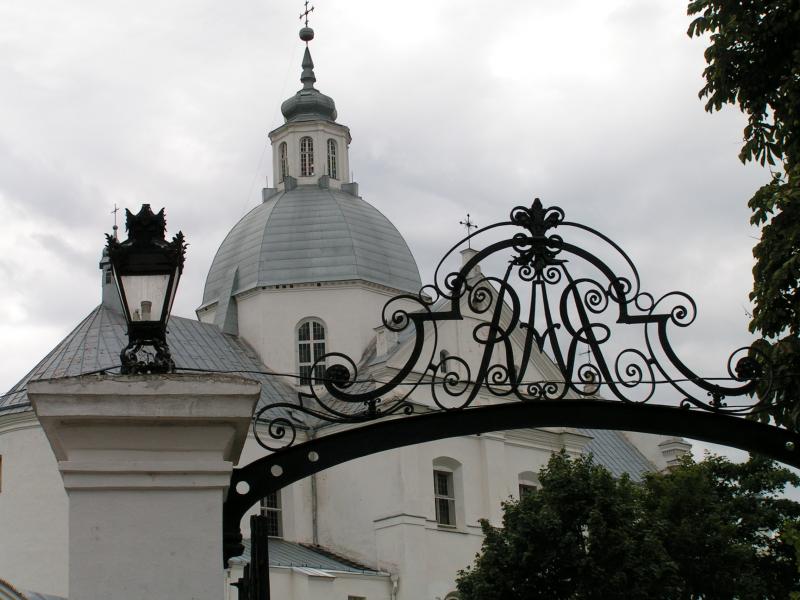 Detail einer orthodox geprägten Kirchenarchitektur mit Kuppel und schmiedeeisernem Tor.
Photo: Ilya
Detail einer orthodox geprägten Kirchenarchitektur mit Kuppel und schmiedeeisernem Tor.
Photo: Ilya
The Kremlin is home to one of the oldest monuments of Suzdal architecture: the white-stone Cathedral of the Nativity of the Virgin (1222–1225), built on the site of even older churches. The present cathedral has little in common with the original structure. Only the lower section of the 13th-century building, defined by its arcade, has survived. The walls above it were built in the 16th century, but no longer from white stone—instead, they were made of brick.
The southern and western porches preserve the old double-leaf doors, known as the Golden Gates, made from copper plates in the 13th century. The images on them, created using the now almost forgotten technique of fire gilding, depict the life of Christ and the Virgin Mary, as well as the deeds of Saint Michael, protector of the Russian princes.
The church interior, filled with deep-blue frescoes, also contains fragments dating back to an earlier period, captivating visitors with their clear lines and soft colors. The restored paintings on the 17th-century, five-tier iconostasis glow with vivid color. Particularly impressive are the large metal processional lantern in the shape of a five-domed church, made at the same time by Suzdal craftsmen, and the magnificent church chandelier with its many candles, a gift from Ivan Shuisky, brother of Tsar Vasily Shuisky. The cathedral bears witness to Suzdal’s grandeur, which reached its historic peak from the 12th to the early 13th century.
Quick facts: Suzdal Kremlin
- The Kremlin forms part of Suzdal’s historic core and lies in a landscape shaped by river meadows.
- The cathedral, earthen ramparts and museum areas offer distinct points of interest.
- The Kremlin is a cultural and religious site where appropriate clothing and respectful behavior matter.
- Ramparts, paths, weather and ground conditions all affect your visit.
- The monasteries, posad and open-air museum are separate destinations that require extra time.
- Check opening hours, admission, services, transport, weather and current access arrangements.
Understanding the Suzdal Kremlin as the city’s core
The Suzdal Kremlin is a good starting point for understanding the city’s development and the way religious and secular buildings come together. It is especially rewarding for travelers who prefer exploring historic spaces in a compact ensemble rather than in a modern metropolis. The grounds, churches and exhibitions are best seen as parts of a single visit.
For practical planning, check current opening hours, admission arrangements and service times. The historic center’s sights can be combined easily with the posad and other monasteries, but snow, rain or large crowds can make the visit take longer. An early start leaves time for additional churches or a break by the river.
The cathedral, earthen ramparts and Suzdal’s townscape
Explore the Suzdal Kremlin through its cathedral, ramparts and setting within the historic townscape. The Kremlin and Suzdal should be planned as a separate walking tour. Historical information about the Suzdal Kremlin provides additional context; confirm current opening hours, admission and photography rules.
Other highlights include the monasteries of Suzdal, the historic posad, the Open-Air Museum of Wooden Architecture, the Convent of the Intercession and the Monastery of Saint Euthymius. Vladimir and the Golden Ring require separate travel time.
Before your visit, check for updates on getting there and local transport, travel preparation, language and communication, staying safe while traveling and culture and history. The latest travel and safety advice for the Russian Federation takes precedence over older information about opening hours or transport.
FAQ: Suzdal Kremlin
What does a visit to the Kremlin include?
The main highlights are the cathedral, historic ramparts, surrounding landscape and any museum areas that are open.
How much time should I allow?
Half a day is enough for a focused visit. Allow extra time for the monasteries, posad and open-air museum.
Can I combine the Kremlin with the monasteries?
Yes, if travel times, opening hours and daylight allow. Plan separate visiting time for each monastery.
What should I check before entering?
Confirm current opening hours, admission, services, clothing requirements, photography rules, weather, transport and return journey.
