
Suzdal Posad: Suburb, Craftsmanship and Historic Cityscape
The road out of the Suzdal Kremlin leads into the former trading and artisan quarter of Suzdal, the Posad (suburb). Buildings from the suburb are scattered throughout the city. The Church of Cosmas and Damian (1725) is noteworthy. It stands near the Kamenka Bridge, where the river makes a sharp bend. Reflected in the water, this picturesque building is a popular subject for photographers and artists in Suzdal.
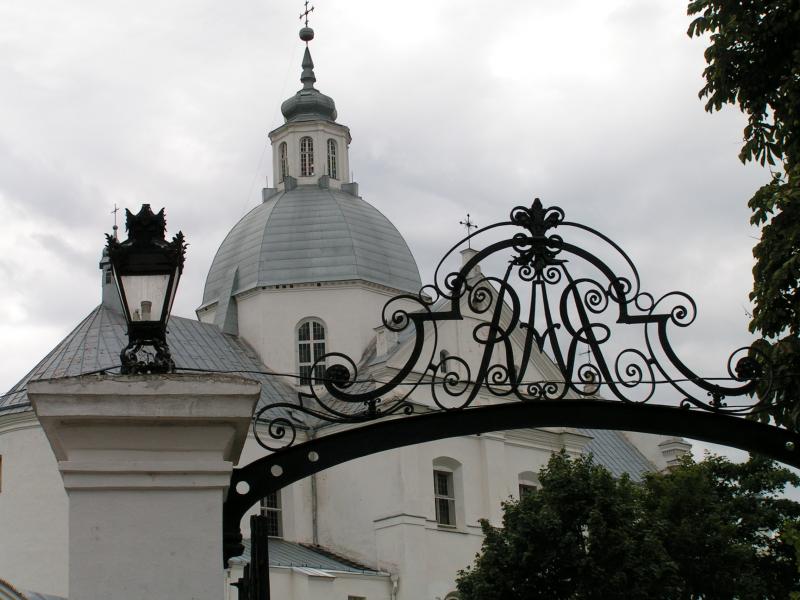 Detail einer orthodox geprägten Kirchenarchitektur mit Kuppel und schmiedeeisernem Tor.
Photo: Ilya
Detail einer orthodox geprägten Kirchenarchitektur mit Kuppel und schmiedeeisernem Tor.
Photo: Ilya
Several buildings dating from the 18th and 19th centuries immediately catch the eye in Suzdal’s Market Square. At that time, Suzdal’s master builders favoured small churches with cubic structures and hipped roofs rather than the old semicircular or shield-shaped gable roofs (zakomaras). Large windows and dome vaults without supporting pillars made the interiors of these buildings more spacious and brighter. Although the buildings were small in scale and simple in form, their builders were far from provincial mediocrity.
A fine example is the Church of the Resurrection of Christ (1720), which stands in front of the market arcades. Its unadorned exterior roof slopes do not even have window frames. By contrast, the keel-arch frieze and the external staircase on the south façade appear all the richer and more impressive. Beside it rises a slender bell tower, adorned with a row of niches lined with coloured tiles. Suzdal’s master builders used the decorative contrast between church and bell tower, a technique they had mastered exceptionally well. It is even said that the original pointed tent roofs that crown the bell towers were devised by the masters of Suzdal. This style of construction is not only elegant, but also echoes the silhouettes of the onion domes, creating a subtle stylistic unity.
Quick facts: Suzdal Posad
- The Posad is the historic part of the city outside the Suzdal Kremlin.
- Streets, churches and the area’s former trading and artisan heritage shape its intimate urban landscape.
- The Kremlin, Posad and monasteries reveal different aspects of the historic city structure.
- Cobblestones, bridges, pathways and weather can affect longer walks.
- The open-air museum, Cucumber Festival and other cultural attractions should be planned as separate activities.
- Check opening times, transport, access, events and current travel conditions.
Explore Suzdal’s Posad on foot
The Posad showcases Suzdal as a historic trading and artisan town and complements a visit to the Kremlin and monasteries. The area is particularly well suited to a walking tour, where visitors can take in the streetscape, wooden houses, churches and setting along the Kamenka together. Anyone interested in photography and urban history should allow time to explore at a leisurely pace.
The route can be shortened depending on the length of your stay or combined with other historic sites. Check current access to churches and museums locally, as not every building is open at all times. Comfortable shoes and some flexibility in case of bad weather are advisable for a walking tour; taking breaks at cafés or restaurants can make the day’s schedule more relaxed.
Plan your route through the Posad
A simple sequence is helpful for a walk through the Posad: start with the main streets and churches, then continue along a stretch of the Kamenka or take a break in the old town. If you have only a short time, choose the most important buildings based on their location. Visitors hoping to take photographs should allow more time for changing light and slower routes than those who simply want to get a sense of the historic layout.
Explore the historic suburb, its paths and urban layout
The Posad reveals how Suzdal developed beyond the Kremlin as a city of streets, churches and small-scale neighbourhoods. The Posad and Suzdal are presented as a walk in their own right. Historical information about Suzdal provides additional context on the city’s urban development; check current routes and access before setting out.
The Suzdal Kremlin, the monasteries, the Museum of Wooden Architecture and Peasant Life, the Convent of the Intercession and the Monastery of Saint Euthymius offer different points of interest. Vladimir, the Golden Ring and the Cucumber Festival should be planned with dedicated time and a check of current access arrangements.
Before your walk, check getting there and transport, travel preparation, travel safety, language and communication and culture and history. The latest travel and safety advice for the Russian Federation takes precedence over older information about events or transport routes.
FAQs about Suzdal’s Posad
What does Posad mean?
Posad refers to the historic part of a city outside its Kremlin. In Suzdal, it is associated with an intimate urban landscape of streets, churches and former trading connections.
How much time should I allow for the walk?
Half a day is enough for a focused walk. Allow extra time for the Kremlin, monasteries and open-air museum.
Is the Posad easy to explore on foot?
Many sights can be enjoyed on a walk, but take the ground conditions, bridges, weather, daylight and the distance you plan to cover into account.
Can I combine the Posad with a visit to the Kremlin?
Yes, provided the routes, opening times and pace you have in mind work together. The two areas remain distinct historic highlights.
