
Vladimir’s History: Rise and Fall on the Golden Ring
The early history of Vladimir is largely unknown. Most Russian chronicles first mention the city in 990, attributing its founding to the Kievan prince Vladimir Svyatoslavich. Other sources say it was founded in 1108 by Vladimir Monomakh, prince of Pereyaslavl.
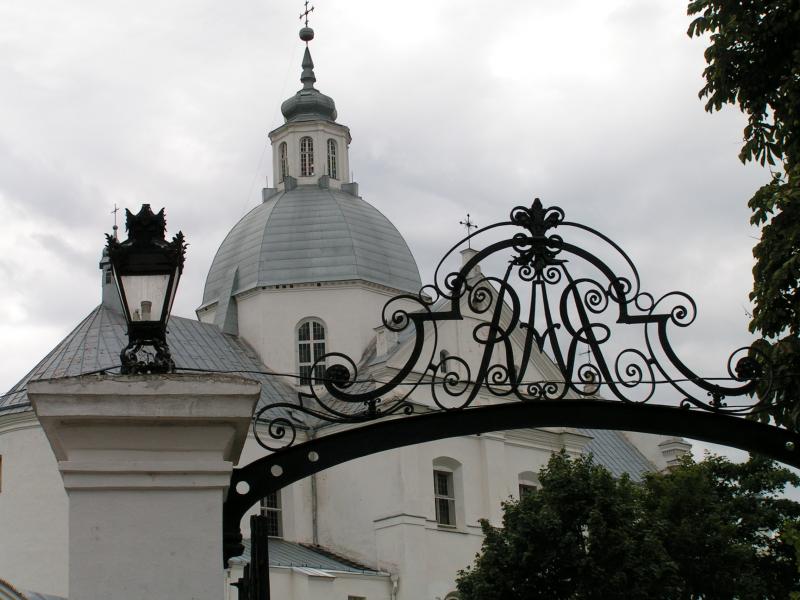 Detail einer orthodox geprägten Kirchenarchitektur mit Kuppel und schmiedeeisernem Tor.
Photo: Ilya
Detail einer orthodox geprägten Kirchenarchitektur mit Kuppel und schmiedeeisernem Tor.
Photo: Ilya
For a long time, Vladimir was no different from other fortified towns, and until the middle of the 12th century it attracted little attention from chroniclers. The city began to rise under Andrei Bogolyubsky, the son of Yuri Dolgoruky. He moved the capital here from Suzdal and, after the death of his father, who ruled in Kyiv (1157), renounced his right to succeed him and the title of Grand Prince of Kyiv, remaining in Vladimir, where he proclaimed himself Grand Prince.
In just seven years, from 1158 to 1165, monumental building projects were completed in Vladimir: earthen ramparts topped with oak walls stretched for miles; the golden-domed Dormition Cathedral rose skyward; the Golden Gate, the city’s ceremonial entrance, was built; and Bogolyubovo, the grand prince’s suburban residence, was constructed.
To strengthen his city’s position, Andrei even tried to establish a church independent of Kyiv, but failed. After setbacks in diplomacy, he asserted the new political center’s supremacy by force of arms: after his victorious campaign against Kyiv in 1169, he did not settle there, as any other prince would have done, but made a conspicuous return to Vladimir on the Klyazma River.
The work begun by Andrei was carried on by his brother Vsevolod, who was nicknamed “Big Nest” because of his large family. Under his descendants, however, the powerful Vladimir principality broke up into several smaller territories, a development that greatly shaped the subsequent history of all Rus.
In 1238, the city fell to the Mongol-Tatar conquerors, who put it to fire and sword. Vladimir was reduced to ashes, but it continued to resist for a long time and did everything it could to rise again. It remained the administrative center of northeastern Rus until 1328. More than that: in 1299, what Andrei Bogolyubsky had striven for in vain came to pass—the city became, albeit briefly, the residence of the metropolitan, head of the Russian Orthodox Church.
Vladimir’s heyday, however, was over. The task of “gathering the Russian lands” now lay ahead for the new capital, Moscow, while the former capital took its modest place among the ordinary towns of the Moscow state. From the 14th century to the beginning of the 17th, Vladimir’s history was an unending succession of Tatar raids, looting, and fires. The city emptied out; according to a census in 1626, it had only 610 inhabitants.
During the 18th century, Vladimir changed status three times: in 1719 it became a provincial center, in 1778 the seat of a governorship, and in 1796 the center of the newly established Vladimir Governorate, with its own coat of arms. A dignified lion, crowned and holding a silver cross in its right forepaw, stood prominently against the red field of the shield. At that time, the city began to be developed according to a uniform plan. Vladimir remained a small town, inhabited by lower-ranking officials, clergy, military personnel, peasants, and craftsmen. The main street was part of the Vladimirka, the notorious route along which convicts began their journey into exile. The city itself was also a place of exile: Alexander Herzen was under compulsory residence there from 1838 to 1840, and Nikolai Fedoseev, one of Russia’s earliest advocates of Marxism, lived there from 1892 to 1893.
Quick facts: The rise and fall of Vladimir
- Vladimir is one of the historic centers of the Golden Ring and has many medieval connections.
- The city’s history was shaped by shifts in power, church construction, and changing political significance.
- The Dormition Cathedral, Demetrius Cathedral, and Golden Gate bring the city’s history to life.
- Historical dates and older accounts may reflect different sources and perspectives.
- The museum, city center, and Bogolyubovo add further context, each requiring its own time and route.
- Opening hours, access, transport, and current travel conditions should be checked separately from historical information.
Discover Vladimir’s history on a city walk
Vladimir’s history is easiest to explore through its historic architecture and the city’s development as an early center of power. A walk from the Golden Gate to the major cathedrals reveals different eras and helps connect the sights. If you are especially interested in history, allow extra time for museums and interpretation.
For a short visit, a focused route through the center is enough; on a full-day visit, you can add churches, viewpoints, and other historic sites. Check opening hours, services, and current access in advance. Distances are manageable, but cobblestones, weather, and time spent at each attraction affect how long the visit takes.
Churches, the city gate, and the museum as historical landmarks
Vladimir’s history is especially easy to understand on site when its political development is considered alongside its surviving architecture. The history of Vladimir is closely linked to the Dormition Cathedral, Demetrius Cathedral, and the Golden Gate. The historical information about Vladimir provides additional context, but does not replace critical evaluation of sources.
The Vladimir Museum adds regional history and collections to a city walk. Bogolyubovo, Suzdal, the Suzdal Kremlin, and the Golden Ring reveal further historical stages, but should not be treated as simple extensions of a short day in the city.
Before your visit, check for updates to Getting there and getting around, Travel preparation, Staying safe, Language and communication, and Culture and history. The latest travel and safety advice for the Russian Federation applies independently of the historical context.
FAQs about Vladimir’s history
Why is Vladimir historically significant?
Vladimir was an important medieval center, and today its churches, the Golden Gate, and its position on the Golden Ring remain defining features.
Which buildings help visitors understand its history?
The Dormition Cathedral, Demetrius Cathedral, and Golden Gate are readily identifiable historical landmarks. The museum adds written context.
Why do historical dates sometimes differ?
Historical accounts draw on different sources, time periods, and perspectives. Reliable historical information should be compared when looking into specific details.
What should visitors keep in mind?
Check opening hours, access, transport, services, admission, and current travel conditions independently of older historical accounts.
