
Airports in Russia
Moscow’s international airports include Sheremetyevo, Domodedovo and Vnukovo; Pulkovo serves St. Petersburg. When choosing, the destination region, actual flight connection and onward journey are all important. The airport name determines where you arrive and how you continue your journey.
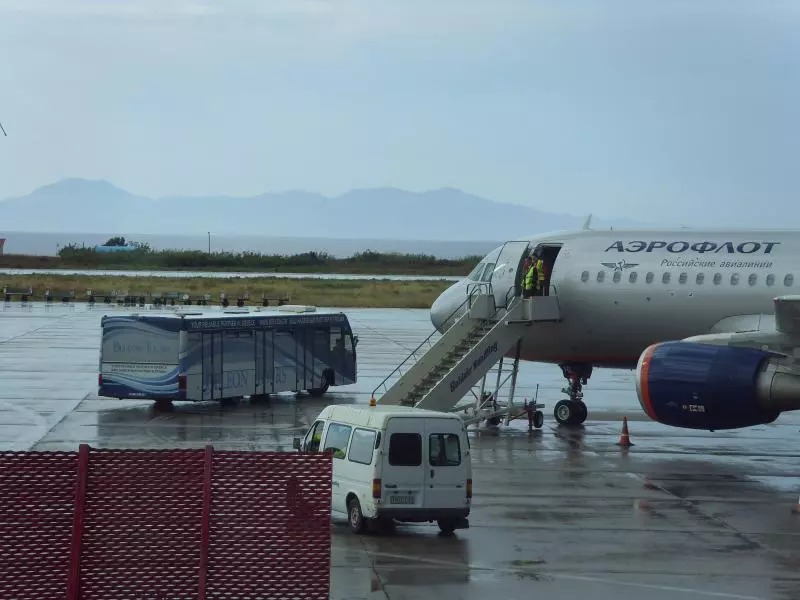 Symbolbild: Aeroflot-Flugzeug auf dem nassen Vorfeld des Flughafens Rhodos in Griechenland. Foto: Markus Lenk.
Photo: Markus Lenk
Russia’s airports: key facts
- Sheremetyevo, Domodedovo and Vnukovo are Moscow’s international airports; Pulkovo serves St. Petersburg.
- Moscow has several airports, so the airport you book is part of your travel plans and cannot be treated as interchangeable with the others.
- Pulkovo serves St. Petersburg and the northwest of the country; Moscow is a different destination region.
- Direct air traffic between Russia and the EU has been suspended; connections via third countries may change at short notice.
Distinguishing Moscow from St. Petersburg
The three Moscow airports serve the capital region, but are located on different sides of the city. Sheremetyevo, Domodedovo and Vnukovo are separate arrival points, each with its own transfer. If you are planning a connecting flight or a train journey, check the specific airport listed on your ticket and calculate the journey to the next terminal or station separately. The Moscow airports differ in location and transport links; you should not infer the order of an airport change from a city name alone.
Pulkovo serves St. Petersburg. If you are combining the city of St. Petersburg with Moscow, plan a separate long-distance leg between the two cities and transfers to and from each airport. The distances between Russia’s destination regions are vast and determine the order of a journey through the country.
Regional airports and distances
Outside the two major cities, air traffic is spread across regional hubs and airports whose importance depends on your specific destination. If you are travelling to Siberia, the Far East or the south, first compare the destination city, then the flights actually available. An airport may serve a region without offering direct access to every smaller town. The final leg may require a train, long-distance bus, local transport or an arranged pickup; journey times and availability depend on the specific location and date.
The map shows distances, not currently bookable connections. Plan around your confirmed booking, arrival time and the terminal listed on your ticket. Air travel and airport arrivalsinvolve check-in, baggage drop and getting from the terminal you booked. Allow time for baggage, security screening and connections based on your booked airport and terminal. For your return flight, include the terminal and the route to baggage drop in your schedule as well; your departure from the airport begins at the airport you actually booked.
Airport closures and travel conditions
The authorities report recurring airport closures lasting several hours, particularly in the west but also as far as the central and southern regions, with numerous flight cancellations possible. Direct air traffic between Russia and the EU has been suspended; connecting flights via international hubs may be reduced or suspended at short notice. Regionally limited internet outages may disrupt communications and access to digital documents.
The travel checklist and itinerary can include buffer time for connections; keep your passport and personal documents in your carry-on luggage while travelling.
Transfers, accommodation and onward travel
For your first journey after landing, consider the airport, destination address, time of day and luggage together. A room near the station may be useful if you have an early train, while accommodation near your destination in the city can shorten your journey. You can tailor your accommodation search to your destination. Transfer options depend on the airport, arrival time and destination address; at night, you may need to arrange a pickup in advance. Depending on the location, you can travel from the terminal to your accommodation by train, bus or car. Transfers and local transportcover the journey between your arrival point and your destination in the city.
If you are continuing by train, the airport and station are separate transport hubs. A connection via Moscow may require changing airports or travelling across the city; allow sufficient time for this in your itinerary. Consider train travel and railway stations together with your arrival point. Offline maps make it easier to find your way if mobile internet is temporarily unavailable.
As of October 25, 2026, the German Federal Foreign Office advises that Visa and Mastercard cards issued in Germany and payment apps do not work in Russia. Cash withdrawals using German cards and transfers to Russia are also not possible. Your travel payment planning must take these restrictions into account. Other holiday ideas should be combined with realistic distances and available connections, rather than based solely on straight-line distances.
Frequently asked questions about airports in Russia
Which airports serve Moscow?
Moscow’s international airports include Sheremetyevo, Domodedovo and Vnukovo. They are separate locations; the airport listed on your ticket is the one that matters.
Is Pulkovo a Moscow airport?
No. Pulkovo is the airport serving St. Petersburg. Sheremetyevo, Domodedovo and Vnukovo serve Moscow.
What does an airport closure mean for a connecting journey?
It may cause delays or cancellations. If your flights are booked separately or you have a train journey afterwards, the next leg may also be affected.
Are there direct flights from the EU?
According to the German Federal Foreign Office’s travel advice, direct air traffic between Russia and the EU has been suspended. Connecting flights may change.
