
Drahobuz between Castle History and Nature
Accommodation in Drahobuz
Drahobuz combines a remarkable natural area with a complex local history. The Stráně u Drahobuzi site of European importance protects near-natural dry grasslands and scrub stages on calcareous soil. The locality is believed to have the largest population of fly orchids (Ophrys insectifera) in Czechia. Thus, in Drahobuz, the landscape and historic buildings stand side by side as distinct themes.
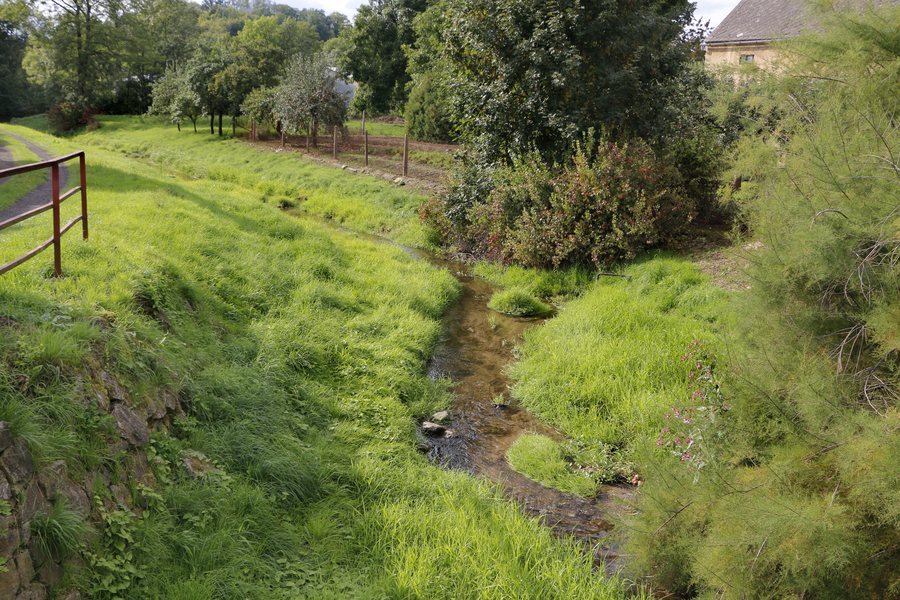 File:Drahobuz, Úštěcký creek II.jpg
Photo: Pavel Hrdlička (Czech Wikipedia user Packa ) via Wikimedia Commons, CC BY-SA 4.0
File:Drahobuz, Úštěcký creek II.jpg
Photo: Pavel Hrdlička (Czech Wikipedia user Packa ) via Wikimedia Commons, CC BY-SA 4.0
History
Drahobuz’s fortified manor house was first mentioned in 1374. At the end of the 16th or beginning of the 17th century, the old fortified manor house was converted into a four-sided Renaissance château before the château was demolished in 1878. House No. 2 formerly served as the château gatehouse. The sequence of the first mention, conversion and demolition makes the historical development of the former manor comprehensible, while the designation as a château gatehouse preserves a distinct architectural connection.
Drahobuz has vernacular wooden buildings from the 18th and 19th centuries, including log houses and half-timbered buildings. There are also 19th-century masonry houses in the Empire style, some with arcades and built from marlstone blocks. The local history can therefore be used to compare not only different periods, but also different forms and materials of construction: wood in log and half-timbered buildings, and masonry, arcades and marlstone in the Empire-style houses.
Districts
The district of Strážiště is home to the pseudo-Romanesque parish church of St. Wenceslas, built in 1865, with a tower visible from a great distance. It also has vernacular log, half-timbered and masonry buildings from the 18th and 19th centuries. The district of Lada has a municipal chapel as another distinctive building feature.
Wine was also cultivated in the district of Břehoryje after the Thirty Years’ War. The district is also home to a memorial oak called “dub u Břehoryj”. These two details belong to different periods and themes: winegrowing refers to historical land use, while the named oak designates a specific natural and commemorative site.
Transport and Activities
Drahobuz is served at regular intervals by the two bus routes 552626 (Litoměřice–Polepy, Hrušovany–Štětí, Radouň) and 552635 (Úštěk–Hoštka–Štětí–Roudnice nad Labem). The site of the former football pitch in Drahobuz includes a multifunctional sports field, a 251 m long asphalt track, a children’s playground, a workout area, a fitness studio and a fire pit. The transport data and the individual components of the sports grounds therefore provide separate practical information for familiarising yourself with the locality.
For a stay in Drahobuz, you can consider the travel dates, room category and cancellation conditions separately when choosing a hotel. This information complements the local details and provides a factual framework for planning your own trip, without mixing the nature, architectural or district-related topics.
Other Places
Other destinations at the same higher-level category include Chodouny, Račiněves, Litoměřice-Město, Mnetěš, Horní Řepčice, Přestavlky U Roudnice Nad Labem, Siřejovice and Libkovice Pod Řípem.
For the higher-level travel overview: Litoměřice District.

