
Měděnec: Hotels and Accommodation
Accommodation in Měděnec
In Měděnec, the Sfingy rock formations are among the town’s distinctive landscape features. They were formed by frost weathering of gneiss and display interesting, varied shapes. The Sfingy rocks offer a beautiful view of the Ore Mountains and the Doupov Mountains.
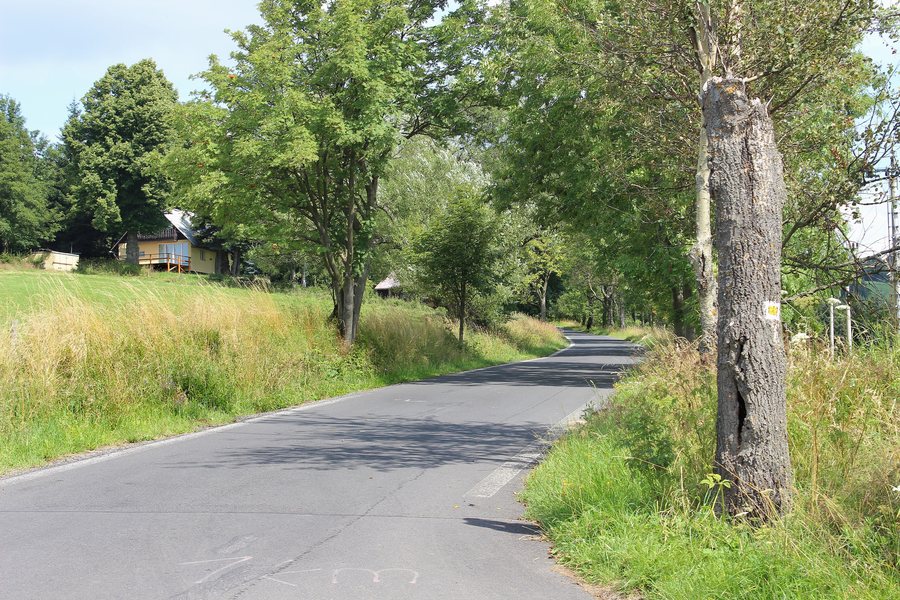 File:Měděnec, Mýtinka, road to Horní Halže.jpg
Photo: Photo: This file is available under Creative Commons BY-SA license . Basically: You can use this picture for any purpose, provided that you attribute it to Pavel Hrdlička, Wikipedia . You may distribute the resulting work under the same license.
File:Měděnec, Mýtinka, road to Horní Halže.jpg
Photo: Photo: This file is available under Creative Commons BY-SA license . Basically: You can use this picture for any purpose, provided that you attribute it to Pavel Hrdlička, Wikipedia . You may distribute the resulting work under the same license.
History
The establishment of the settlement of Mědník, later renamed Měděnec, was closely linked to mining on the hill of the same name; mining was probably already being carried out there as early as the 10th century. The first documented reports of mining in Měděnec date from 1449. From 1520, Měděnec was a mining town with the privilege of freely purchasing silver.
Culture
The Chapel of the Immaculate Conception of the Virgin Mary is a Baroque rotunda chapel built in 1674 at the summit of Mědník. In 1994, it was completely reconstructed, including its interior. During the Měděnecká pouť pilgrimage in September, a procession travels to the Chapel of the Immaculate Conception of the Virgin Mary every year.
Mining
The Hornická krajina Mědník mining landscape is an authentic mining area. It documents the extraction of iron, copper and, to a lesser extent, silver ores from the mid-15th to the mid-19th century. The Štola Panny Marie Pomocné (Mariahilfstolln) is an extensive system of mine workings of various ages; the oldest hand-hewn passages date from the 16th century.
More than 100 shafts and adits once stood on the slopes of Mědník. Numerous collapsed entrances and spoil heaps have survived.
Adits and Trails
The underground Mědník mining area is currently accessible through two historic adits. They preserve significant evidence of manual labor and the expansion of underground spaces through fire-setting from the 16th century to the beginning of the 19th century. Part of the Štola Panny Marie Pomocné (Mariahilfstolln) is now open to the public.
The entrance to the Štola Země zaslíbená lies on the southern slope of Mědník, directly below the Chapel of the Most Sacred Heart of the Lord. The Štola Země zaslíbená preserves unique evidence of historic hand mining and rock loosening through fire-setting. It was probably established in the 17th or 18th century.
The historic educational trail Cesta z města begins in Útočiště, a district of Klášterec nad Ohří, and ends at the church in Měděnec.
Other places: Mašťov, Loučná Pod Klínovcem, Vrskmaň, Bílence, Vysoká Pec U Jirkova, Křimov, Háj, Klášterec Nad Ohří.
To the wider travel overview: Chomutov District.
