
Georgia
Accommodation in Georgia
Georgia offers a wide range of reasons to travel: you can explore historic sites such as Mtskheta and Uplistsikhe, hike in national parks, or discover the long tradition of Qvevri wine. The priorities that matter to you can help you decide which places and experiences will shape your trip.
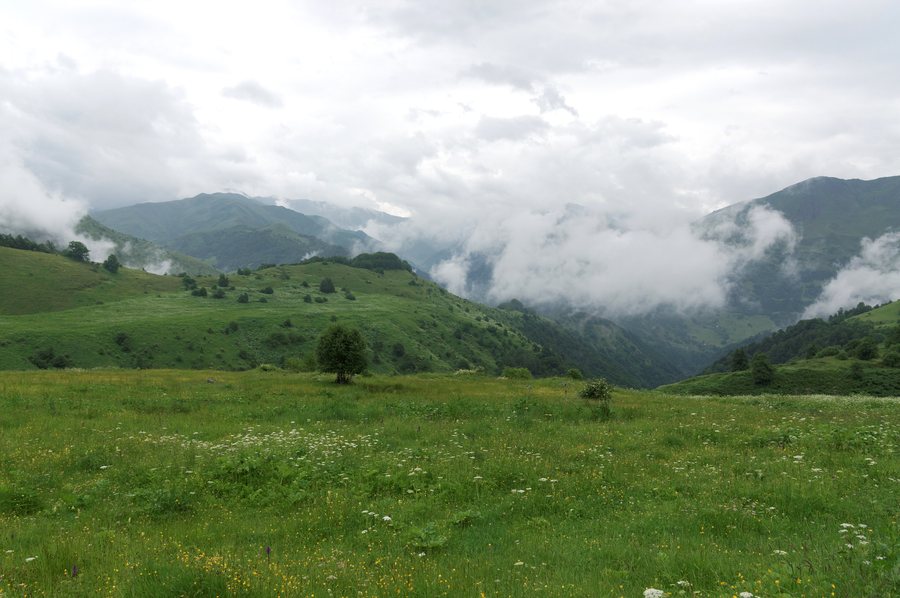 File:Abudelauri valley under clouds, early summer, Georgia.jpg
Photo: Vyacheslav Argenberg via Wikimedia Commons, CC BY 4.0
File:Abudelauri valley under clouds, early summer, Georgia.jpg
Photo: Vyacheslav Argenberg via Wikimedia Commons, CC BY 4.0
Quick facts about Georgia
From the 3rd century BC to the 5th century AD, Mtskheta was the ancient capital of the eastern Georgian Kingdom of Kartli. Christianity was declared Georgia’s state religion there in 337. Qvevri winemaking began 8,000 years ago, is still practised today, and was awarded UNESCO Intangible Cultural Heritage status in 2013. Nature and active holidays range from hiking to winter sports in Gudauri.
Which historic sites can you discover?
The Historical Monuments of Mtskheta comprise three structures: Jvari Monastery, Svetitstkhoveli Cathedral and Samtavro Monastery. Together with Mtskheta’s history, they offer a gateway to Georgia’s religious and political past. In Uplistsikhe, the walking route leads through the streets and squares of a settlement carved into the rock. Sights include public areas, temples, a theatre, pharmacies, wine presses and wine cellars. Uplistsikhe was already an important spiritual centre in the 4th century BC.
In Vardzia, you can experience another form of rock-cut architecture: the 900-metre-long fortified city spans several levels connected by tunnels. The Church of the Dormition of the Virgin, with its frescoes, still stands at the centre of the complex. Mtskheta and Vardzia therefore offer different emphases: one centres on historic monasteries and a cathedral, the other on a rock-cut city complex with a central church.
Which nature and activity options suit your trip?
Borjomi-Kharagauli National Park combines marked trails with opportunities for hiking, horseback riding, cycling and snowshoeing. Overnight huts, picnic areas and campsites are suitable for multi-day trips. Wildlife in the park includes Caucasian grouse and lynx; it also contains relict stands of yew. If you want to combine wildlife watching with physical activity, you’ll find a different experience here than at the rock-cut sites and historic centres.
Mtirala National Park offers one- to two-day hikes on marked trails. There are picnic and camping areas along the routes, and accommodation is available on the two-day trail. The park’s landscapes include mist-covered Colchian forests, a lake and Tsablnari Waterfall, which can be explored on foot or on horseback. In Kazbegi National Park, meanwhile, forests, alpine meadows, snow-covered peaks and inaccessible rock faces define the landscape, providing habitat for rare animals and birds. Truso Valley also contains a fortress complex, abandoned villages with some still-functioning monasteries, mineral springs, travertine formations and Abano Mineral Lake.
How do wine and winter experiences differ?
For wine enthusiasts, Kakheti offers a clear focus: it is Georgia’s leading wine region. The Kakheti Wine Route includes cycling routes for different fitness and experience levels; the best time to ride them is April to October. At Iago Winery, visitors can walk through organic vineyards, visit the Qvevri cellar and taste wines and seasonal local produce. You can also learn about Georgian Qvevri winemaking there.
Gudauri is an option for winter sports: in addition to skiing, you can go snowboarding, freestyle skiing and heli-skiing. For the latter, skiers are flown by helicopter to mountain peaks and ski down away from marked runs. The twenty ski runs are divided into four European difficulty levels. The drive from Tbilisi usually takes about 2 to 2.5 hours; this is an approximate guide for planning your trip.
Which regions would you like to learn more about?
For further regional information, find pages about Samegrelo and Upper Svaneti, Tbilisi, Adjara, Racha-Lechkhumi and Lower Svaneti, Adjara, Kvemo Kartli, Samegrelo-Zemo Svaneti, Shida Kartli, Lower Kartli, Inner Kartli, Samtskhe-Javakheti, Guria, Kakheti, Mtskheta-Mtianeti, Imereti and Abkhazia.
FAQ
What can you see in Uplistsikhe?
The walking route leads through streets and squares. Sights include public areas, temples, a theatre, pharmacies, wine presses and wine cellars carved into the rock.
What activities does Borjomi-Kharagauli National Park offer?
Activities include hiking, horseback riding, cycling, snowshoeing, and cultural and educational tours. Marked trails, huts, picnic areas and campsites are suitable for multi-day trips.
When is the best time to cycle the Kakheti Wine Route?
April to October is considered the best time to ride the cycling routes of the Kakheti Wine Route. The routes cater to different fitness and experience levels.
How long does the drive from Tbilisi to Gudauri take?
The drive usually takes about 2 to 2.5 hours.

