
Cluj-Napoca: Botanical Garden, Culture and Parks
Accommodation in Cluj-Napoca
Cluj-Napoca provides several specific ways to experience culture, history and green urban spaces. For your planning, you can organize places by plants, rural culture, urban history, exhibitions, views and leisure activities.
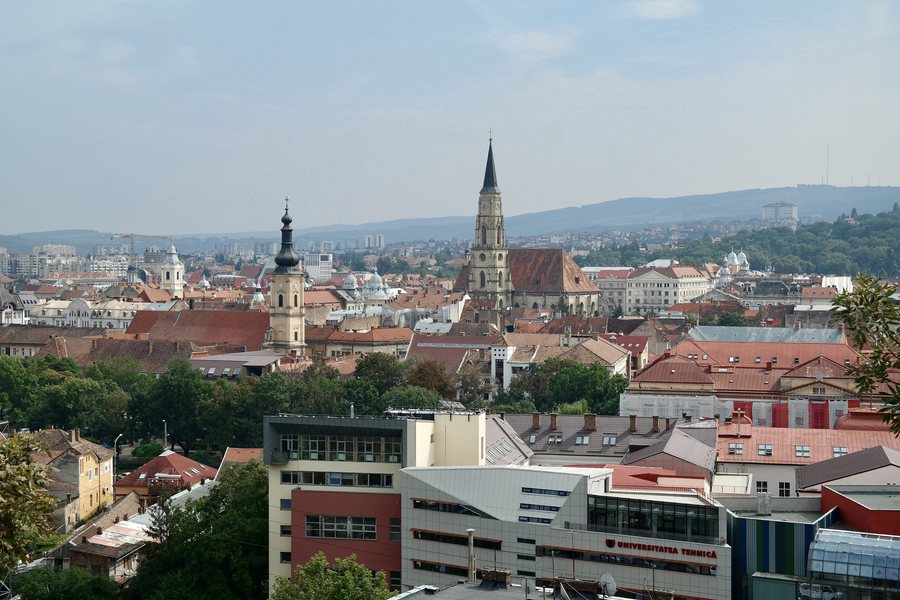 File:Cluj-Napoca as seen from Cetățuia Park.jpg
Photo: Choinowski via Wikimedia Commons, CC BY-SA 4.0
File:Cluj-Napoca as seen from Cetățuia Park.jpg
Photo: Choinowski via Wikimedia Commons, CC BY-SA 4.0
Culture
The “Alexandru Borza” Botanical Garden in Cluj-Napoca was founded in 1920 and officially opened to the public in 1925. It covers 14 hectares and cultivates around 10,000 plant categories. Its founding, official opening, area and plant collection provide a chronological and spatial framework for understanding the garden.
The “Romulus Vuia” National Ethnographic Park in Cluj-Napoca was founded on June 1, 1929, as Romania’s first open-air museum. The original design concept envisaged original rural households being inhabited by farmers who carried out traditional economic activities. Here, the focus is not only on the museum format, but also on a historical concept for presenting rural ways of life and work.
The Tailors’ Bastion was part of the Old Fortress of Cluj, which was built during the 15th century on the orders of the Hungarian King Sigismund of Luxembourg. The Tailors’ Bastion is a multifunctional space with a center for urban culture and an exhibition hall. The site thus combines a chapter of the fortress’s history with a present-day cultural use, without being limited to a single form of presentation.
The Firefighters’ Tower was completed in 1574. It is set up as a center for urban culture and presents various exhibitions, objects and old photographs related to firefighting. In addition, the Firefighters’ Tower offers a 360-degree panoramic view over Cluj-Napoca. History, the themed collection and the view each provide their own focus here.
Some of the small-format icons from the Cluj-Napoca Art Museum are displayed in the first hall of the National Gallery.
City
Central Park offers outdoor leisure facilities, including a basketball court illuminated at night, freely accessible fitness equipment and a specially designed children’s park. For planning your day, indoor and outdoor cultural sites as well as different park offerings can be compared according to your preferred focus.
Geographical Location
The Statuia lui Baba Novac monument is located in the vicinity of Cluj-Napoca. Also located in the vicinity are the Statuia lui Ion Agârbiceanu monument, the Mânăstirea Romano-Catolică Franciscană Cluj-Napoca monastery and the Statuia lui Mihai Viteazul monument.
The Vârful Peana peak is located in the area surrounding Cluj-Napoca. The Dealul Melinilor and Dealul Sălaşului mountains are also located in the same area. The Parcul Etnografic Romulus Vuia Cluj-Napoca park is located in the vicinity of Cluj-Napoca. The distinction between the vicinity and the surrounding area helps you consider the spatial information on different levels.
When comparing hotels in Cluj-Napoca, you can use travel dates, room category and cancellation policies as separate points to check. The offer pages can be compared carefully based on this information before you select an option.
Other Places
Poieni, Izvoru Crişului, Negreni, Margau, Sic, Beliş, Lungești and Ciurila
To the higher-level travel overview: Cluj-Napoca.

