
Luna De Sus – Churches, Archaeology and Routes
Accommodation in Luna De Sus
Luna De Sus can be explored through three distinct perspectives: the architectural history of its churches, traces of the past revealed by archaeology, and routes. The topics can be considered separately or compared using their location and date information; no fixed order is necessary for this.
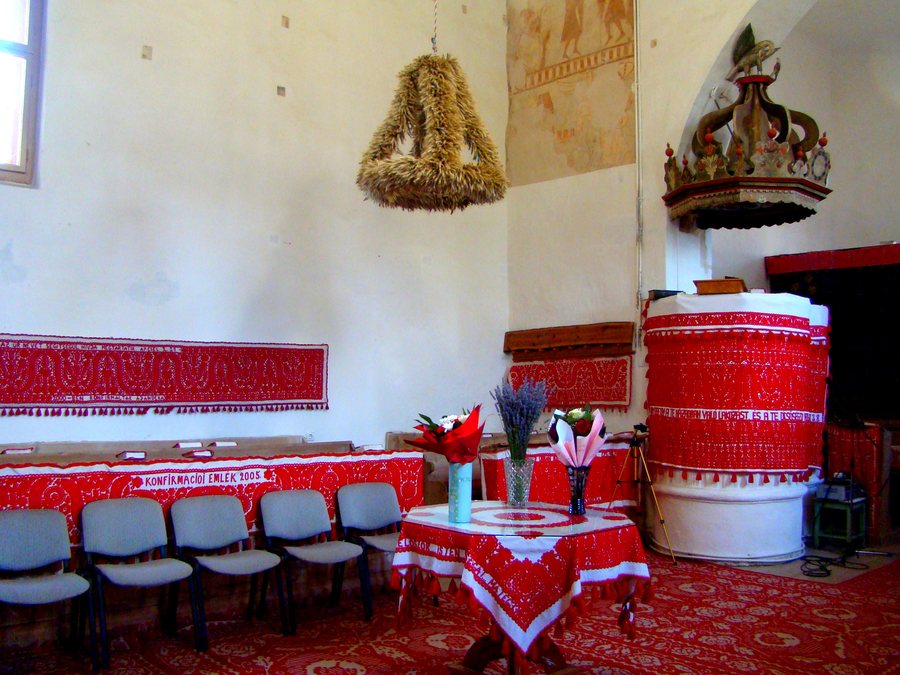 File:Biserica reformată din Luna de Sus (103).jpg
Photo: Țetcu Mircea Rareș via Wikimedia Commons, CC BY-SA 4.0
File:Biserica reformată din Luna de Sus (103).jpg
Photo: Țetcu Mircea Rareș via Wikimedia Commons, CC BY-SA 4.0
Culture
The Reformed Calvinist church in Luna De Sus was built in the Gothic style. Its historical monument protection number is CJ-II-m-B-07694. The coffered ceiling was executed in 1752 by the Saxon craftsman Umling the Elder, while the tower of the Reformed church was built in the Baroque style in 1828. Those who consider architecture not only according to a style but also according to individual building components can read this information separately.
The Orthodox Church of the Holy Archangels Michael and Gabriel complements this cultural focus. Its construction began in 1927 during the tenure of the priest Ioan Radu and it was built of bricks. In 1928, Bishop Nicolae Ivan consecrated the church. The architect Kuncz Ernest designed its cruciform floor plan. This provides four different points of reference for examining the building: the beginning of its construction, its consecration, its building material and its floor plan.
The cultural information about Luna De Sus thus encompasses different levels: historical classification, visible architectural features and the names of the people involved in the churches. Together, they do not form a uniform stylistic picture but rather two distinct architectural approaches. This separation is useful when comparing the churches by construction history, furnishings or the sequence of their creation.
History
The Râpa Dracului archaeological site near Luna De Sus is a fortified and settlement site from the Bronze Age and the Hallstatt period. The Dealul Ţarineş archaeological site near Luna De Sus is attributed to the Paleolithic, Neolithic, Bronze Age, Hallstatt period and Migration Period. Dealul Ţarineş is located west of Luna De Sus, approximately 350 meters east of the A3 Transilvania motorway.
The Roman Tower of Luna de Sus – Dealul Mic 5 is dated to the 2nd to 3rd century. It lies southwest of Luna De Sus in the Pădurea Orașului forest. The sites differ in their dates and locations.
The historic sites in Luna De Sus therefore differ both in their chronological periods and in their types of location. Fortification and settlement remains, a broadly defined archaeological sequence and the single Roman Tower should not be combined into one common period. Considering them separately makes the chronological and spatial contrasts of the surrounding area particularly visible.
Routes
For your own planning, you can distinguish between the starting point, intermediate locations and destination on the route. CTP metropolitan bus route M23 connects Calea Florești with Luna De Sus. The route from Luna De Sus via Someșu Rece to Luna De Sus begins at the roundabout at the entrance to Luna De Sus. It passes through Stolna and Someșu Rece, then runs past Gilău Reservoir and reaches Gilău.
Further destinations
Gilău, Someșu Rece, Lunca Vişagului, Maia, Băișoara, Petreștii De Jos, Muntele Băişorii, Suatu
To the overarching travel overview: Cluj-Napoca.

.jpg)