
Moldava nad Bodvou: Churches, Karst and Hotels
Accommodation in Moldava nad Bodvou
Moldava nad Bodvou combines historical monuments, religious buildings and distinctive karst landscapes. The town brings together urban history, winemaking traditions and natural features of scientific interest; at the same time, routes and excursion destinations lead beyond the town into the surrounding area.
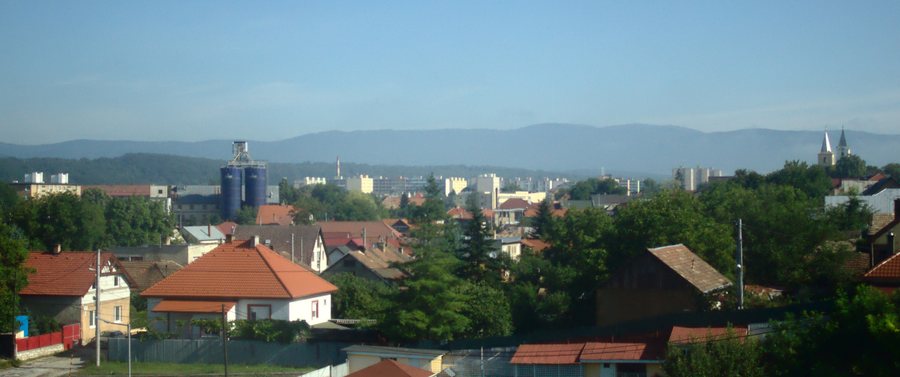 File:Moldava nad Bodvou, pohled na obec.jpg
Photo: I would appreciate being notified if you use my work outside Wikimedia. More of my work can be found in my personal gallery . via Source, CC BY-SA 4.0
File:Moldava nad Bodvou, pohled na obec.jpg
Photo: I would appreciate being notified if you use my work outside Wikimedia. More of my work can be found in my personal gallery . via Source, CC BY-SA 4.0
Culture
The Roman Catholic church is located in the historic centre. It was built in the 15th century under King Matthias Corvinus in the Gothic style on the foundations of a masonry church that already existed before 1290, and it is listed as a cultural monument. The Reformed church also stands in the historic centre, on the square. It was built in 1773 in the Classical style. Its furnishings include an intricately carved pulpit.
Another historic symbol of the town is the Szojkova brána. A replica of a wooden gate was unveiled in 1996 and commemorates the town fire of 1795. The Národopisné múzeum s kováčskou vyhňou is housed in a stone building constructed around 1850 at Hlavná ulica 130. In the front section, the Národopisné múzeum s kováčňou contains an authentic smithy with an open forge fire. The museum can only be visited by prior arrangement with the Municipal Cultural Centre.
History
On a hill outside the built-up area, in the cadastral area of Moldava nad Bodvou, stands the Chapel of Saint Roch. It was built in 1833 in honour of the patron saint, Saint Roch, and in memory of the victims of the cholera epidemic that broke out in the town in 1831. Every year in August, a mass of indulgence is celebrated in the chapel in memory of the victims. It is open only during these annual services.
Nature and Karst
Moldavská jaskyňa is located in the karst of Medzevská pahorkatina on the border between Slovenský kras and Košická kotlina. At more than 3 km long, it is one of the thirty longest caves in Slovakia. Six bat species and 83 species of invertebrates have been identified in the cave. Thus, in addition to its geological significance, the site also has a documented natural-history dimension.
A green-marked hiking trail to Moldavská skalná brána begins at the railway station in Moldava nad Bodvou. The rock formation can be accessed in the Hazalutov locality, directly within the town of Moldava nad Bodvou. It lies in Moldavský kras, which is part of Slovenský kras National Park but is not an officially protected area. From Moldava nad Bodvou, you can also take a trip to Zádielska dolina.
Wine and Urban History
The Wine Museum is located in one of the cellars beneath the Municipal Cultural Centre of Moldava nad Bodvou. A memorial plaque commemorates Máté Laczkó Szepsi (1576–1633), who worked as a preacher, teacher, historian and poet and is considered the first producer of Tokajer Samotok, “Aszú”. The historic character of the town also includes two- and three-storey cellars built for storing wine and agricultural produce.
Further destinations
With its infrastructure and services, Moldava nad Bodvou is a starting point for various local-history and nature excursions in the surrounding area. For further navigation, you can go to the following destination pages: Malá Ida, Vyšný Medzev, Bukovec, Vyšný Klátov, Zlatá Idka, Turňa Nad Bodvou, Štós, Nižná Myšľa.
Back to the higher-level travel overview: Košice-Okolie District.

