
Soligorsk: Potash Mining, Industrial City and Travel Planning
Today, Soligorsk, located in the south of Minsk Region, is one of Belarus’s major industrial cities. The country’s main export product, potash fertilizer, is produced here. Soligorsk is home to Belaruskali, Belarus’s largest export-oriented company.
.webp "Soligorsk") Die Kaliberge vor Soligorsk
Photo: Markus Lenk
Die Kaliberge vor Soligorsk
Photo: Markus Lenk
Soligorsk at a glance
- Soligorsk lies in the south of Minsk Region and is shaped by potash mining.
- The city developed in connection with the exploitation of potash deposits in the region.
- Waste heaps, industrial history and Soviet urban planning define the city more than a traditional old town.
- Industrial facilities and waste heaps are not automatically open to the public or freely accessible.
- Minsk, Gomel, Brest and other destinations in Belarus require separate planning for distances and travel times.
- Entry requirements, safety, transport, access, accommodation and current local guidance should be checked in advance.
- Soligorsk is an industrial city in the south of Minsk Region that grew out of potash mining.
- Waste heaps, urban development and mining history are more central to understanding the city than a conventional old-town itinerary.
- The city is best suited to travelers with an interest in history, economics or geology.
- A stay can be combined with a visit to Minsk or other destinations in Belarus, but distances mean that realistic travel times are essential.
- Claims about health retreats, prices, access and medical services should not be taken from older travel descriptions.
The salt city of Belarus
The origin of the city’s name is easy to establish: “Soligorsk” (Belarusian: Salihorsk) means “city of salt.” Indeed, the city came into being because of salt. In the early 1950s, geologists discovered large deposits of potash salts in the area. Work immediately began on building a mining and processing complex, which later became the city’s main employer and defining enterprise. The city was built around the complex. Today, Soligorsk is a typical example of the Soviet new towns built throughout the USSR in the 1960s and 1970s.
The huge piles of stored potash salt around Soligorsk are the highest “mountains” in all of Belarus and can be seen from many kilometers away, rising above the flat landscape.
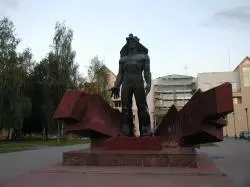 Because the city was essentially built “from scratch” in 1958, it has neither a collection of urban legends nor a long history of its own. The mines are the main feature that might interest visitors. There are plans to turn them into a museum, similar to the one in Wieliczka, Poland, once they have been fully worked out. However, it will be a long time before these plans are realized.
Soligorsk is virtually unknown in Western Europe. Perhaps only keen football fans will remember that Soligorsk’s football club, Shakhtyor, once took part in UEFA competitions as a medal-winning team in the Belarusian league. But the Belarusian club did not achieve any spectacular success.
Health retreats in Soligorsk’s disused mine shafts
Business travel is probably the main type of tourism in Soligorsk, with health retreats also offered more recently: treatments for certain forms of asthma are provided in some disused mine shafts. Hard as it may be to believe, Soligorsk is known for the high quality of these retreats and the special healing properties of its salt mines. The Republican Speleotherapy Clinic is of particular interest to visitors. This unique clinic was established within the Soligorsk potash basin. It specializes in treating respiratory diseases. The treatment has two stages: patients receive various procedures on the surface, then descend 430 meters underground for direct lung ventilation with therapeutic air. These therapies have age restrictions: patients must be at least 15 and no older than 55. It is not easy for Belarusian citizens to book a stay here, as waiting lists are very long.
Soligorsk: industrial city and landscape
Soligorsk can be considered as part of a regional itinerary alongside the Belarus overview and Minsk. A trip linking it with Vitebsk or other cities should be planned only after confirming travel times. Those wishing to compare mining history and landscapes can also look at the Wieliczka Salt Mine, though each destination requires a separate leg of the journey.
A visit focuses on the cityscape, potash mining and the visible traces of industrial development. Individual facilities and waste heaps are not necessarily open to tourists. Before setting out, check routes, closures, weather, photography rules and how to return safely. The topics nature and landscapes and culture and history can help you choose an itinerary suited to what is actually available.
Assess health retreats and medical matters with care
The older entry describes treatments in salt mine shafts and gives specific age and healing claims. This information is neither a current description of services nor medical advice. Anyone interested in a health retreat should request up-to-date information from the relevant facility and consult a doctor. The general section on relaxation and well-being provides travel context only.
Environmental and resource issues should also be part of today’s travel planning. The guidance on environmental protection and the impacts of tourism helps put industry, transport and sensitive areas in context. Check prices, access and available services directly with the relevant organizations before departure.
Plan your journey and stay
For your specific itinerary, check getting there and transport as well as entry requirements and documents. Choose accommodation based on your arrival, return journey and the routes you can access; a packed itinerary involving several distant destinations is rarely practical for a stop in an industrial city. Confirm current safety and payment conditions before traveling.
Understanding potash mining and urban development
Soligorsk is of interest above all as a young industrial city shaped by potash mining. Its layout, residential districts, waste heaps and regional economic history tell a different story from that of a medieval town center. Belarus provides the national context; Minsk and Gomel are separate city topics.
The name “salt city” explains the connection with potash, but it does not mean that every mine, waste heap or industrial site can be visited. Respect barriers, property rights, safety rules and local access restrictions. For historical comparisons, consider Brest, Grodno and Mogilev, each of which has a different urban history.
Before making concrete travel plans, check the latest information on entry requirements and documents, getting there and transport, staying safe while traveling and travel preparation. The official country information for Belarus provides additional geographic information. Current legal, safety and access requirements take precedence over older travel accounts.
FAQ about Soligorsk
What is Soligorsk known for?
Soligorsk is associated with potash, mining, waste heaps, industrial urban development and Minsk Region.
Can you visit a mine or a waste heap?
This can only be confirmed for a specific place and date by checking current permits and access rules. Do not enter industrial sites on your own.
How can Soligorsk be combined with Minsk?
Both destinations can be included in a trip to Belarus. Check schedules, accommodation, the safety situation and the time needed for each city separately.
What is especially important before traveling?
Confirm entry and safety information, transport, accommodation, access, payment options and local rules shortly before your trip.
